
Anthropic is turning on Auto Mode for Claude Code: What it means for you
 Follow Us

This is the end of Anthropic asking you to click “allow” every five minutes. Beginning August 14th, Claude Code will be set to auto mode by default for all those on the Pro, Max, and Team Plans, a change which reflects the extent of the control which developers give up to the AI as it codes on their behalf.
 Survey
Those who have already chosen an alternative default may get asked once about switching modes. If you have a default that has been set by your administrator via managed settings, then there will be no change for you. The current option to enable Claude Code applies only to Enterprise users and Claude Code API customers on AWS Bedrock, Google Cloud, and Microsoft Foundry, although Anthropic says this will come soon as well.
Also read: Who is Deepak Dhar: The Indian Physicist who just won the 2026 Dirac Medal
What auto mode actually does
At the moment, Claude Code is constantly interrupting you, requesting a thumbs up before performing any operation, modifying any files, or making changes to your repository. Auto mode will replace that with an automatic classifier that checks all your actions for any non-reversible, damaging, or external-to-your-local-environment action. It will do this most of the time without you even noticing it. Whenever it blocks something, Claude usually figures out a way around this issue or just asks you right away. This is done only when three or twenty blocks occur in one session.
Why Anthropic is doing this now
Also read: Sovereign infra and sovereign AI not the same, says Tata Communications’ Andrew Winney
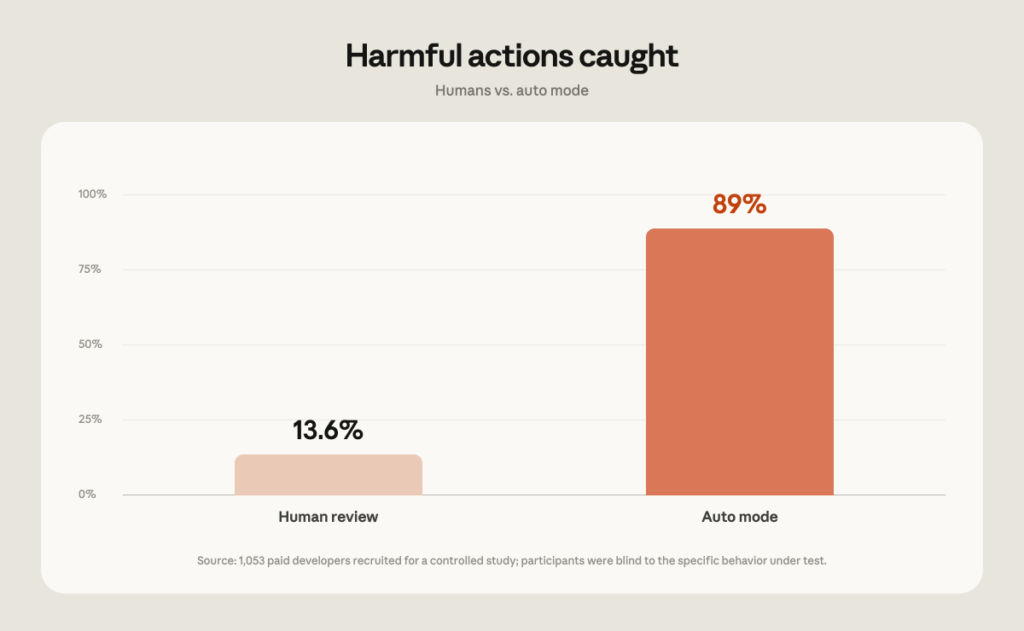
The numbers provided by the company make a rather uncomfortable argument that manual review fails to provide reliable results. Permission prompts are approved 97 percent of the time by developers, which does not seem to be thorough analysis but mere checking the boxes. In a controlled experiment conducted on over a thousand paid testers, people were able to detect dangerous commands added to their sessions only in 13.6 percent of cases, while auto mode managed to detect those 89 percent of the time. The discrepancy grew with every passing minute of a session because human testers got increasingly less efficient due to fatigue while classifier’s results stayed the same.
Moreover, there is an implicit acknowledgment hidden in the numbers that about 50 percent of active Claude Code users have already created general allow rules or skipped permission checks altogether to avoid getting interrupted.
What it costs
Absolutely nothing, at least until further notice. The classifier does consume a small amount of extra tokens per invocation, but Anthropic is not charging for that overhead for Pro, Max, and Team plan subscribers anymore. And for cost-sensitive development teams in India, who are always looking to save on their token usage, that is the only clear-cut gain in this scenario.
The catch
As Anthropic acknowledges, this is a classifier, not an insurance policy. This lowers risk but does not remove it entirely. Anthropic still advises reviewing anything related to its production infrastructure by hand, and its own internal data reveals that the system is fallible but more reliable than the typical person mindlessly pressing “allow.”
For the typical software developer tinkering with agentic coding tools, this trade-off makes sense. You sacrifice some hand-holding, get slightly improved math around safety, and save a decision a few times a minute. It might be either a welcome convenience or a slight loss of control, depending on your faith in your own “allow” presses.
Also read: Best laptops to buy for students in India under Rs 65,000: Our top picks for August 2026


