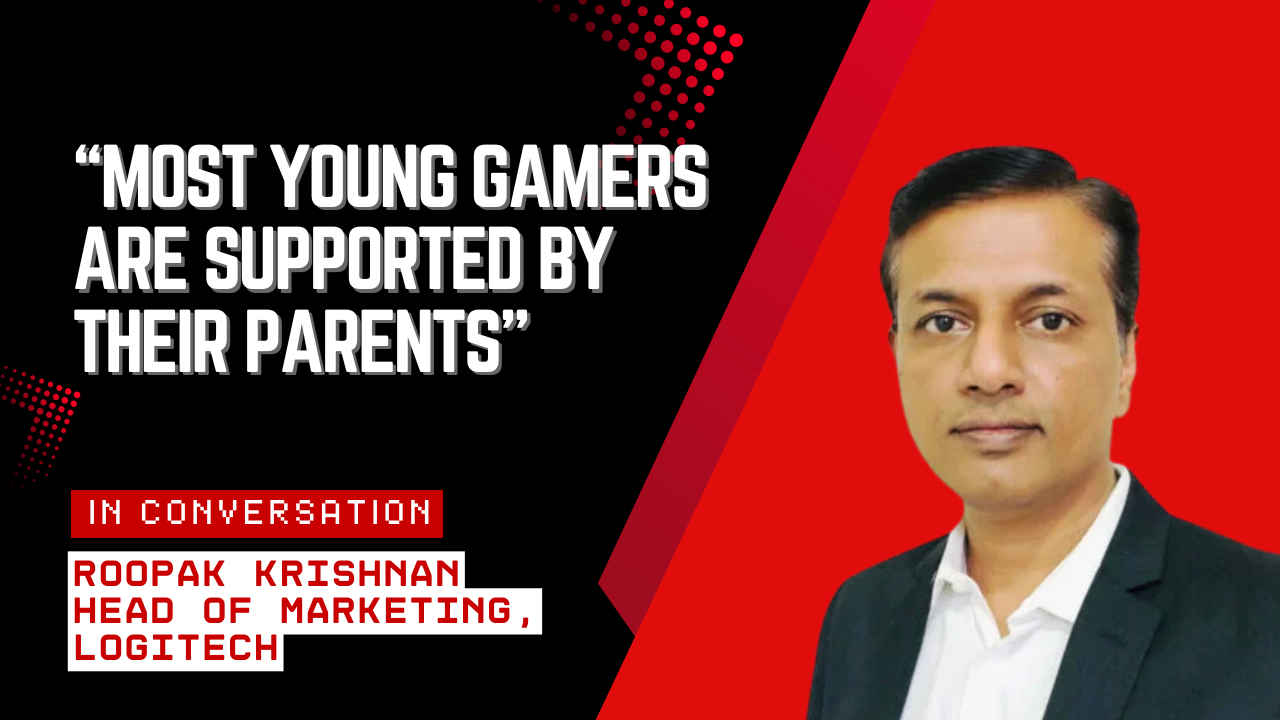
Until a couple of years ago, gaming was considered to be a hobby or a distraction. Very few people in India dared to imagine a career in it, and even those who did had to face many challenges. Some popular esports players had earlier shared, while speaking to Digit, that their parents used to assume that they were gambling online. That mindset has now shifted, and Indian parents are now more supportive than ever. And to ensure that these gamers have the best experience possible, Logitech is hard at work, as per its Head of Marketing, Roopak Krishnan. ‘Our distribution strength is such that in the remotest corner, you can have logical products,’ he says.
 Survey
In an exclusive conversation with Digit, Krishnan shared that even though mobile gaming dominates India, the PC gaming market has shown an uptick. He also shared his insights on the gaming scenario, India’s unique consumer habits, how parents are supporting gaming careers, and more. Here are the key excerpts from the discussion.


Also read: 5 AAA titles, 1 device: The Alienware 18 Area 51 gaming experience
Gaming is growing in India
It is no secret that mobile gaming dominates India. In FY 2024-25, the country recorded 8.45bn mobile game downloads, making it the world’s largest market, according to Sensor Tower. So, how does a PC peripherals company view this? According to Krishnan, this is not a challenge but an opportunity since this is how markets evolve.
He explained, ‘India is primarily a mobile gaming market. We have a large chunk of mobile players, which is natural because a good smartphone today costs around Rs 20,000, mobile data is among the cheapest in the world, and access to popular global titles is easy.’
‘But once players get into gaming, they start wanting a more immersive experience. That’s why mobile’s share, which used to be around 95%, has now dropped slightly to 87-90%. Meanwhile, there’s a clear uptake in PC and console gaming because the experience is richer.
‘Another factor is esports. While mobile esports exists, many global tournaments, including those supported by governments and the Olympics, are PC-centric. Publishers of titles like League of Legends are driving this shift. For Logitech, this is not a challenge but an opportunity. We’ve seen markets evolve this way globally.’
‘Gamers want the best gear to complement their systems. Just as a professional cricketer needs a good bat, serious gamers need quality peripherals. Logitech has been present in India for over 25 years and sees strong potential for growth in PC gaming.’
Talking about Tier 2 and Tier 3 cities, he said that gaming is growing in places like Guwahati, Lucknow, and Bihar. He added, ‘So our experience says that gamers exist everywhere. It is not very specific at the top.’
Krishnan also states, ‘Many times, when we work with influencers, they are not necessarily from metro cities. They are from places like Bengal, Bihar, or Kerala. What I have seen in esports is that the most followed influencers often use vernacular languages rather than English. This shows that gaming has truly spread beyond metro cities in India and is everywhere. Everyone wants to be part of it, and the setup is already quite democratic.’
Parents’ growing support for gaming
As mentioned already, Krishnan said that there has been a shift when it comes to the way parents approach gaming today. He said, ‘Young gamers, often under the age of 20, are usually supported by their parents since they haven’t usually earned their first paycheck. Many parents now see that gaming can coexist with academics and even nurture talent. For example, at a recent Apple event in Bangalore, many coders who are gamers were in attendance. This generation balances play and skill development naturally.’
He added, ‘So, gaming aspirations exist everywhere, parents are supportive, distribution is expanding, and communities are thriving. Logitech’s goal is to ensure everyone who wants to play has the tools to do so.’
How is the Indian gamer unique?
There are many Indie game studios in India working on never-before-seen titles. Similarly, there are many gamers who want to try out new games made by independent publishers. And this is unique about Indian gamers.
Krishnan explained, ‘One thing we’ve noticed is that Indian gamers are very experimental. Globally, you’ll see the same set of popular titles dominating, but here, players actively try indie and lesser-known games. That’s unique, and it’s driving local publishers and investors to create India-first titles, which also creates jobs in game development.’
Giving an example of a learning experience that he wants to share in regards to Indian consumers, Krishnan added, ‘For instance, young gamers who grow up using mechanical keyboards for play often carry them into professional life, especially in coding or creative fields. They love the tactile feedback and speed. That’s why we launched mechanical versions in our MX series for professionals, and the acceptance has been strong.’
‘Similarly, with a mouse, gamers demand high accuracy, but so do designers and engineers. Our MX Master series, while not made for gaming, is often used by gamers as well. This crossover between gaming and productivity is a clear trend in India,’ he added.
Why do customers choose premium products?
Just like every other industry, the gaming peripherals industry also has many ‘just good enough’ products that get the job done at cheaper prices. So why do consumers opt for premium products, and how does Logitech stand out in such a market?
Krishnan explained, ‘‘There are three main factors. First, accuracy as our high-grade sensors and in-house technology ensure the precision gamers need to win. Second, ruggedness, as our gear is built to withstand thousands of hours of intense play. Third is co-creation. Every Logitech G product is developed and tested with pro gamers, which very few companies can claim.’
He adds, ‘We also innovate constantly. For example, our new Rapid Trigger keyboard reduces key actuation delays, giving players faster movement in-game. These details matter, and they come from deep R&D, including at our Chennai centre. That’s why Logitech G enjoys strong love from Indian gamers despite the competition.’
One of the factors that leads to a premium price tag is Logitech’s focus on sustainability. And even though the price factor is always there, customers see the value in it.
Talking about sustainability and whether customers would pay more for a product that is better for the environment, Krishnan said, ‘Price is always a factor, but Gen Z is vocal about sustainability. Indian consumers are increasingly aware and value environmentally responsible products. Logitech has been committed to sustainability since 2007, achieving carbon neutrality for our gaming range using post-consumer recycled plastics. Consumers appreciate these efforts and believe in sustainability, even if price remains important.’
Talking about brand loyalty in customers and whether they keep switching brands or prefer to stick to one, Krishnan said, ‘Loyalty comes from the values a brand represents and the experience it delivers. If a product works as expected, consumers are willing to pay a premium and stick with it. But if a brand falters, customers move on. You can’t blame the customers for that.’
Investing in esports
Logitech has sponsored various esports events as well, but for them, these are more than just deals. Krishnan said, ‘Sponsorships are important because they nurture talent and inspire others to join esports. But for us, it’s never only about sales. Logitech’s philosophy has always been: if the ecosystem grows, the brand grows. So we invest in players, events, and communities, intending to make esports sustainable in India. Every individual who succeeds attracts more players, more viewers, and more investment, which benefits the entire industry. That’s where we see our role: not just as a gear maker, but as an enabler of the ecosystem.’
Casual vs Hardcore gamers
We all know that there are two types of gamers: those who will happily enjoy games on easy mode and play them for the fun experience. And another who would freak out at missing a shot and probably rage quit a game if it gets too difficult. And when it comes to peripherals, both have different preferences. So how does Logitech balance these preferences?
Krishnan explained, ‘Casual gamers want gear that’s both functional and visually appealing. Esports players demand high-performance tech, often without any flashy design. We have product lines for every segment, from beginner to pro, offering the right technology and style for each type of user. For example, our iconic 5 Series caters to different user needs, providing wired, wireless, RGB, or non-RGB options across price bands.’
Coming to Gen Z, Krishnan said they are the ones who ‘define trends’. He said, ‘Gen Z defines trends. Gamers often start from age 10, and those between 10-20 are the most active. We consider their preferences in product design, ensuring our peripherals resonate with younger audiences’ style and usability.’
Thus, gaming is no longer just a hobby or a passing trend in India. With wider acceptance from families, popularity in smaller cities, and a growing appetite for both play and performance, gaming has become a serious pursuit. And to ensure that all gamers have the best possible experience, brands like Logitech are at the helm. By supporting players, communities, and innovation, they’re ensuring that anyone with the passion to play has the tools to level up.
Also read: Elden Ring changes how you play games forever – Here’s how Silent Hill f proved it
 Follow Us
Divyanshi Sharma
Divyanshi Sharma is a media and communications professional with over 8 years of experience in the industry. With a strong background in tech journalism, she has covered everything from the latest gadgets to gaming trends and brings a sharp editorial lens to every story. She holds a master’s diploma in mass communication and a bachelor’s degree in English literature. Her love for writing and gaming began early—often skipping classes to try out the latest titles—which naturally evolved into a career at the intersection of technology and storytelling. When she’s not working, you’ll likely find her exploring virtual worlds on her console or PC, or testing out a new laptop she managed to get her hands on. View Full Profile


