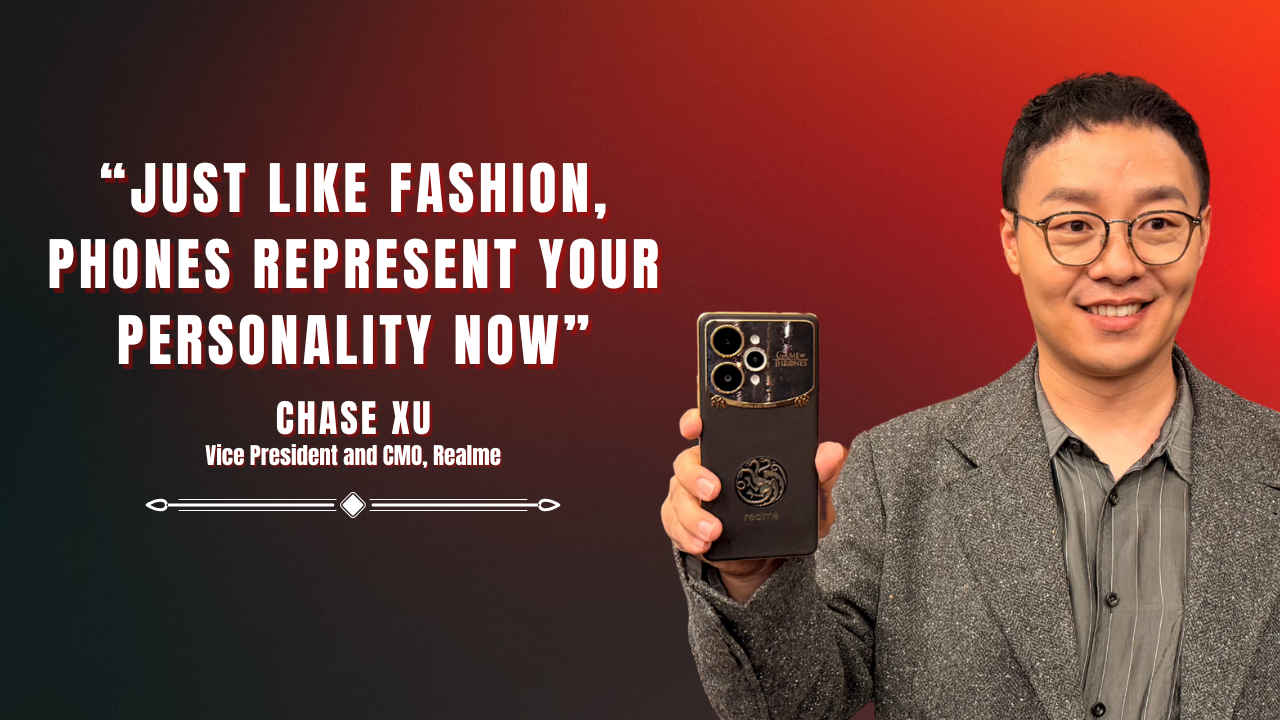
Northern Ireland is not the first place you would expect a smartphone company to host a launch. Yet recently, Realme gathered journalists and content creators from around the world at the home of Game of Thrones. Why? Because they think creating phones is not just about tools, but stories. The occasion was the launch of the Realme 15 Pro Game of Thrones Limited Edition, which is the first phone to roll out with this collaboration. On this Limited Edition phone, you get a few engravings on the back, a customised UI, and a vegan leather back that shifts colour with heat, inspired by Daenerys Targaryen’s rise from the ashes. The idea sounds almost too cinematic for a mid-range smartphone, but here’s why it’s part of a deliberate strategy for Realme.
 Survey
“We wanted to combine the GOT vibe with our technology,” says Chase Xu, Vice President of Realme. “The inspiration came from Daenerys rising from the ashes. We wanted to recreate that kind of magical scene through our design.”


It’s not the company’s first such experiment. Over the years, Realme has partnered with Naruto, Dragon Ball Z, Coca-Cola, and even Aston Martin F1. But unlike traditional product tie-ins, these are not just marketing gimmicks. Limited-edition phones have become an increasingly strategic tool for smartphone makers. For them, it is a way to stand out in a saturated market and speak directly to specific subcultures of fans.
Exclusivity plays a major role
Smartphone launches have begun to feel like clockwork: new chip, better cameras, faster charging. Amid this sameness, collaborations like Realme’s Game of Thrones edition aim to evoke emotion, rather than playing the same specs and benchmarks game.
“The most difficult part,” Chase admits, “was creativity and inspiration. Game of Thrones is a classic, award-winning IP. How do we make that fit into our phone without losing its soul?”
To get it right, Realme pitted two internal design teams against each other, one focused on industrial design, another on brand expression. Both teams submitted multiple design concepts that were later tested with Game of Thrones fans across different countries. “We actually talked to global fans and experts to see which one would wow people the most,” Chase says.
That feedback-driven approach hints at something larger: limited editions are not about selling more units, but about building deeper engagement. The Game of Thrones phone, for instance, is capped at just 5,000 units worldwide. “Some countries asked if they could get more,” Chase laughs, “but we had to say no. We want our core fans to feel proud, like owning a limited-edition car or designer jacket.”
The business logic of being exclusive
At first glance, limiting production sounds counterintuitive for a company chasing growth. But scarcity has its own kind of marketing power. Limited-edition phones create symbolic value, which is something that makes fans feel seen and special. And again, who doesn’t want to feel seen or special these days?
“Collaboration editions are not about revenue,” Chase explains. “They are about providing irreplaceable value to fans. It’s more about emotion, pride, and collectability.”
This approach mirrors the fashion and automotive industries, where exclusivity drives desirability. Realme’s past collaborations, like the Aston Martin Racing Edition, have proven that emotional connection can draw in audiences who might have never considered the brand before. “We met people who bought the phone because they were F1 fans,” Chase says. “They had never used Realme before. But after trying it, they became our core fans.”
That shift, from one-time buyer to brand loyalist, is what makes these projects more than flashy side quests.
Hopping on a trend or culture
As smartphone hardware becomes more uniform, differentiation increasingly comes from brand identity. For Realme, collaborations serve as a way to say something about the kind of people who use their phones.
“We hope that people who use Realme are seen as cheerful, young, and open-minded,” Chase says. “Just like fashion, phones represent your personality now.”
That’s a crucial insight in a world where technology has become a lifestyle. Apple has built decades of brand equity on creative self-expression. OnePlus cultivated a tribe around tech enthusiasm. Realme, through its tie-ups with pop culture icons, is betting on youthful fandom, a generation that sees collecting, watching, and belonging as forms of identity.
Why limited edition phones are beyond sales
Still, the obvious question remains: does any of this translate into actual sales?
Realme admits there’s no concrete number to measure that. “It’s hard to quantify,” Chase concedes. “But we do annual research and interviews with users, and we keep seeing more who say they discovered Realme through these collaborations.”
That qualitative data, word-of-mouth, social chatter, and community pride, is what Realme calls the “halo effect.” A limited-edition phone may not sell millions, but it strengthens the emotional capital around the brand.
Each launch also acts as a mid-year reminder for users. “Usually, a product’s cycle lasts six months,” Chase explains. “When we launch a special edition later, it reignites interest in the number series and reminds users of our innovations.” It’s kind of like an extended cut of your favourite movie, released at an unexpected time, but with even better details.
A sign of where smartphones are headed
Now, Realme isn’t alone in this playbook. From Samsung’s S series Edition phones to OnePlus’ collaborations, limited editions have quietly evolved from marketing stunts to strategic brand-awareness tools, mainly among youngsters. They blur the line between tech and culture.
“We’ve learned a lot from our partners,” Chase says. “How they build worlds, how they care about fan experiences, it inspires us. For Realme, collaborations are a way to grow and expand our vision.”
If anything, this growing trend suggests that the smartphone market is no longer just about the next big spec sheet. It’s about that next element of connection that they can share with people.
 Follow Us
Mustafa Khan
Mustafa is a young tech journalist who tells it like it is, cutting through buzzwords to deliver straightforward smartphone reviews. He’s the office go-to for insider tips and quick demos, and his video content doesn’t waste anyone’s time. When he’s off the clock, he geeks out over cars, photography, and hunting down the best spot for Indian food. View Full Profile


