
Intel Crescent Island explained: Specs and architecture of the new GPU D-series
 Follow Us
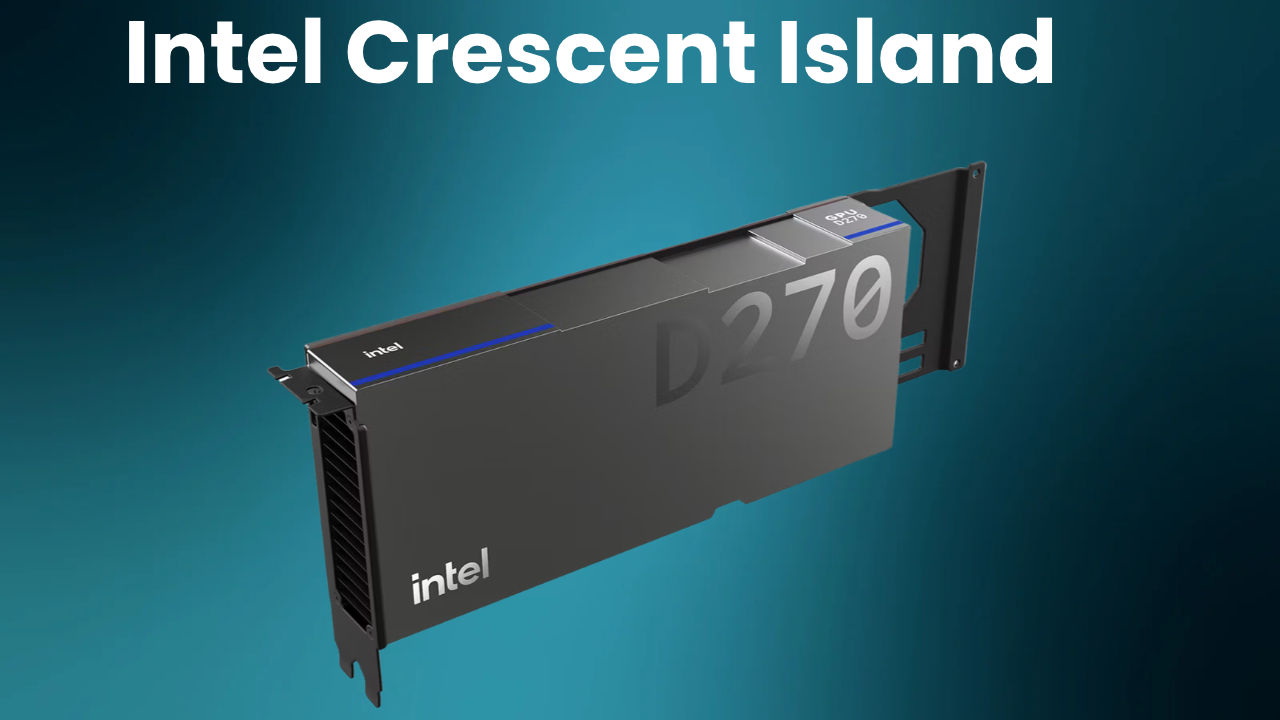

Everyone who works in AI looks for the most powerful chip. Intel has now unveiled a card that wants to claim the title of being the largest card out there. At the Open Compute Project Global Summit, Intel provided some more information on their new GPU called Crescent Island. They have given it a new name of Intel GPU D-series, which has only one purpose – inference. Training someone else’s problem.
 Survey
Also read: Apple iPhone Duo gets off to strong start, but supply may be the real challenge
The numbers
Intel’s headline specs are these.
- Xe3P architecture
- Up to 480GB of LPDDR5X memory
- 1.5TB/s of memory bandwidth
- 1.3 petaflops of FP8 compute
- 350W power envelope
- Standard PCIe form factor, air cooled
Memory is the whole argument
Go back to that list. The compute is good enough but no story can be written about that. The memory is the story here. 480GB on a single chip is ridiculous for our times, and according to Intel, it is enough for running models with 300 billion parameters on one chip. Cluster eight such chips, and the firm promises more than a trillion parameters.
What is the point? Large language models require lots of memory. Lots of memory is required even for long context windows and lots of simultaneous users. When inference becomes slow, it happens not because mathematics is hard, but because it requires more memory than available. Intel believes that capacity wins over speed for many practical problems.
What is the sacrifice? LPDDR5X replaces stacked HBM used in top-of-the-line accelerators. That memory type is both more affordable and more available, and 1.5TB/s is way below what HBM chips offer. Consider that as having a huge warehouse but a tiny loading dock. It may work fine for serving multiple models to multiple tenants. It is not good for beating benchmarks.

Also read: Apple may bring touchscreen to MacBook Pro but does the Mac even need one?
Built to slot in
Here the design makes sense as well, using a regular PCIe card, air cooled, that uses 350 watts. No liquid cooling, no custom racks. Intel claims it will fit into an existing data centre, and a common Xe software stack allows to port the code between Intel GPUs. Targets go from multi-tenant AI applications to robotics and any other latency-sensitive tasks.
Intel also claims to have day zero support for any new open model, and one such recent example is named as Meta’s Muse Glimmer. This was a good idea for a company trying to encourage developers to play with its technology.
Where Xeon fits
But Intel does not want you to consider the GPU alone. Intel’s case is that of the multi-step grind of retrieval, reasoning, tool use, and execution, where much of it happens on CPUs. Hence, the company has shown Xeon 6+ racks designed with ORv3 architecture, some even exceeding 46,000 cores per rack at 133.45kW. This is quite a number of cores required to power so many agents. The GPU thinks while the Xeons do the work.
The catch
Before you get too enthusiastic, 480GB is the maximum capacity of any partner built cards. In a footnote to its announcement, Intel itself only mentions 160GB LPDDR5X in its own PCIe card. It’s quite a large amount of memory, but only a third of what you saw above. Make sure to check the card before making any price comparisons.
Customer sampling is already ongoing. There are no prices, availability dates or benchmarking data out there yet. Till then, take these figures at face value, because everything that follows is just Intel’s. Indian startups building AI or cloud services looking for more economical inference will be keeping an eye on the matter.
Also read: NVIDIA Nemotron 3.5 Super VL: Frontier level accuracy at one fifth the size


