Oppo has been on a strong run lately. The brand has had a stellar array of recent launches, including the Find X9s and the mighty Find X9 Ultra. But it’s not just the flagship phones; Oppo has built a strong lineup across various price segments, be it in the form of the premium mid-range Reno series or the budget-focused K-series. Having said that, one gap that still remains is the upper mid-range segment, that tricky Rs 35,000 to Rs 40,000 range where buyers expect that top-tier premium smartphone experience without the flagship price tag.
To tackle this, the Oppo F33 Pro is the brand’s answer. It sits just above the K-series and just below the Reno 15 series. It’s a phone I’ve used as my daily driver for a good while, and after all that time, I can tell you exactly who it is for. I don’t want to sound poetic, but it’s a device that looks and feels like much more than it does. But then there’s the hardware, which tells a slightly different story.
So, what really makes the Oppo F33 Pro worth it and, at the same time, what are its shortcomings? All this and much more in my full review. Let’s dive in.
When it comes to the looks, build, and design, the F33 Pro does not disappoint. Without a shadow of a doubt, it is one of the best-looking phones at this price. It features what Oppo likes to call the ‘Starry Sea’ lens module on the back, which is a fancy way of saying: there’s a rectangular camera island, housing the camera and a ring flash, and it gives the phone a distinctive look.
Oppo sent me the Misty Forest variant for testing, and, among all the other colour options, it has to be my favourite. It features a subtle gradient that catches the light beautifully, and, rather than the simple back design most phones use, it feels unique. I will also admit that the design has been a bit of a head-turner in public.
Coming in at just 194 grams, the F33 Pro feels relatively compact and well-balanced for a phone carrying a 7,000mAh battery. Where Oppo has really gone above and beyond, though, is durability. The phone carries IP66, IP68, IP69, and IP69K certifications, in addition to the MIL-STD-810H military-grade shock resistance.
Overall, with the Oppo F33 Pro, you not only get the good looks but also a phone that has reassuring build quality.
Also Read: Google Pixel 10a review: Seven years of reasons to buy this phone
Moving over to the front of the phone, the Oppo F33 Pro gets a ‘not so big, but not so small’ 6.57-inch FHD+ AMOLED panel with a 120Hz refresh rate. Compared to the other phones in the price range where larger displays are becoming more common, I much prefer the relatively compact footprint of this device. For my hand, it fits in perfectly for one-handed usage. Visually too, the display is sharp and fluid, and Oppo has done a good job with the tuning, making anything on the screen pop in a way that most buyers will immediately notice.
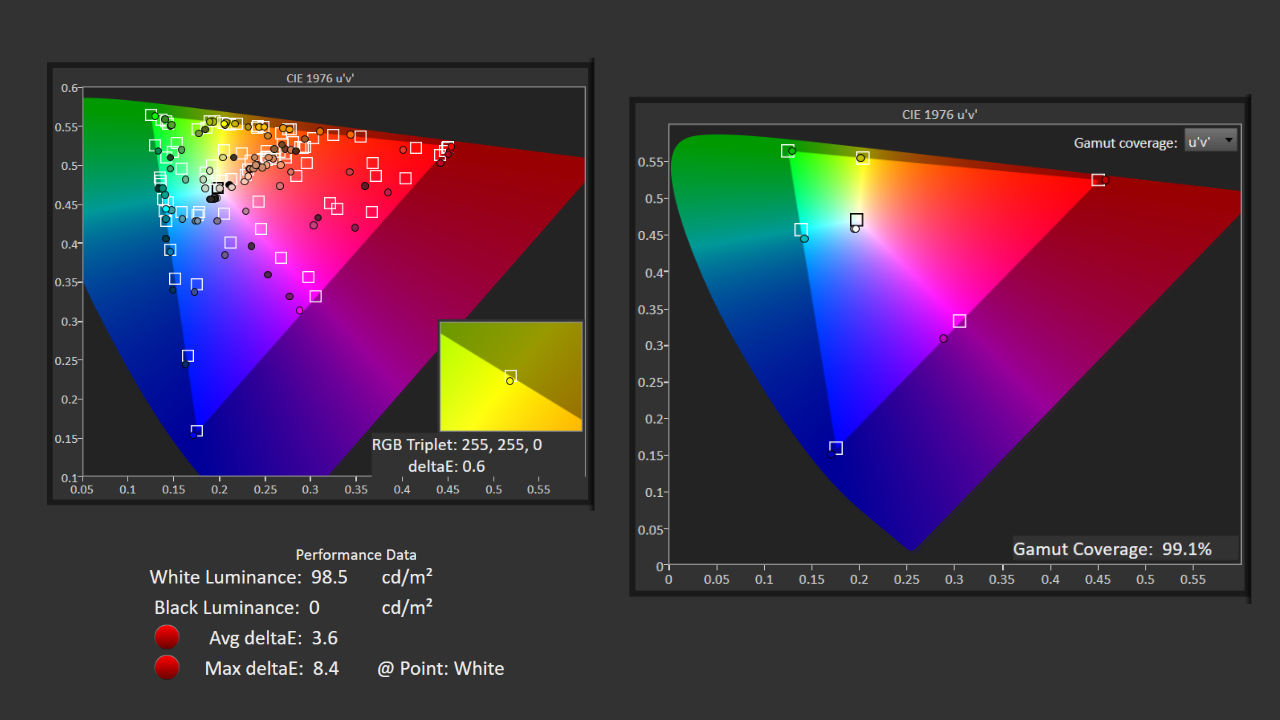
On our lux meter, the F33 Pro hit a brightness of 1,840 nits, which is much higher than Oppo’s official 1,400 nits claim in High Brightness Mode. What you need to know is that the display is quite bright to be comfortably readable even under harsh summer sun. Moving over to our Calman analysis, again, you don’t get disappointed by the numbers, as the colour gamut coverage came in at an impressive 99.1 per cent.
Though the average Delta E of 3.6 in the colour checker analysis is a bit lower than expected. For the most part, it’s acceptable for this segment, but if you were to put it in side-by-side comparisons with other devices, chances are it might fall a bit short. For most users, though, the display will simply look great.
Personally, I had a lot of fun watching both YouTube videos and OTT content on the Oppo F33 Pro, and a major reason behind it was the excellent speakers. Just like other Oppo phones, the F33 Pro features a 300 per cent volume boost mode, which makes the sound much louder. The audio feels clear, and for the price range, it is well on par with other devices.
Now, the performance is where I felt like the mid-range pricing starts to show itself. Internally, the phone comes powered by the MediaTek Dimensity 6360 Max, which is a 6 nm chip capable of handling everyday tasks like browsing, social media and casual video streaming without any major hiccups. But again, if you’re buying a phone, at this price range, you’d typically expect the phone to do more than that.
In Antutu, the F33 Pro scored a modest 647,777, which is much lower when compared to other phones in the same price range. A similar pattern was seen in the Geekbench 6 tests, as it put up a single-core score of 771 and a multi-core at 1,980, which is well behind what the competition offers at this price point. In our 15-minute CPU throttle test, the chip settled at 93 per cent of peak performance, which suggests that managing sustained performance is reasonable, but yes, in the real world, the performance does start to throttle when pushed to the limits.
Naturally, gaming is again where the difference starts to become most apparent. I tried playing games like BGMI and Call of Duty, and on medium-to-high settings, the results weren’t impressive. There were noticeable frame drops, and anyone who games seriously will find this chipset limiting. Not to forget that the UFS 2.2 storage is another tough sell in 2026, as at this price, at least, UFS 3.1 should be the standard. For a device and this price range, this is a difficult trade-off to accept.
Thankfully, the software side of things is much better. The Oppo F33 Pro boots ColorOS 16 based on Android 16, which feels smooth and polished. Along with that, it’s loaded with genuinely useful AI features like AI Eraser, AI Summary, and AI Writing Assistant. While the bloatware situation is less impressive, the good thing is that you can uninstall a lot of stuff that you don’t need. However, at this price point, a cleaner UI experience is generally expected.
Also Read: iPhone 17e review: Apple’s case for the faithful
Where performance falls short, the battery almost makes up for it, as battery life is clearly one of the highlights for the F33 Pro. The phone packs a large 7,000mAh battery paired with an 80W fast charger in the box. It’s a combination that Oppo has been using on a lot of its devices recently.
In real-world usage under medium to heavy load, the phone consistently lasted 1.5 to almost 2 full days. Meanwhile, in our PCMark Work 3.0 battery test, it ran for a solid 23 hours and 22 minutes before hitting 20 per cent, which indicates a strong result. Moreover, the 80W charger allows the phone to be charged in under an hour.
We cannot talk about an Oppo phone without talking about its camera. Clearly, the brand has built an identity to provide a solid camera performance in its smartphones across price segments. That said, after clicking a bunch of pictures with both the front and rear cameras, I felt like it carried an almost split personality. What I mean to say is that there are effectively two different camera experiences here, depending on which camera you’re using.
First off, the 50MP front camera is arguably the best selfie camera in this price range. The natural skin tone processing makes portraits look like actual people, and the main advantage comes in the form of group selfies. They are handled with ease, as the wide field of view makes capturing large group selfies possible. I tried clicking pictures in both harsh outdoor sunlight and even low light, and the front camera balances both these experiences very well.
However, the rear camera is much different. In bright daylight, the 50MP main sensor performs well; the colours feel vivid, there’s a good amount of detail, and the images feel natural. Where it struggles, however, is almost everywhere else. Yes, you read that right. The dynamic range is poor, and photos taken in low light are a clear weakness, as there’s visible noise and softness. Just have a look at some of the samples yourself.
To sum it up, just know that the front camera is very good on the F33 Pro. In my books, it is actually excellent. However, the experience with the rear camera, on the other hand, feels dated. Limitations like no ultra-wide, no telephoto, no OIS, and only 1080p video recording restrict the experience.
When you’re spending this kind of money on a smartphone, these are some things that are not minor omissions but basic expectations.
In the end, it’s safe to say that the Oppo F33 Pro is a phone that rewards you instantly but makes your mind question later on. On one hand, the design is excellent, the display is bright and vibrant, and the battery will easily keep you away from the wall. Even the selfie camera is among the best at this price. If you were to buy this phone based on a quick demo, you would feel good about it.
However, once you start to dig deep, things like the performance chops of the Dimensity 6360 Max, the dated UFS 2.2 storage, and the limited camera system start to reveal the gap between what this phone looks like and what it actually is. Honestly, that’s like the middle child dilemma that the phone suffers with. Stuck between the performance-focused K-series and the camera-focused Reno series, it’s almost kind of a hard sell.
But nonetheless, for a buyer who prioritises build quality, battery, and selfies above all else, the Oppo F33 Pro is a solid pick. For everyone else, at the price of Rs 37,999, you can easily consider phones that offer more performance and much better cameras.
Also Read: Xiaomi 17T Review: The return of fan-favourite formula