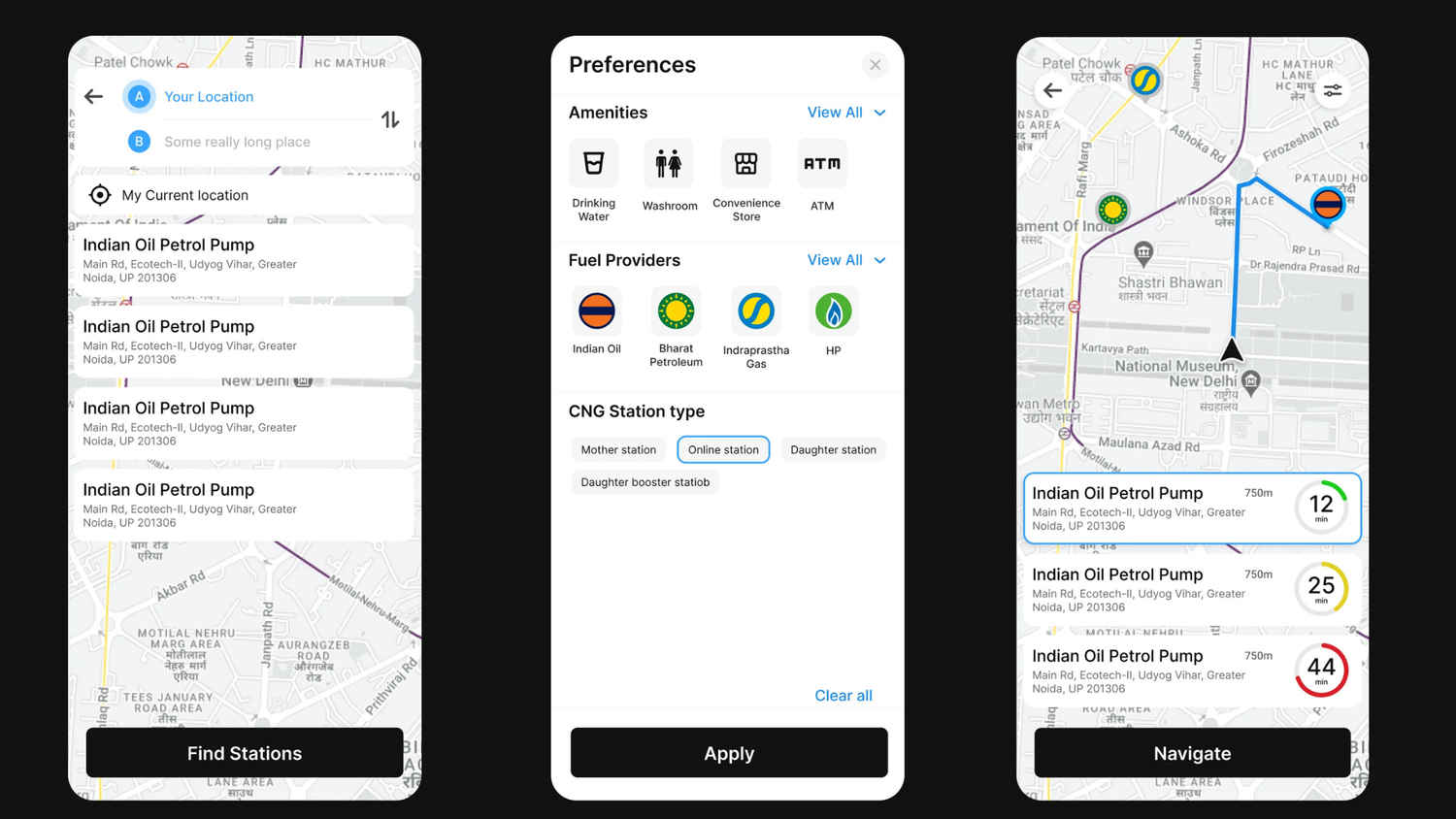
In a country like India, where several lakhs of people own their own vehicles, be it a two-wheeler or a four-wheeler, fuelling is seen as a big problem. Given the country’s large population, almost every fuel pump is always occupied, leading to long queues and time wastage.
While apps like Google Maps give users some idea of traffic, what’s happening inside the pump remains a mystery to most travellers. Though most recently, I came across an app called ‘Nawgati’ that is reducing this uncertainty.
I got a chance to speak with the co-founder and CEO of the company, Vaibhav Kaushik, with whom I had an insightful conversation. Before you check out our conversation, let’s first quickly take a look at how their app works.
Also Read: SBI to Salesforce: Arundhati Bhattacharya on Women in Tech leadership
So Nawgati is solving the fuelling problem for both consumers and fuel owners with the help of an app and a data dashboard. On the consumer side, they have an app that is available for users who are connected with fuel stations across the country. It allows users to check out various things, including fuel prices, queue sizes, and fuel pumps across their cities.
On the fuel station side, they’re connected with various fuelling companies to acquire data. They do that by equipping each fuel station with their systems that get connected to a platform called ‘Aaveg’. It is their dashboard that gets connected to the station to display the data.
While I did not get to try the dashboard, I did spend some time with the app. It’s very easy to use, and I found it very useful. Be it tracking fuel prices or checking out the petrol stations nearby my location, it was making my life a bit easier. With that said, let’s now take a look at the edited excerpts from my conversation with the co-founder and CEO Vaibhav Kaushik.
Q) From a user’s perspective, how does Nawgati reduce the uncertainty that is about refilling your cars every day?
Kaushik: The problem is that the users who are running on gas don’t really know if there’s a station on the route. If there’s a CNG station, does it really have CNG? And what is the fuel price for that matter? For petrol and diesel, you will see every outlet; most highways would have a diesel or petrol dispensing unit. But for CNG, it becomes a challenge.
This is where Nawgati steps in. We’re working with every oil and gas company in the country, dealers and consumers maintain the station data. So we know which station is serving fuel at what price and if fuel is even available.
We operate the largest fuelling app in India, more than three million users are using the app to navigate to a station on their route and plan their journeys in a better manner. So the uncertainty of whether or not they’ll be able to run for a hundred more kilometres gets solved by Nawgati.
Q) How did you come across the fact that this problem exists and there needs to be a solution in the market?
Kaushik: I was using Uber primarily for going to my place of internship, and I had a discussion now and then, and the drivers kept complaining that when we go for an intercity trip, we don’t know where to find a CNG station, and even in Delhi NCR, we have to wait for a very long duration of time.
So if there was a way of knowing where the station is, if gas is even available, or what the waiting time is, then it would sort of solve our problems. And I thought that this was a fairly trivial problem in my head. I thought that this is something very basic and somebody would have solved it. But I realised that nobody had solved it and there needed to be a solution around this.
So I spoke to my friends, now co-founders, Aalap and Aryan. I said, “Okay, you know, let’s do something like this.” And that is when we formed a company. We got BITS Pilani to invest a small amount of money via the Ministry of Electronics and IT, and that is how the idea sort of started taking shape.
Q) Is Nawgati towards the everyday consumers, or are they targeted more towards the cab drivers who are involved with Uber and Ola?
Kaushik: When we started, I saw the problem for the first time with CNG. Because for CNG, the serving time is higher. That is why the waiting time is also higher, and because the ecosystem is very nascent, as opposed to, say, petrol or diesel that has existed for far more decades.
The same problem also exists for EVs. The serve time for them would be 30 to 40 minutes. For petrol, diesel, the problems are again: What is the fuel price? Because India is a cost-sensitive, price-conscious market.
But Nawgati is being positioned as a fuel-agnostic provider. We would ensure that you have a seamless fuelling experience, no matter what fuel your vehicle is running on. But obviously, because we first realised the problem with CNG, most of the user base would be at present the CNG community.
Q) Could you explain how the Aaveg dashboards work from a technical standpoint? What data sources do you feed to the system for it?
Kaushik: Aaveg is our B2B offering, which is made available to oil and gas companies and petrol pump dealers. You can think of it as a super AI assistant for the dealer or the oil and gas companies. They need to know what is happening at the outlet at all times.
Nawgati’s Aaveg dashboard provides that information. You need to know what the congestion is, what the turnaround time is, how many attendants are deployed, and what sales are happening at an outlet.
So everything that is happening at the outlet is processed through the Aaveg dashboard. If you operate a petrol pump we would deploy the hardware. It will connect to your existing CCTV cameras, dispensers, compressors, underground tanks, and your POS machines.
Q) What structural issues do you think the current Indian fuelling ecosystem has?
Kaushik: I feel that considering the population of the country, it is in the best possible scenario. At present, we’re also seeing companies use newer technologies to ensure that the station layout or the dispenser positioning is improved. And companies are also adopting technologies now, more so than earlier.
Considering the dynamics that are there in terms of geography, which are there for the country, you would have urban centres, tier-two, and tier-three cities. I think it is managed in an excellent manner as of today. But there’s always some or other scope of improvement. But I think with the technological advancements, that gap is getting bridged.
Q) What would be the ideal smart fuel station in India? Let’s say in the next five to ten years, what would that ecosystem look like? A ‘smart fuelling’ ecosystem.
Kaushik: We’re already close to that in the sense that the fuelling experience is much better than it was a decade ago. I don’t see the country as a whole sort of transitioning to a manpowerless state. Unlike the West, where there’s a self-filling system. In India, it will always have the attendants because the queue lengths are significantly higher, and the queue has to be managed.
But I think the newer stations that are coming up are ensuring that the entry to exit for the customers who are coming to the outlet is as seamless as possible so they spend the shortest time inside the station; the turnaround time is fairly less than it was a decade ago.
In terms of the integrations that we’re already doing by converting the existing assets into smart assets. The dispenser, compressor, underground tanks, POS machines, and cameras. Through our hardware, everything is getting smarter. But I think a complete overhaul will not be possible. But making the best of whatever exists, I think we are getting there.
Nawgati is changing the way consumers interact with the fuelling ecosystem. Though at the same time, it also makes me wonder if tech giants like Google and Apple, given the amount of resources and networks they have, would ever want to invest in a solution like this.
Safe to say, that’s a whole different conversation for some other time. But speaking of which, if you want to check out the Nawgati app, you can try it out on both Android and iOS devices.
Also Read: BGMI 4.3 update: Krafton India’s Srinjoy Das reveals secret to game’s success