The acid test for every technology tool or application in India is all about whether it can scale to a billion people. UPI has done that in fintech, but what about the next revolution in AI?
The Digi Doot whitepaper, released alongside the India AI Impact Summit 2026, suggests that India may now be attempting for artificial intelligence what it once achieved with digital payments. Nothing less than a billion plus population-scale public infrastructure moment powered by agentic AI.
Authored by an unusually heavyweight coalition including MIT Media Lab’s Ramesh Raskar, Aadhaar’s founding CTO Srikanth Nadhamuni, and contributors from IISc, IIT Kanpur and the broader DPI ecosystem, the paper proposes a deceptively simple idea.
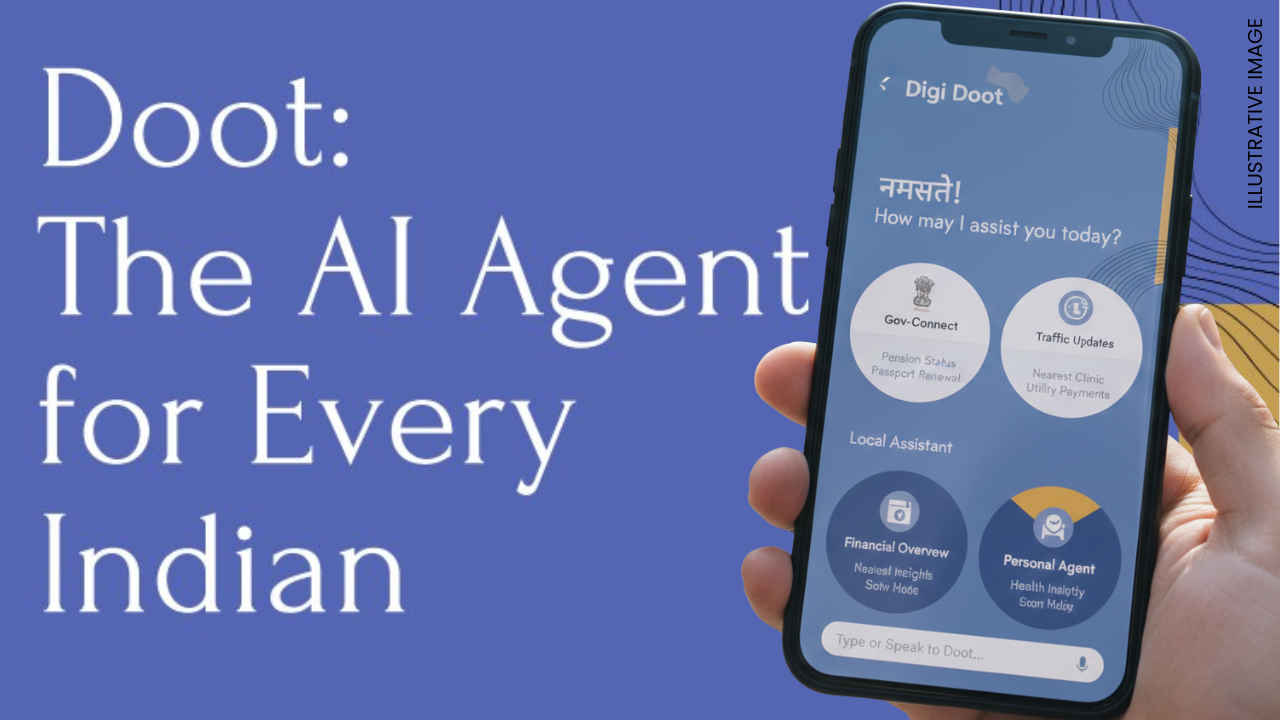
The Doot AI paper suggests that every Indian should get a personal AI agent. Not an app, not a free chatbot service. An actual digital twin that you can delegate tasks under certain conditions.
The Doot whitepaper’s foreword spells out the ambitious endeavour. India, writes IndiaAI Mission director K. Mohammed Y. Safirulla, has “the unique opportunity and responsibility to shape an inclusive, impact-driven agenda for artificial intelligence, one rooted in the principles of People, Planet, and Progress.”
That language mirrors the rhetoric that once surrounded Aadhaar and UPI – public infrastructure designed not merely for efficiency but for inclusion.
I’d highly recommend you go and read the whitepaper on Digi Doot’s website, the contents of which have drowned out in other glitzier headlines from India AI Impact Summit 2026. At its core, the authors propose the creation of “Doot,” a citizen-owned AI agent running primarily on a user’s device and connected to India’s Digital Public Infrastructure services such as Aadhaar, DigiLocker and UPI.
Why does India need this Digi Doot AI agent, you ask? It’s a fair question. It’s because India has reached the limits of its current digital rails, argues the whitepaper. Despite the success of Aadhaar and UPI, citizens are still bogged down by a fragmented ecosystem of schemes, portals and verification layers.
The proposed solution is what the authors of the whitepaper call “Agent One” – a national architecture in which every citizen’s AI agent can discover services, verify eligibility, complete transactions and resolve disputes across public and private systems.
Also read: India AI Impact Summit 2026: Union Railway Minister Ashwini Vaishnaw on sovereign AI models
Instead of navigating segregated portals, citizens interact with the Doot agent with expressed intent. The agent layer “converts it into a single, natural-language interface,” allowing users to simply say: “I need a birth certificate,” “Apply for this subsidy,” or “Track my pension.” The agent then plans and executes those actions on the citizen’s behalf.
This is where the UPI example becomes unavoidable, if you think about it. Just as UPI abstracted away the complexity of banking systems into a simple “send money” interface, Digi Doot aims to abstract away the complexity of governance and services into conversational intent.
The whitepaper describes the architecture – called “Agent One” – as the next layer of digital public infrastructure, enabling citizens to “discover, access, and complete government and private services through natural language, voice, and local context.”
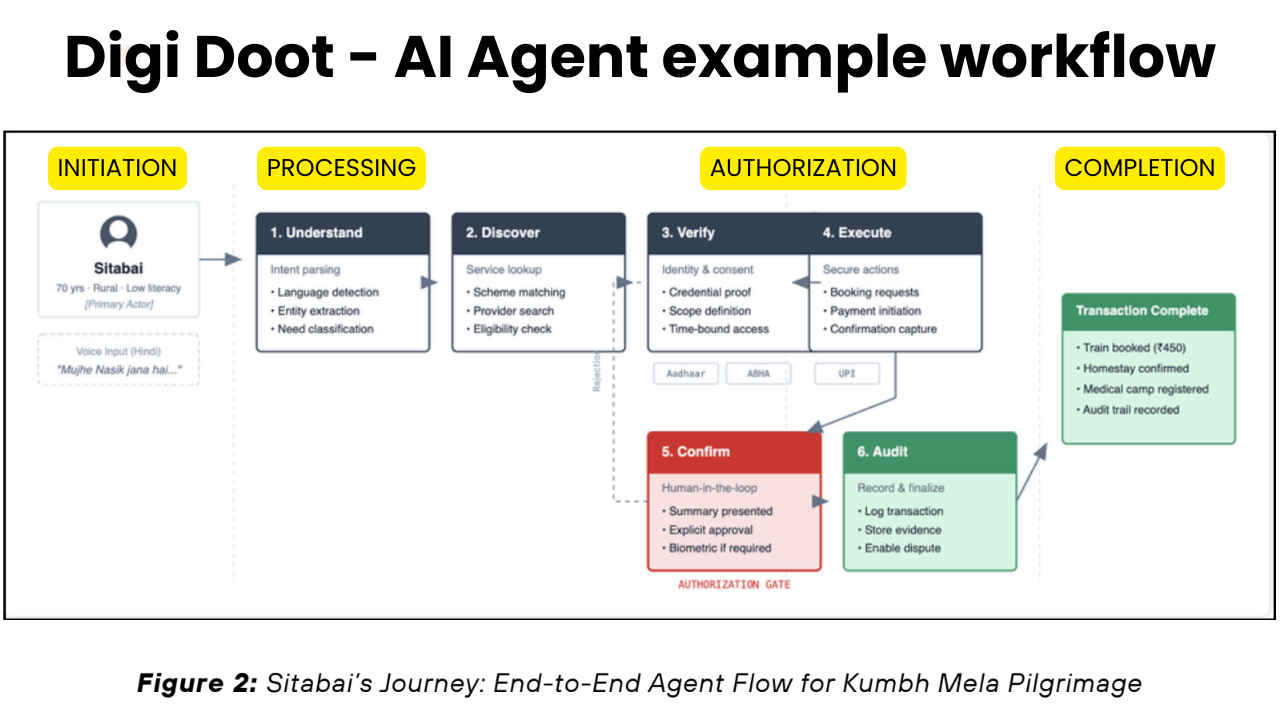
Examples given in the Digi Doot AI agent whitepaper proposal are practical and believable. Consider the example of Sitabai, a 70-year-old citizen planning a trip to the Kumbh Mela. With a single voice command – “Mujhe toh Nasik jana hai Kumbh Mela ke liye. Main kya karu?” – her agent coordinates travel, verifies eligibility for concessions, books accommodation via UPI, shares limited medical data with a health camp and even handles dispute resolution if a booking fails.
Also read: India AI Summit: MIT’s Ramesh Raskar says AI’s real impact lies beyond tech
The Doot AI agent proves Sitabai’s eligibility without exposing personal data, executes payments securely and seeks confirmation before critical actions. If UPI turned every phone into a payments terminal, Digi Doot aims to turn every phone into a service navigator.
Of course, the number one question with Doot AI agent is how it impacts citizen’s private data, and on that note the whitepaper is careful not to oversell technological magic. Its authors repeatedly note that the real constraints are governance and adoption, not model intelligence.
Agents must operate under “fine-grained, revocable consent,” with identity-bound accountability and full audit trails. Sensitive data stays on-device where possible, and high-risk actions require explicit human confirmation.
Within the context of the India AI Impact Summit, the message is unmistakable. If executed well, Digi Doot could do for services what UPI did for payments – remove friction, democratize access and embed intelligence directly into everyday transactions.
Digi Doot AI agent is only a proposal for now, it’s not launching anytime soon. But this whitepaper’s definitely interesting, because it’s trying to ask whether India can standardise AI in a way that’s useful, easy to govern and deploy it at population scale.
Also read: India AI Impact Summit 2026: BharatGen Param 2, SarvamAI, and the rise of Indian LLM models so far