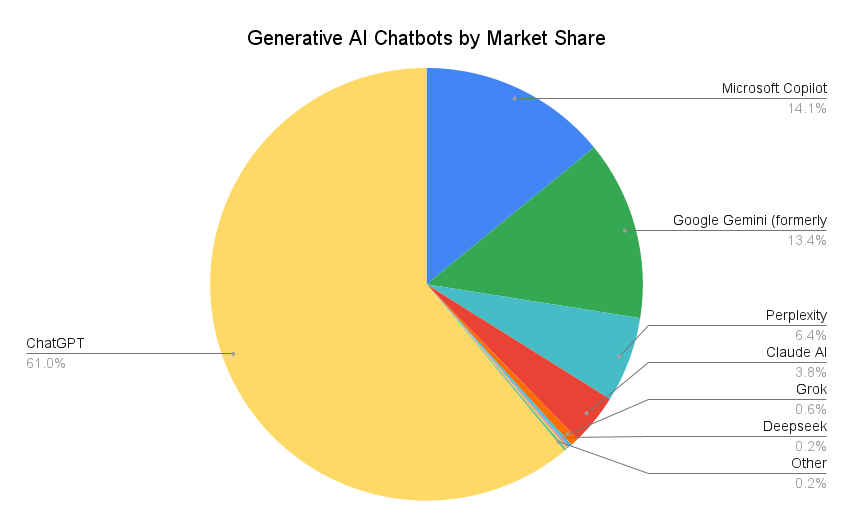
As ChatGPT blows out the candles on its third birthday, the party mood at OpenAI might be dampened by a sobering new reality. While the platform still boasts a massive 800 million weekly users, a shift is underway. A series of new reports and user engagement data from late 2025 suggest that the “one bot to rule them all” era is ending, with users increasingly migrating to Google’s Gemini and Anthropic’s Claude for their daily drivers.
The narrative isn’t about a mass exodus, but a “splintering”, a trend where power users, developers, and creatives are abandoning ChatGPT for rivals that have simply become better at specific tasks.
Also read: Google Ironwood TPU explained: How it compares with NVIDIA’s AI chip
According to a November 2025 analysis by First Page Sage and recent reports highlighted by Tom’s Guide, while ChatGPT remains the volume leader, it is no longer the growth leader. Competitors like Claude and Perplexity are seeing double-digit quarterly growth rates, outpacing OpenAI’s flagship.
The core issue driving this migration? Specialization.
Also read: Elon Musk on Google, Nvidia, AI and danger to humanity
For the first two years of the generative AI boom, ChatGPT was the default utility for everything. But in late 2025, users are realizing that “good at everything” often means “great at nothing.”
1. The Coder’s Exodus to Claude The most significant brain drain is happening in the developer community. Once the stronghold of GPT-4, coding forums and Reddit threads are now dominated by praise for Claude 3.5 and 4.5 Sonnet.
2. The Google Ecosystem Lock-in Google’s Gemini (now on version 3.0) has finally found its footing, not just by being smarter, but by being everywhere.
3. “ChatGPT Fatigue” Perhaps the most damaging trend is intangible: the “corporate” tone of ChatGPT. User feedback from late 2025 highlights a growing annoyance with ChatGPT’s “toxic positivity” and verbose, lectured responses.
Is ChatGPT dying? Far from it. With a $157 billion valuation and near-universal brand recognition, it remains the “Google” of chatbots, the default starting point for the masses.
However, the data suggests we have hit peak consolidation. The market is unbundling. You might use Gemini to summarize your emails, Claude to write your code and essays, and Perplexity to search the web.
ChatGPT launched as a revolution, but three years later, it is becoming something arguably more dangerous for a tech giant: a legacy product. As we head into 2026, the question isn’t whether you use AI, but which AI you trust to get the job done, and for a growing number of people, the answer is no longer ChatGPT.
Also read: Apple, Intel and 18A: Why the foundry deal could rewrite the future of PCs