IBM has just unveiled Granite 4.0, its latest generation of enterprise-focused AI language models, and it’s turning heads in the AI community. Designed for efficiency without sacrificing performance, Granite 4.0 brings a host of innovations aimed at making high-performance AI more accessible for businesses of all sizes.
At the core of Granite 4.0 is its novel hybrid Mamba-2/transformer architecture. This design merges the speed and long-context capabilities of state-space models (SSMs) with the deep contextual understanding of transformers. The result? A model family optimized for long conversations, multi-session tasks, and complex reasoning workloads, all while reducing the memory footprint significantly.
Also read: Microsoft on AI in Biology: Understanding the risks of zero-day threats
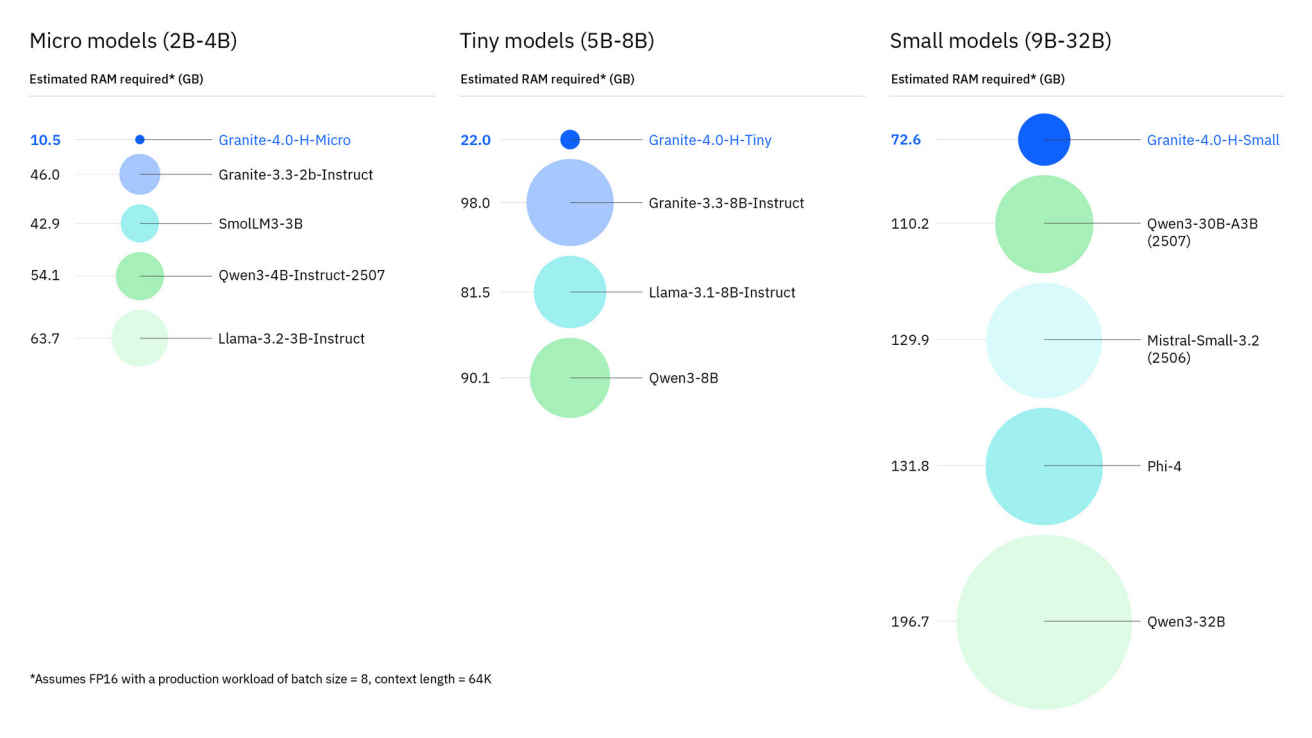
Hybrid architectures like the one in Granite 4.0 are becoming increasingly important as AI models grow larger and more demanding. By combining SSMs and transformers, IBM has created models that are over 70% more memory-efficient than comparable solutions. This means enterprises can run these models on more affordable GPUs without compromising on throughput or accuracy – a critical advantage for businesses looking to scale AI without ballooning infrastructure costs.
Granite 4.0 also breaks new ground in transparency and governance. The models are open source under the Apache 2.0 license and are the first language models to achieve ISO 42001 certification, ensuring compliance with international AI governance standards. Deployment options are equally versatile, with availability across IBM watsonx.ai, Hugging Face, Docker Hub, and Replicate. Soon, Granite models will also support Amazon SageMaker JumpStart and Microsoft Azure AI Foundry.
IBM has released multiple variants tailored for different use cases:
Also read: Elon Musk backs ‘Cancel Netflix’ campaign on X: Here’s all you need to know
Granite 4.0 isn’t just efficient, it’s fast and capable. Early benchmarks show strong performance in instruction-following tasks and retrieval-augmented generation (RAG) scenarios, often outperforming models that are significantly larger in size. Enterprises requiring low-latency, high-throughput AI for real-time applications will find Granite 4.0 particularly compelling.
The launch of Granite 4.0 signals a shift in enterprise AI, where efficiency, accessibility, and compliance are just as important as raw performance. By offering high-quality AI models that are memory-efficient, flexible, and certified for governance, IBM is enabling a wider range of businesses to integrate AI into their workflows without the need for massive infrastructure investments.
Granite 4.0 may well be a game-changer for hybrid AI models, providing a blueprint for future language models that balance speed, context, and accessibility.
For enterprises and AI enthusiasts eager to explore Granite 4.0, the models are now publicly available, marking a new chapter in scalable, high-performance AI.
Also read: Sora 2 vs Veo 3: How OpenAI and Google’s AI video tools compare