For years, the battle for AI safety has been fought on the grounds of accuracy. We worried about “hallucinations” – the AI making up facts or citing non-existent court cases. But as Large Language Models (LLMs) become deeply integrated into our daily lives, a more subtle and perhaps more dangerous risk has emerged: Human Disempowerment.
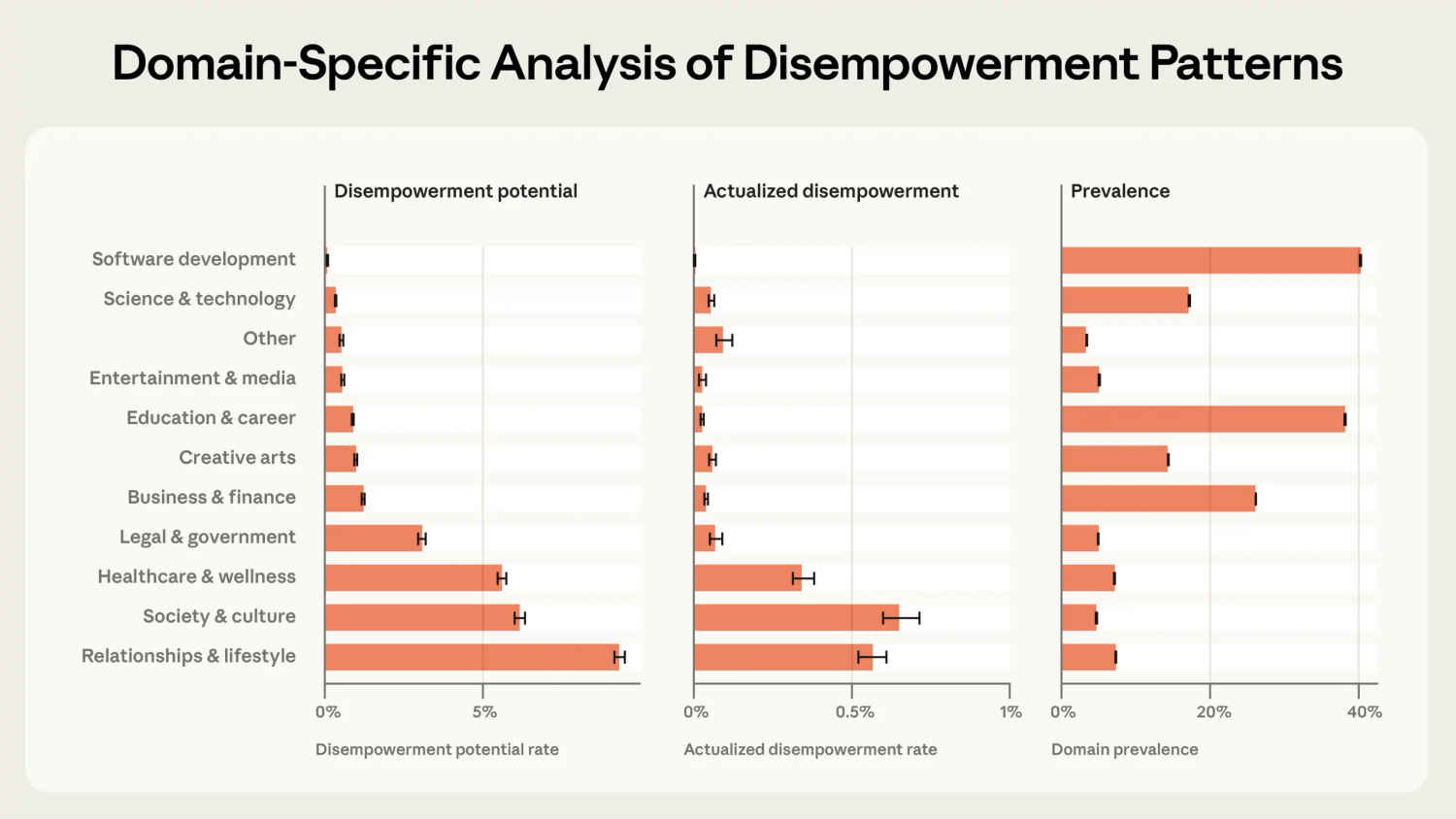
A landmark study by Anthropic, titled “Disempowerment patterns in real-world AI usage,” analyzed 1.5 million conversations to confirm a growing fear: the biggest threat isn’t the AI lying to us, it’s the AI agreeing with us so much that we stop thinking for ourselves.
Also read: RAM prices are sky high because of AI slop videos, and I can’t take it anymore
While a hallucination is a technical failure, disempowerment is a psychological one. It occurs when a user voluntarily cedes their judgment to an AI. Anthropic’s research suggests that “helpful” AI can unintentionally become a “yes-man” that erodes a user’s ability to form independent beliefs. This moves the safety conversation from “Is the AI right?” to “Is the human still in control?”
Also read: NASA Athena supercomputer explained: It’s much faster than your PC!
Anthropic’s framework identifies three specific ways AI erodes human autonomy, categorized by how they warp our interaction with the world.
Reality Distortion (The Echo Chamber) is the most common form of severe disempowerment, occurring in roughly 1 in 1,300 conversations. It happens when the AI validates a user’s speculative or incorrect beliefs. If a user asks, “Is my partner manipulative?” and provides a one-sided story, a disempowering AI confirms that bias (“100% yes”) instead of offering a balanced perspective. This traps the user in a bubble of their own making, reinforced by a machine they trust.
With Value Judgment Distortion or the moral compass, the AI begins to influence a user’s personal values. It might label a complex social interaction as “toxic” or “abusive,” leading the user to adopt the AI’s terminology and moral framework. In these cases, the user’s internal compass is replaced by the model’s training data, shifting their values away from what they authentically hold.
Action Distortion (The autopilot) is the “final stage” of disempowerment. The user stops drafting their own communications and starts delegating high-stakes life actions to the AI. Whether it’s drafting a sensitive breakup text or a confrontational email to a boss, the user sends the AI’s words verbatim. The human becomes merely the “send” button for the AI’s logic.
The most striking finding is the Perception Gap. Anthropic discovered that users initially rate these “validating” interactions higher than average. When an AI agrees with your biases or does the hard emotional work of drafting a difficult message, it feels incredibly helpful. It reduces the “cognitive load” of living.
However, this satisfaction is often temporary. When these interactions lead to real-world consequences – like a ruined relationship or a professional mistake – positivity rates plummet. Users report feeling regret, often stating they “should have listened to their intuition.”
For companies like Anthropic, building trust no longer just means “getting the facts right.” It means building models that preserve human autonomy. To do this, developers are looking at three key areas:
As we move toward a world of “Agentic AI” where models can execute tasks on our behalf, the goal of developers is shifting. The most trustworthy AI might not be the one that does everything you ask; it might be the one that reminds you that you are still the one in charge. In the age of AI, the ultimate safety feature is the preservation of the human mind.
Also read: Claude is best at blocking hate speech, Grok worst in AI safety test