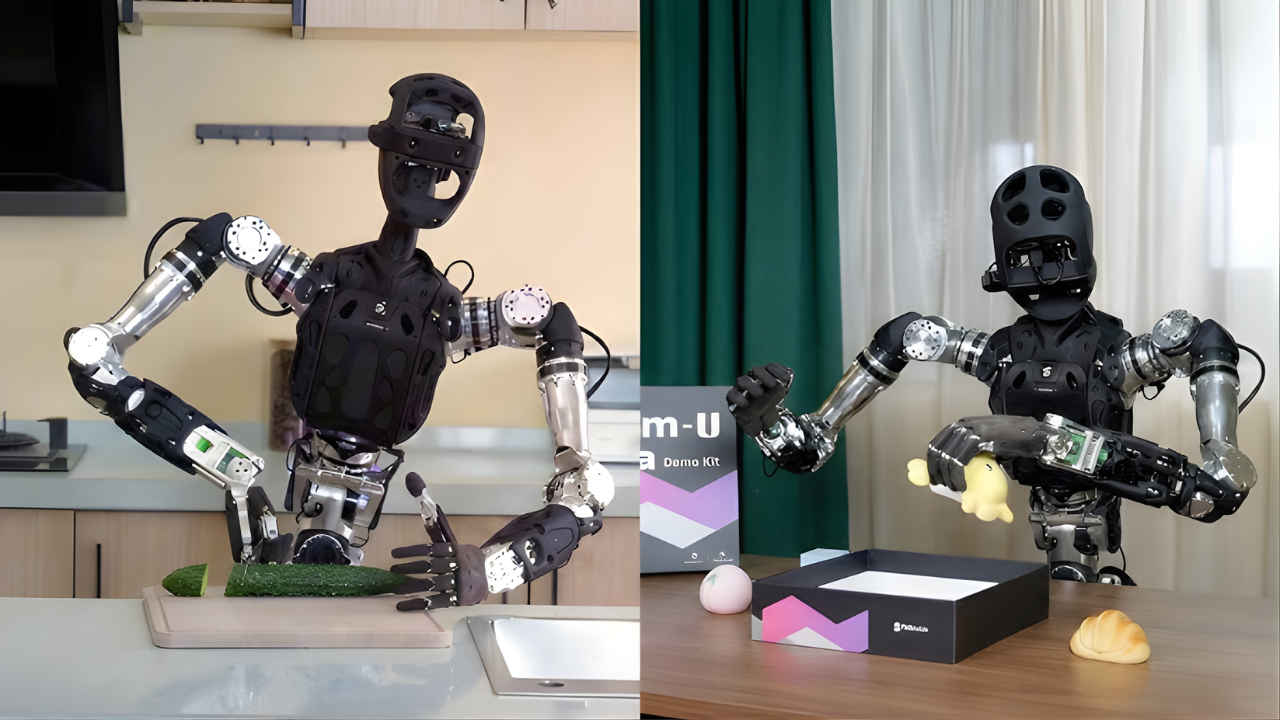
In the global race to build useful humanoid robots, speed has become the defining benchmark. Not speed in movement, but speed in learning. That is where Adam U Ultra stands out. Developed in China, the humanoid points to a future where robots no longer need weeks of coding and calibration to perform complex physical work.
What makes Adam U Ultra different is its ability to learn tool use and fine manipulation tasks in a matter of hours. Traditionally, teaching a robot to use tools like screwdrivers or to precisely align and place objects involves painstaking programming in controlled environments. Each task must be defined in advance. Adam U Ultra challenges this approach by using a vision language action system trained on thousands of real world interactions, allowing it to generalise across tasks rather than memorise instructions.
Also read: Factories to your home: 6 humanoid robots from CES 2026 that will make your jaw drop
At the core of this system is a tightly integrated loop of perception and action. The robot uses continuous visual feedback to adjust grip force, wrist angle, and hand position in real time. This adaptability is crucial for tool use, where small variations in position or resistance can cause failure. Instead of executing a rigid sequence, the humanoid responds dynamically, closer to how a human worker would react when handling unfamiliar tools.
Also read: Physical AI chips: Arm’s role in powering this next shift in robotics computing
Tool use remains one of the hardest problems in robotics because it demands contextual understanding, not just mechanical accuracy. A robot must understand how a tool relates to its own body and the object it is manipulating. Adam U Ultra’s ability to acquire these skills quickly suggests a shift away from narrowly programmed machines toward systems that can learn on the job.
The speed of learning has serious implications for industry. In manufacturing, logistics, and laboratories, tasks change frequently and environments are rarely static. Robots that can be trained within hours rather than weeks could reduce downtime and make automation viable in settings where traditional industrial robots struggle.
China’s growing focus on practical humanoid robots provides important context. Rather than prioritising spectacle, the emphasis is moving toward deployable systems that can operate alongside humans. While Adam U Ultra is not yet a replacement for skilled labor, it signals a clear change in direction. The future of humanoid robotics may not be defined by how strong or fast robots are, but by how quickly they can learn to work with the tools of the human world.
Also read: Meet Atlas upgraded: Boston Dynamics’ robot will build cars with cutting edge AI, here’s how