After having written about Intel’s Wi-Fi 8 philosophy – the 802.11bn pivot from raw speed to reliability – what’s striking about Qualcomm’s announcement at MWC 2026 is that they’re operationalising Wi-Fi 8 as an AI-native connectivity stack, not just defining the radio. And that’s a very different posture.
Strip away all the marketing gloss, and three key technical pillars emerge from Qualcomm’s Wi-Fi 8 vision.
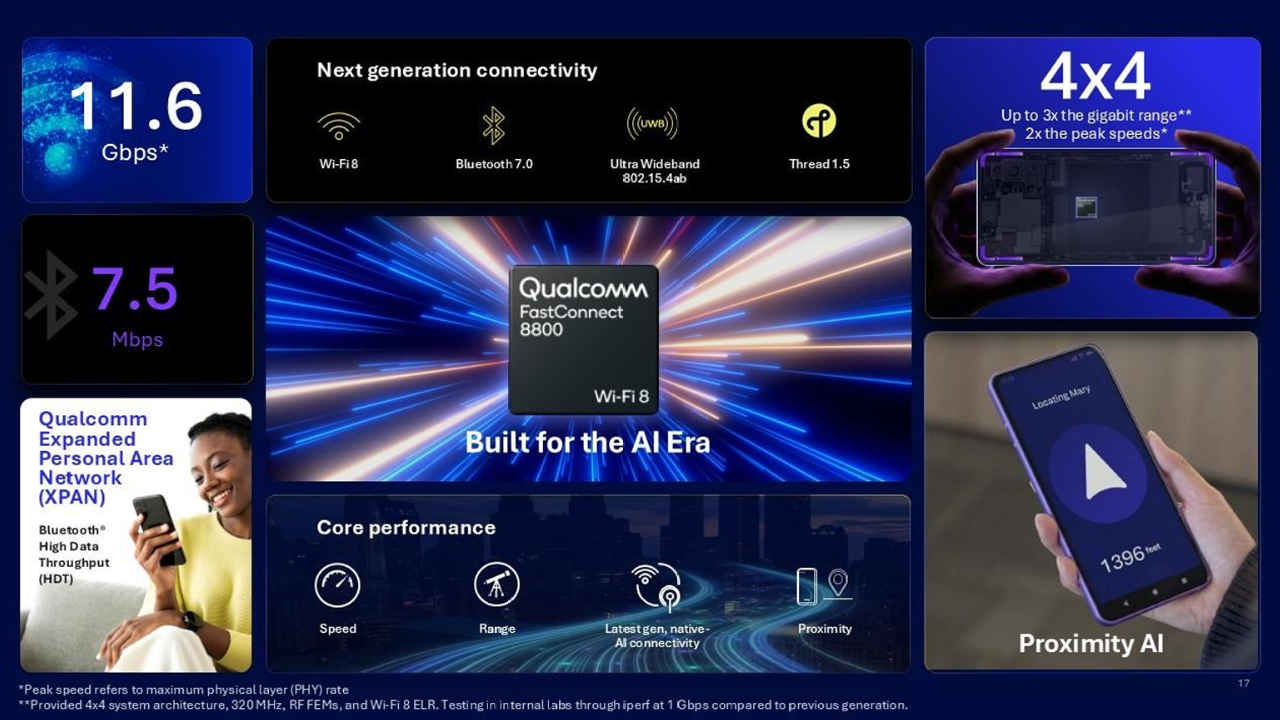
The headline silicon in Qualcomm’s Wi-Fi 8 stack is the FastConnect 8800, which Qualcomm describes as the world’s first mobile connectivity system with a 4×4 Wi-Fi radio configuration.
Why does that matter? Most smartphones until now have only ever 2×2 radio configuration. Moving to 4×4 spatial streams on mobile isn’t just an incremental gain, it fundamentally changes how peak throughput, range, and multi-user connectivity operates in dense environments of the near future.
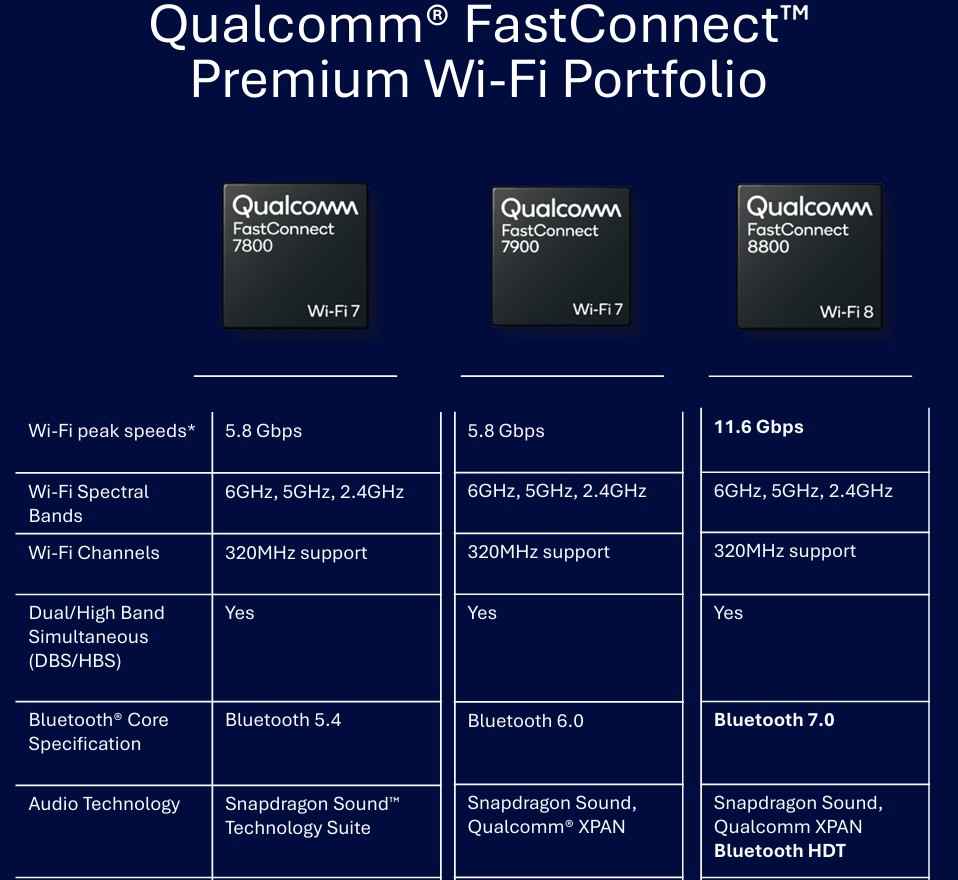
In FastConnect 8800, Qualcomm claims 10+ Gbps peak PHY rates, up to 3x gigabit range, Bluetooth HDT jumping from 2 Mbps to 7.5 Mbps.
Also read: Wi-Fi 8 will work in India without 6-GHz access, Intel explains how
Remember, peak PHY numbers are always lab-friendly. So the more meaningful detail is the range claim. Wi-Fi 8’s Extended Link Range (ELR) combined with 4×4 MIMO increases link budget and spatial diversity. This will result in fewer dead zones, better uplink stability, and stronger performance under increased radio interference.
More interestingly, FastConnect 8800 integrates Wi-Fi 8, Bluetooth 7.0, UWB (802.15.4ab), and Thread 1.5 on a single chip. That convergence matters because Wi-Fi 8 isn’t being framed as a faster pipe – it’s being positioned as part of a unified sensing and proximity architecture. This brings us to Qualcomm’s second big idea.
FastConnect 8800 introduces what Qualcomm calls Proximity AI, leveraging UWB, Bluetooth Channel Sounding, and Wi-Fi ranging for centimeter-level tracking – which is previously unheard of, believe you me!
This is where Qualcomm’s Wi-Fi 8 vision diverges from the “just better networking” narrative. Qualcomm’s baking AI-driven contextual awareness directly into the connectivity layer.
That means radios aren’t just transmitting bits – they’re feeding spatial intelligence like never before. For XR, robotics, automotive cabins, and multi-device ecosystems, this is foundational for improved precision and performance. Wi-Fi 8 here becomes part of a distributed sensing fabric.
Also read: MWC 2026: Honor shows off Robot Phone with gimbal camera system
If FastConnect 8800 is the client play, the Dragonwing Wi-Fi 8 platform provides the essential architectural shift to bring Qualcomm’s Wi-Fi 8 vision to life.
The Dragonwing NPro A8 Elite features a 5×5 Wi-Fi 8 radio system, claiming up to 40% higher throughput at typical distances, 2.5x latency reduction during peak usage, and 30% lower daily energy consumption. How is it able to do all of this? Because it includes a penta-core CPU and an integrated Hexagon NPU for edge AI processing.
That’s the crucial takeaway here. In the age of Wi-Fi 8, routers aren’t going to be dumb devices that just transfer data packets or radio signals here and there. Qualcomm is turning them into AI nodes capable of classifying network traffic in realtime so they can do interference mitigation. There’s predictive congestion handling baked-in as well as application-aware QoS for AI workloads.
Add integrated 10G PON (FiberPro A8 Elite) and 5G FWA via X85 modem support, and what you get is a vertically unified access architecture – fiber, fixed wireless, and Wi-Fi 8 sharing intelligence at the edge. In short, Qualcomm isn’t treating Wi-Fi 8 as a radio upgrade. It’s treating it as the fundamental connective tissue of the AI era.
Also read: Xiaomi 17, 17 Ultra, Pad 8 Series announced at MWC 2026: Specs, India launch details