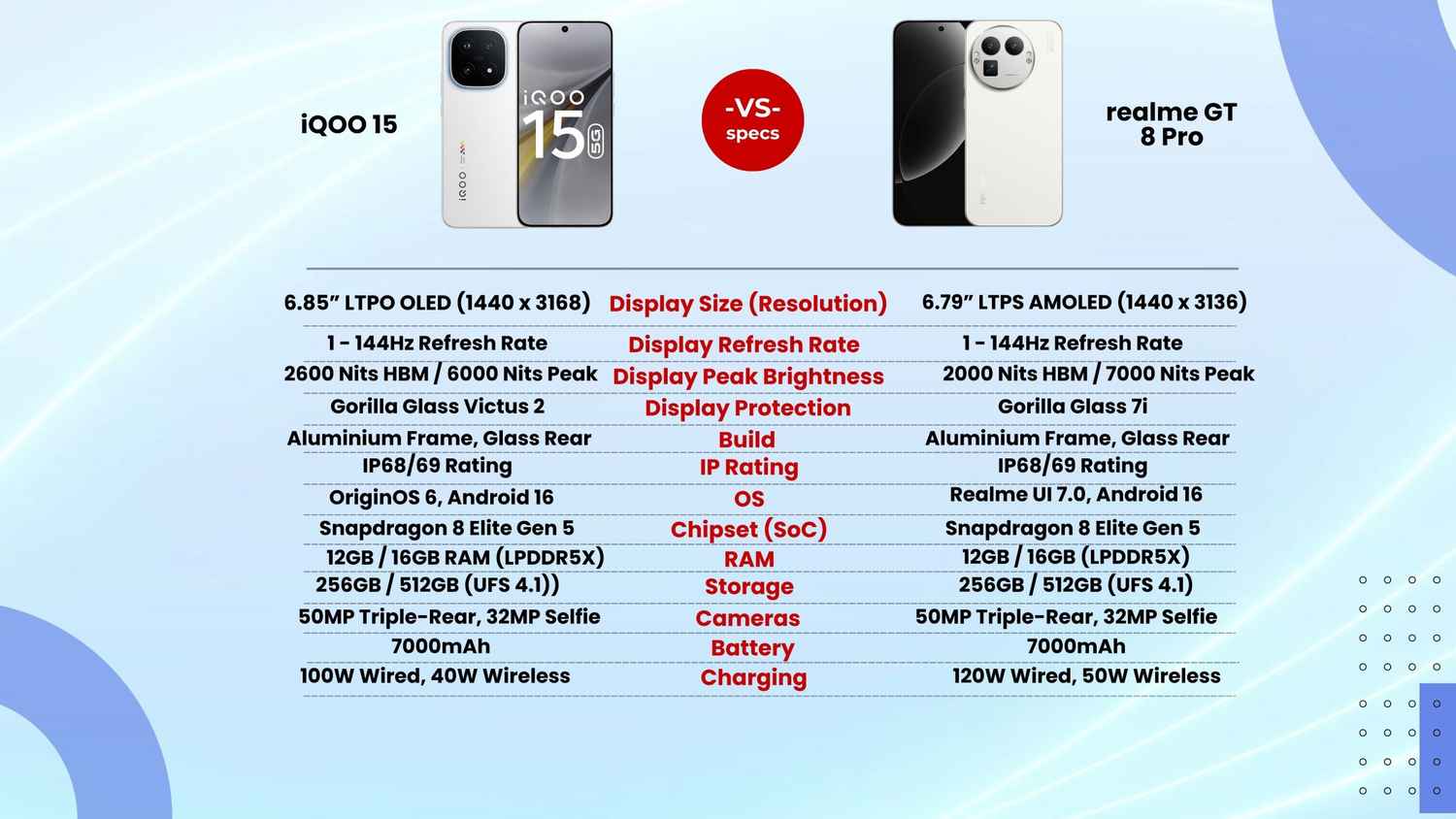
When you look at the current generation of Android flagships, the iQOO 15 and the Realme GT 8 Pro stand out as two of the most performance-focused options of 2025. Both are powered by Qualcomm’s top-end Snapdragon 8 Elite Gen 5 chip, both come with large 7,000mAh batteries, and both promise serious speed for gaming and productivity. They are also priced very close to each other, with both the iQOO 15 and Realme GT 8 Pro starting at Rs 72,999 for the 12 GB RAM + 256 GB storage variant. Their top-end models sit at Rs 79,999 and Rs 78,999, respectively.
But when two phones look this similar on paper, one question becomes more important for real buyers: which one actually lasts longer? Battery life can dramatically change the everyday experience, especially if you are someone who works on the go, games frequently, or simply doesn’t want to hunt for a charger in the middle of the day. To find out, we ran a controlled 6-hour battery drain test covering video playback, camera usage, benchmarks, gaming and social media. And while both phones performed well, the results offer a clearer picture of how each flagship handles sustained load.
To keep things consistent, both phones were connected to the same Wi-Fi network and fully charged to 100% before starting. Brightness was calibrated to 500 nits using a lux meter, resolution was set to Auto, refresh rate was locked at the highest available mode, and volume was kept at 50%. These conditions ensured that neither phone had an advantage going in.
Also read: iPhone 17 Pro Max vs Galaxy S25 Ultra battery drain test: Which flagship lasts longer?
iQOO 15: Rs 72,999 (12 GB + 256 GB), and Rs 79,999 (16 GB + 512 GB)
Realme GT 8 Pro: Rs 72,999 (12 GB + 256 GB), and Rs 78,999 (16 GB + 512 GB)
The iQOO 15 features a 6.85-inch LTPO OLED display, while the Realme GT 8 Pro uses a slightly smaller 6.79-inch LTPS AMOLED panel. Both run at up to 144Hz, but iQOO does have the advantage in terms of offering a variable refresh rate. Brightness tuning is also different: iQOO offers 2,600 nits HBM brightness and a very high 6,000 nits peak, while Realme offers 2,000 nits HBM and 7,000 nits peak brightness for HDR content.
Inside, both devices pack the Snapdragon 8 Elite Gen 5 chipset, up to 16 GB LPDDR5X RAM and up to 512 GB UFS 4.1 storage. Even the camera setups are nearly identical at first glance, with 50MP triple rear systems and 32MP front cameras. Although the Realme does offer a 200MP periscope telephoto camera.
We began with 2 hours of YouTube playback at high resolution. Interestingly, both displays looked extremely sharp, but the colour tuning differed. Realme opted for a more neutral, natural tone, while iQOO leaned towards a slightly more vibrant and boosted look. The difference wasn’t dramatic, but noticeable if you pay attention. Where the iQOO 15 really stands out is in brightness. It is one of the brightest displays you can get, and even though Realme’s panel is very capable, the iQOO simply appears more intense in direct sunlight.
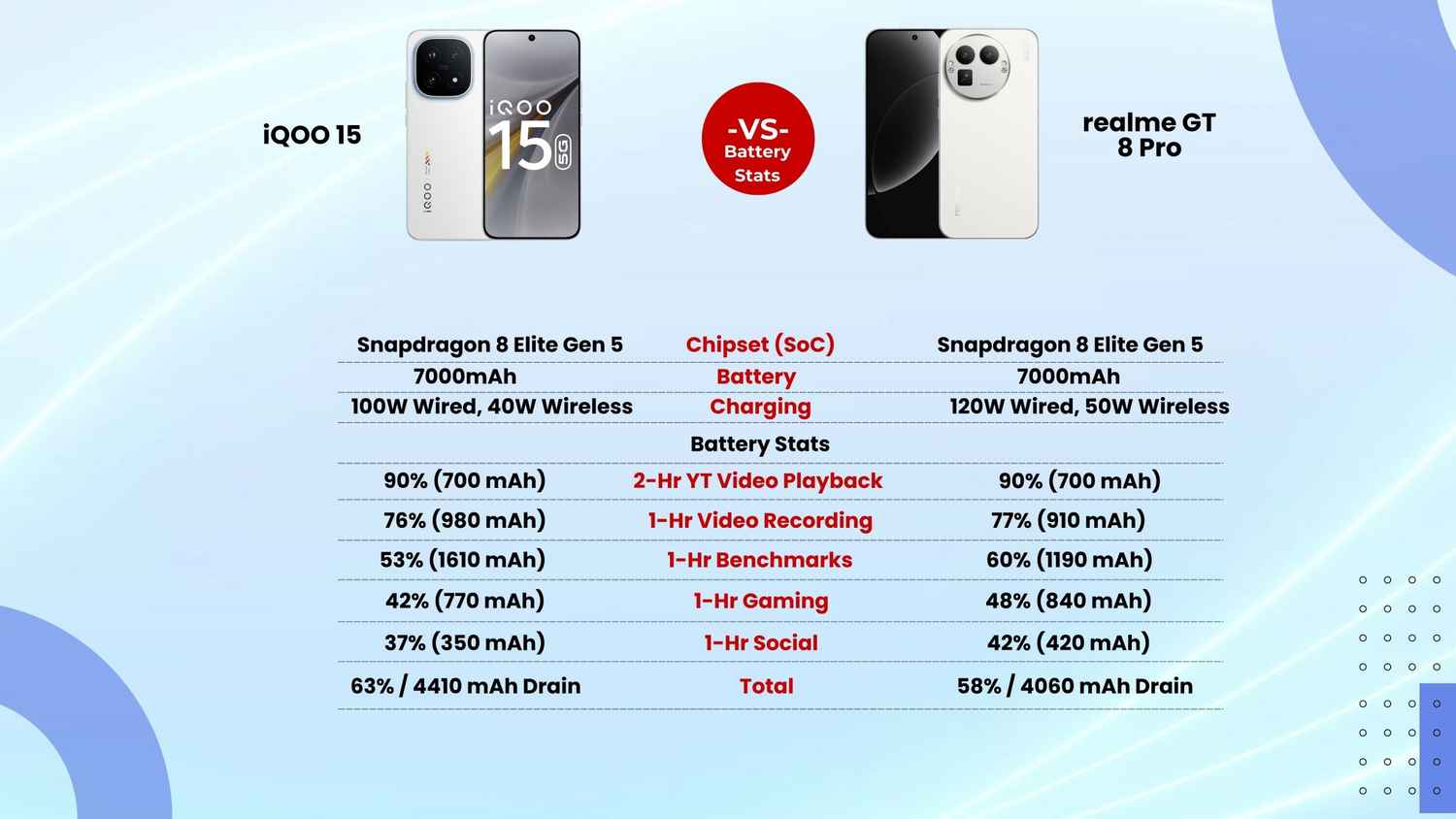
After two hours, both phones were tied at 90%.
The next test pushed the camera systems with one hour of 4K recording split between the rear and front cameras. Both phones can shoot up to 8K 30fps from the rear and 4K 60fps from the front, so there is no hardware limitation here.
The thermal behaviour was interesting. During rear-camera recording, the iQOO 15 peaked at around 39°C, while the Realme GT 8 Pro stayed slightly cooler at 38°C. But during front-camera recording, the iQOO ran cooler at around 37°C compared to the GT 8 Pro’s 38°C. Neither phone overheated, and both maintained stable performance throughout the hour.
At the three-hour mark, the Realme GT 8 Pro held a very slim lead with 77% battery remaining, while the iQOO 15 sat at 76%.
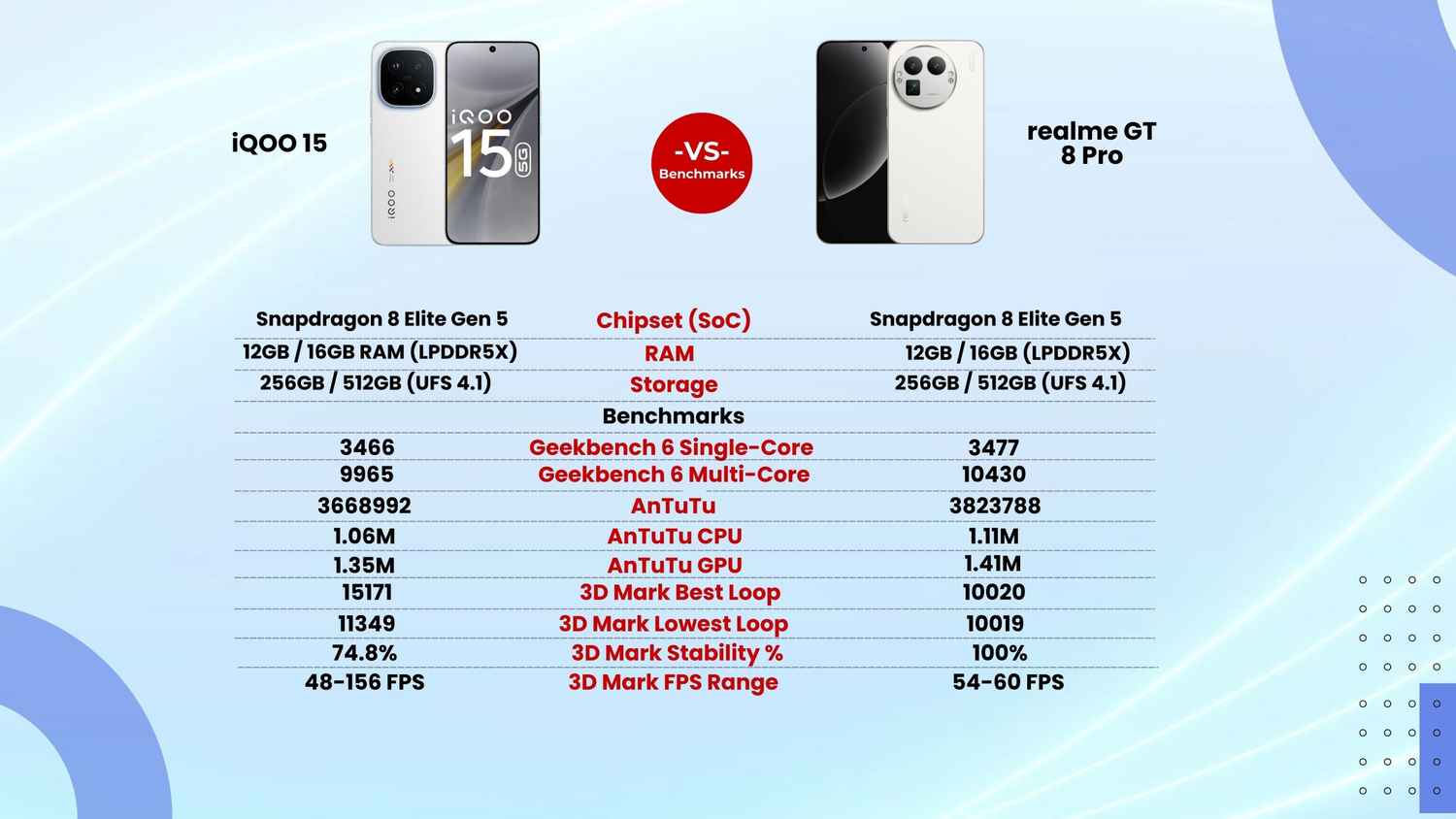
Synthetic benchmarks usually drain batteries fast, and this round showed clearer differences between the two phones. Geekbench results were nearly identical in single-core scores, but Realme pulled ahead in multi-core performance by around 4.7%. In Antutu, Realme again led by about 4%, thanks to stronger CPU and GPU scores.
But the biggest difference came from the 3DMark Stress Test. Here, the iQOO 15 delivered much higher peak performance, but that dropped over time, ending with around 75% stability. The Realme GT 8 Pro, in contrast, delivered perfect 100% stability, holding the same performance consistently.
The CPU Throttle Test further highlighted the difference. Realme maintained higher sustained performance and throttled far less compared to the iQOO 15.
By the end of the fourth hour, battery levels reflected this behaviour. The iQOO 15 dropped to 53%, while the Realme GT 8 Pro remained ahead at 60%.
Moving from synthetic load to real gameplay evened things out. Both phones ran BGMI, COD: Mobile and other common titles at high frame rates without lag. The iQOO 15 felt slightly snappier during quick movements, while the Realme GT 8 Pro prioritised stability over bursts of peak performance.
Thermals were consistent with the benchmarks. The iQOO 15 warmed up a little faster and peaked at around 39°C, whereas the Realme GT 8 Pro remained around 38°C and felt more controlled over longer sessions.
After five hours of total testing, the Realme GT 8 Pro held its lead with 48%, while the iQOO 15 dropped to 42%.
The final hour involved scrolling through Instagram, which is a lighter workload but still enough to show the battery differences after sustained use.
By the end of the full 6-hour test, the Realme GT 8 Pro finished at 42% battery, while the iQOO 15 wrapped up with 37%.
iQOO 15: 63% drain (approx. 4,410mAh)
Realme GT 8 Pro: 58% drain (approx. 4,060mAh)
The results show two distinct approaches to performance and efficiency. The iQOO 15 delivers higher peak power, a brighter display, and a slightly snappier feel in day-to-day use. It is the device to pick if you prefer bursty performance and don’t mind a little extra heat during heavy tasks.
The Realme GT 8 Pro, on the other hand, focuses on consistency. It runs cooler, maintains stable performance under long workloads and ultimately uses battery more efficiently. This is why it finished the test with a noticeable lead, despite having the same 7,000mAh battery.
In the end, both phones offer strong all-day battery life. The choice comes down to what you value more: the iQOO’s top-grade performance and brighter display or the Realme’s consistent endurance and stability. Either way, you’re getting a flagship that performs well under pressure, but the GT 8 Pro did have the edge in this battery test when it came to lasting longer.
Also read: Oppo Find X9 Pro Review: A Flagship That Finally Feels Complete