In a significant stride toward democratizing advanced AI translation, Google has unveiled TranslateGemma, a new suite of open translation models designed to break down language barriers with unprecedented efficiency. Released just yesterday, this new family of models is built on the architecture of Gemma 3 and promises to bring high-fidelity translation to everything from massive cloud servers to the smartphone in your pocket.
At the heart of the TranslateGemma release is a focus on “efficiency without compromise.” By distilling the knowledge of Google’s most advanced large models into compact, high-performance open architectures, the company has created a solution where developers no longer need massive computational resources to deploy research-grade translation tools. The release marks a pivot from simply making models larger to making them smarter and more dense, utilizing a specialized two-stage fine-tuning process that includes Supervised Fine-Tuning (SFT) and Reinforcement Learning (RL) to refine the “intuition” of the AI.
Also read: Yoshua Bengio’s new safe AI vision cuts AI’s biggest risks by rewarding truth
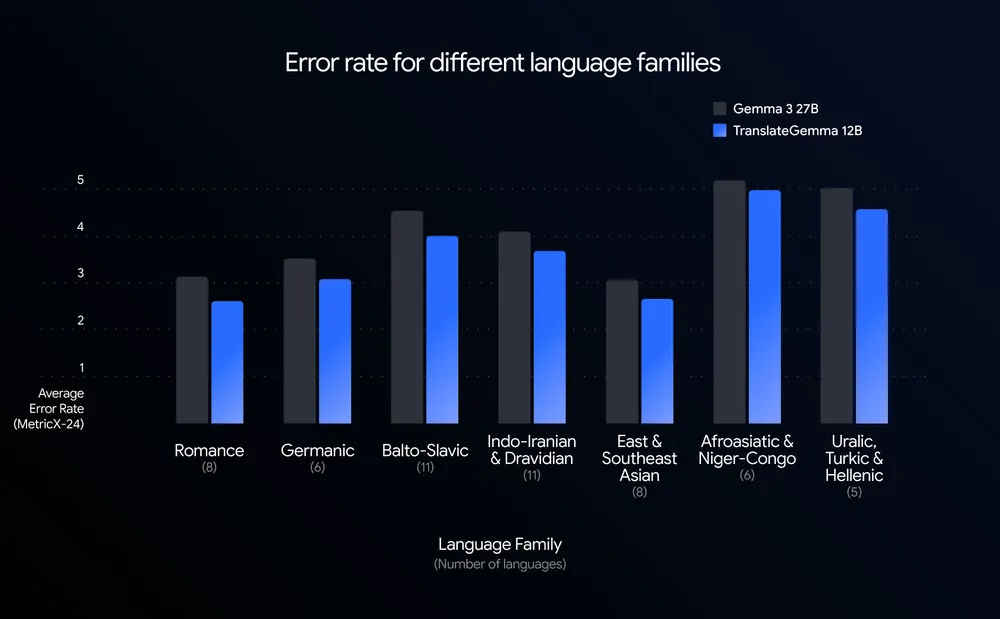
Google has launched the model in three distinct sizes: 4 billion (4B), 12 billion (12B), and 27 billion (27B) parameters. While the 27B model is designed for maximum fidelity in cloud environments, the smaller models represent the true technical marvels of this release. According to Google’s technical evaluation, the mid-sized 12B model actually outperforms the much larger Gemma 3 27B baseline. Similarly, the compact 4B model rivals the performance of the 12B baseline.
This efficiency breakthrough is critical for the future of on-device AI. The 4B model is optimized specifically for mobile and edge deployment, while the 12B model is capable of running smoothly on standard consumer laptops. This allows developers and researchers to run high-throughput, low-latency translation tasks locally, bypassing the privacy concerns and latency issues often associated with cloud-based API calls. The training process involved distilling synthetic translations generated by Google’s flagship Gemini models, followed by a reward-based learning phase using metrics like MetricX-QE to ensure translations sound natural rather than robotic.
Also read: Elon Musk denies Grok AI created illegal images, blames adversarial hacks
TranslateGemma has been rigorously trained and evaluated on 55 core language pairs, ensuring reliable performance across major global languages like Spanish, Chinese, and Hindi, as well as numerous low-resource languages that are often underserved by digital tools. However, the scope of the project extends far beyond these primary languages. The team pushed the boundaries by training on nearly 500 additional language pairs, providing a robust foundation for researchers to further fine-tune the models for niche dialects and specific community needs.
Beyond pure text, TranslateGemma retains the strong multimodal capabilities of its parent architecture, Gemma 3. Early tests indicate that the model improves the translation of text within images – a critical feature for real-world applications like travel assistants and document scanning – even without specific multimodal fine-tuning. With availability on platforms like Kaggle, Hugging Face, and Vertex AI, TranslateGemma is poised to become the new standard for open-source linguistic accessibility, giving developers the tools to foster greater understanding across cultures without requiring industrial-grade hardware.
Also read: MedGemma 1.5 & MedASR explained: High-dimensional imaging and medical speech-to-text