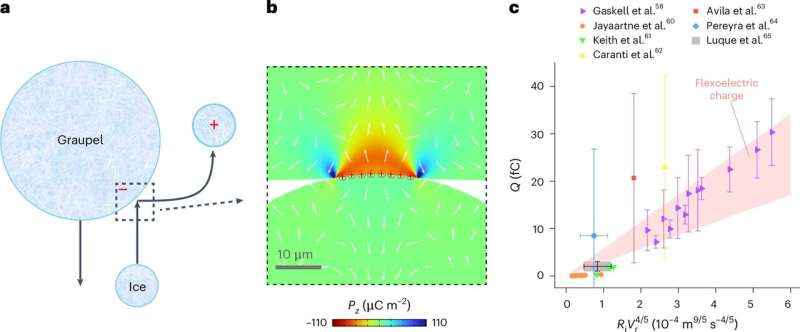
For centuries, ice has been a symbol of static, unyielding cold. Yet, a groundbreaking discovery is turning our understanding of this common substance on its head. Scientists have found that ice is a flexoelectric material, possessing the remarkable ability to generate a small but measurable electric charge when it is bent or unevenly deformed. This finding, published in the journal Nature Physics, is more than just a scientific curiosity; it’s a revelation that could solve one of meteorology’s oldest mysteries and pave the way for a new generation of green technology.
Also read: From balloons to satellites: Why Esrange is the world’s most flexible space center
The idea that mechanical stress could create electricity is not new. Many materials, from quartz to certain ceramics, are known to be piezoelectric. This means they generate an electric charge when uniformly compressed. But ice is not one of them, which has long puzzled atmospheric scientists. For decades, we have understood that lightning, the universe’s most dramatic electrical display, is caused by a massive buildup of electrical charge within turbulent storm clouds. This charge is believed to come from the countless collisions between tiny ice particles. If ice isn’t piezoelectric, what was causing this charge separation?
Also read: GenAI effect: US college students are questioning value of higher education due to AI
The new research provides a compelling answer: it’s not the compression, but the bending that matters. The study, conducted by an international team of researchers, including those from the Catalan Institute of Nanoscience and Nanotechnology (ICN2), discovered that ice exhibits flexoelectricity. This phenomenon occurs when a non-uniform deformation, like bending or twisting, causes a redistribution of electrical charges. Think of a tiny ice crystal in a storm cloud being twisted and contorted as it collides with another. This uneven stress is enough to separate the positive and negative charges, creating an electric dipole. When billions of these tiny crystals do the same thing, the cumulative effect is a colossal electric potential, ripe for a lightning strike.
This discovery has profound implications that reach far beyond atmospheric science. The fact that ice behaves like an advanced electroceramic material opens up a new world of technological possibilities.
Imagine a future where sensors in the Arctic and Antarctic are powered by the constant motion of the ice they’re embedded in, harvesting energy from the very environment they monitor. Such devices could provide crucial data on climate change without the need for traditional power sources, batteries, or cumbersome solar panels in regions with minimal daylight.
Furthermore, this breakthrough could lead to the development of novel flexible electronics. Today’s flexible screens and sensors are often made from expensive, rigid materials that are bent into shape. The discovery that ice can be used to generate electricity through bending could inspire new materials and designs. Engineers might one day create self-powered, foldable electronic devices that generate a charge simply by being used. This could revolutionize wearable technology, medical implants, and even futuristic robotics designed for extraterrestrial exploration. On an icy moon like Jupiter’s Europa, for instance, a robot could potentially power itself by simply moving across the frozen surface.
While the discovery is exhilarating, it is just the beginning. The next frontier for scientists is to understand the full extent of this effect and learn how to harness it efficiently. Researchers will need to determine the optimal conditions for generating charge and explore methods for scaling up the process. The current effect is small, but with dedicated research, it could be amplified for practical use. The ultimate goal would be to develop energy-harvesting technologies that are not only sustainable but also built from one of the most abundant resources on our planet: water.
This research reminds us that sometimes, the greatest scientific breakthroughs are not found in the most complex compounds or exotic materials, but in the simple things we see every day. The next time you see an ice cube, consider its hidden potential – a frozen world of possibility waiting to be bent into a new era of power.
Also read: Inside Google’s Nano Banana: Gemini’s new AI image editor