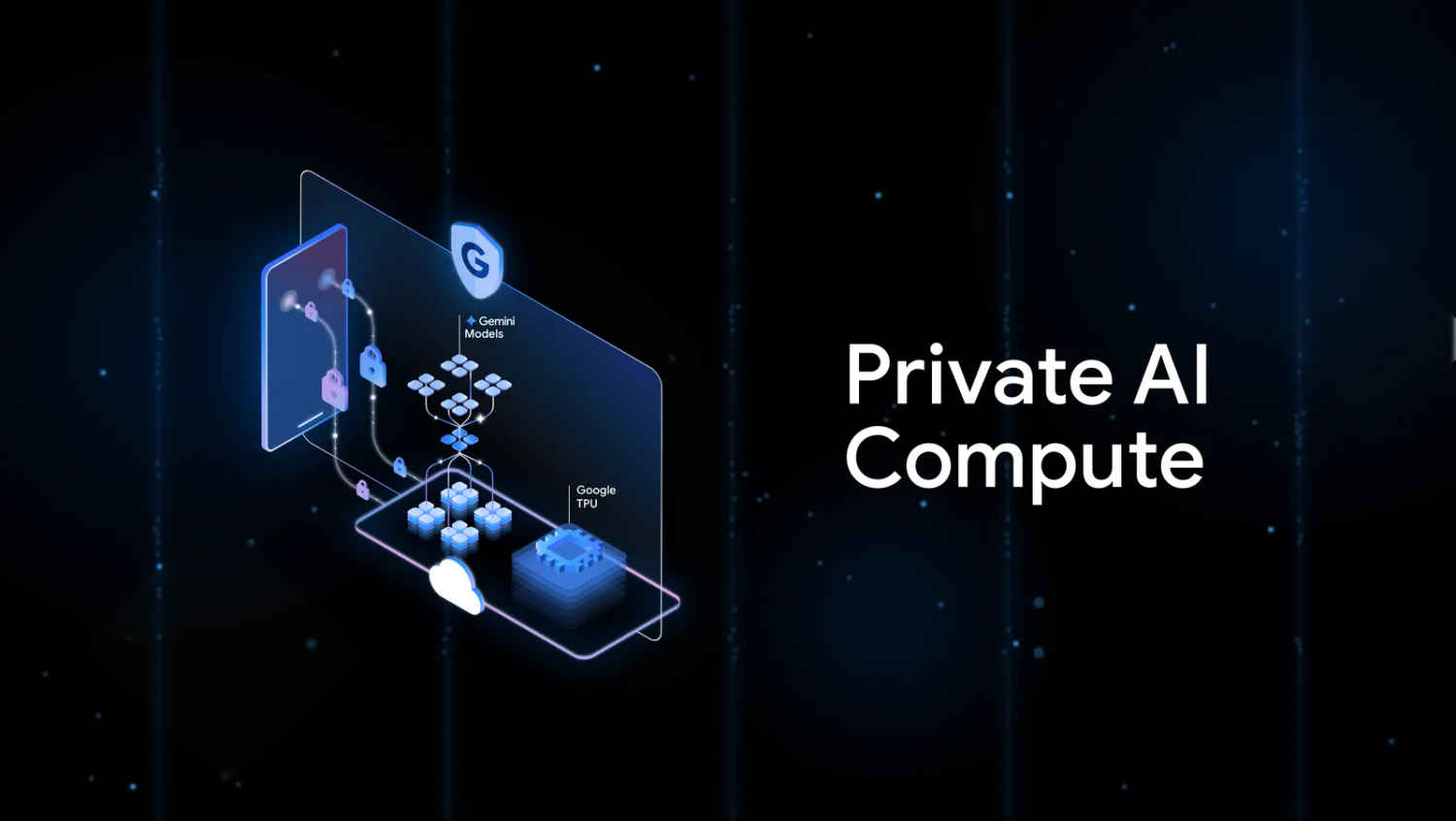
For years, artificial intelligence has wrestled with a paradox: the most capable models need vast cloud power, but users want the privacy of local computing. Google’s new initiative, Private AI Compute, aims to dissolve that trade-off by reengineering how computation itself happens.
This isn’t a new product or setting; it’s an architectural rethink. The idea is simple but radical: run powerful AI models in the cloud, but make it mathematically and technically impossible for Google or anyone else to see what’s inside.
Also read: AI chips: How Google, Amazon, Microsoft, Meta and OpenAI are challenging NVIDIA
At the heart of this system are secure enclaves, isolated hardware environments built into Google’s custom Tensor Processing Units (TPUs). Whenever your device sends data for an AI task, say, summarising a conversation or generating a response, it doesn’t go to a general cloud server. It enters a Titanium Intelligence Enclave (TIE), a sealed section of the chip that’s cryptographically locked.
Only your device holds the keys to encrypt or decrypt the data. Even Google’s engineers can’t access the content inside. The AI model runs within that bubble, produces the result, and the data is deleted immediately after processing.
This means that the power of large Gemini models can be used without the exposure risks of traditional cloud processing – a crucial step toward scalable, private AI.
To prove this privacy isn’t just theoretical, Google uses remote attestation. Each request sent to Private AI Compute must pass a cryptographic check that verifies the enclave is genuine, secure, and unmodified. If anything about the environment is tampered with, the computation won’t start.
In other words, users don’t have to trust Google’s word, the system proves its own integrity. It’s privacy that’s verifiable by design, not promised by policy.
Private AI Compute also redefines how devices and the cloud share responsibility. Your phone remains the controller – holding your identity, keys, and permissions – while the enclave performs the heavy lifting.
This ensures that personal identifiers never leave the device. What travels to the cloud is the task, not the user. For example, when a Pixel phone uses features like Magic Cue or the Recorder summariser, the Gemini model might process voice data remotely, but the link between your voice and your Google account stays local and protected.
Google’s design embeds protection across multiple levels:
Also read: AMD vs NVIDIA GPUs: AI, efficiency, and gaming, who wins?
This layered architecture means privacy isn’t an add-on, it’s built into every stage of computation.
Traditional privacy-preserving computation often slows AI to a crawl. Google’s innovation lies in maintaining performance: the AI doesn’t need to process encrypted data, it processes inside an already private zone.
That allows the same speed and reasoning depth of large Gemini models while meeting high privacy standards. It’s the cloud, reimagined as a private vault.
Private AI Compute is Google’s attempt to reconcile the growing need for powerful AI with society’s demand for privacy. By combining cryptographic verification, secure enclaves, and layered security, it creates a path where intelligence and confidentiality can coexist.
If successful, it could redefine how AI systems are trusted, not just by promising privacy, but by proving it in code and silicon. And that, more than any new app or feature, might be Google’s most transformative innovation yet.
Also read: Anthropic will beat OpenAI where it matters most: Here’s how