In a country where conversations shift from Hindi to Tamil to Marathi before you’ve even crossed a state border, language isn’t just a tool – it’s identity, emotion, and culture wrapped together. Yet for most AI systems today, this diversity is noise, not nuance. They understand English beautifully, but stumble when faced with the rhythm of Indian languages or the layered logic of local expressions.
That’s where OpenAI’s new project, IndQA, steps in. Designed as a benchmark for multilingual intelligence, IndQA isn’t just testing whether AI can translate a sentence correctly, it’s asking whether it can think across languages, understand context rooted in culture, and reason the way a human would in India’s multilingual reality.
Also read: Kosmos explained: The AI scientist that can read 1,500 papers
IndQA – short for Indian Question Answering Benchmark – represents a crucial leap in evaluating AI reasoning beyond the Anglocentric framework. Built across 12 Indian languages, the benchmark tests an AI model’s ability to handle complex, culturally rooted questions that demand contextual and factual understanding.
Unlike traditional benchmarks that rely on simple translation-based tasks, IndQA focuses on multilingual reasoning, factual consistency, and cultural adaptability. It’s not just about whether a model knows the Hindi word for “computer,” but whether it can correctly interpret a question about local governance, festivals, or regional idioms across linguistic boundaries.
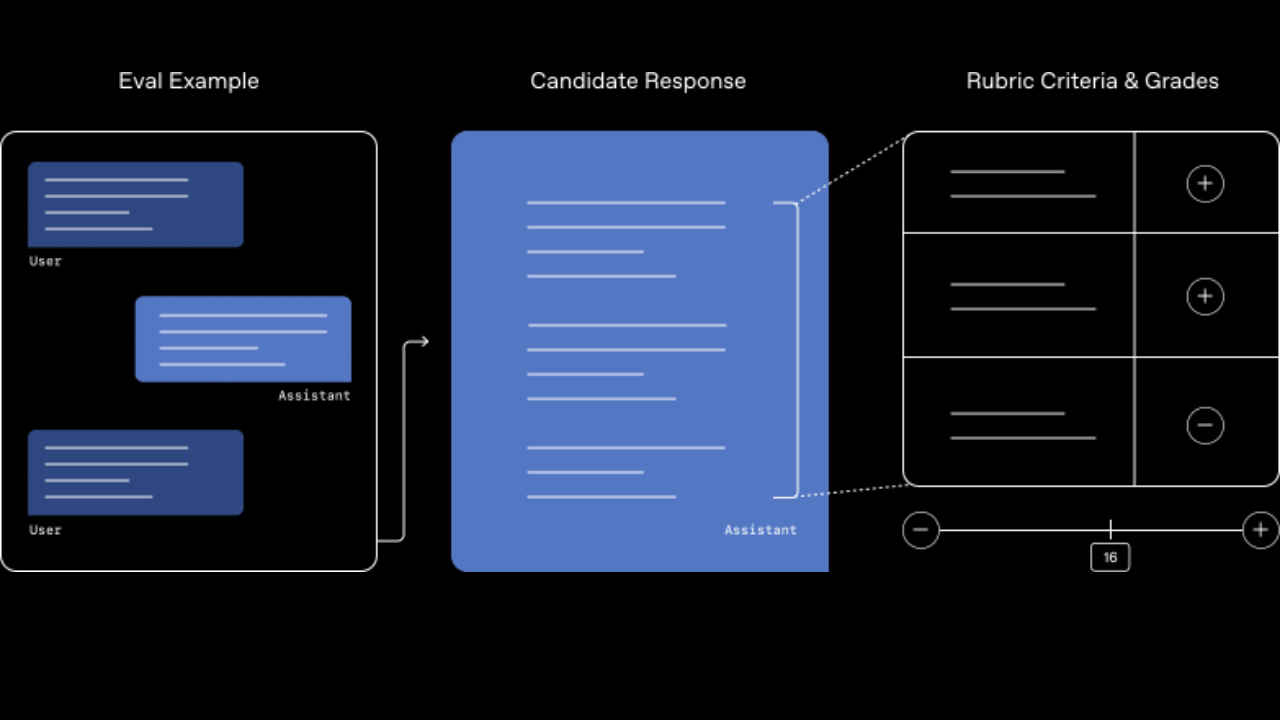
IndQA is structured as a scientific evaluation dataset, created through a meticulous process involving native speakers, linguists, and AI researchers. Each question is carefully designed to test comprehension, reasoning, and contextual grounding, rather than surface-level recall.
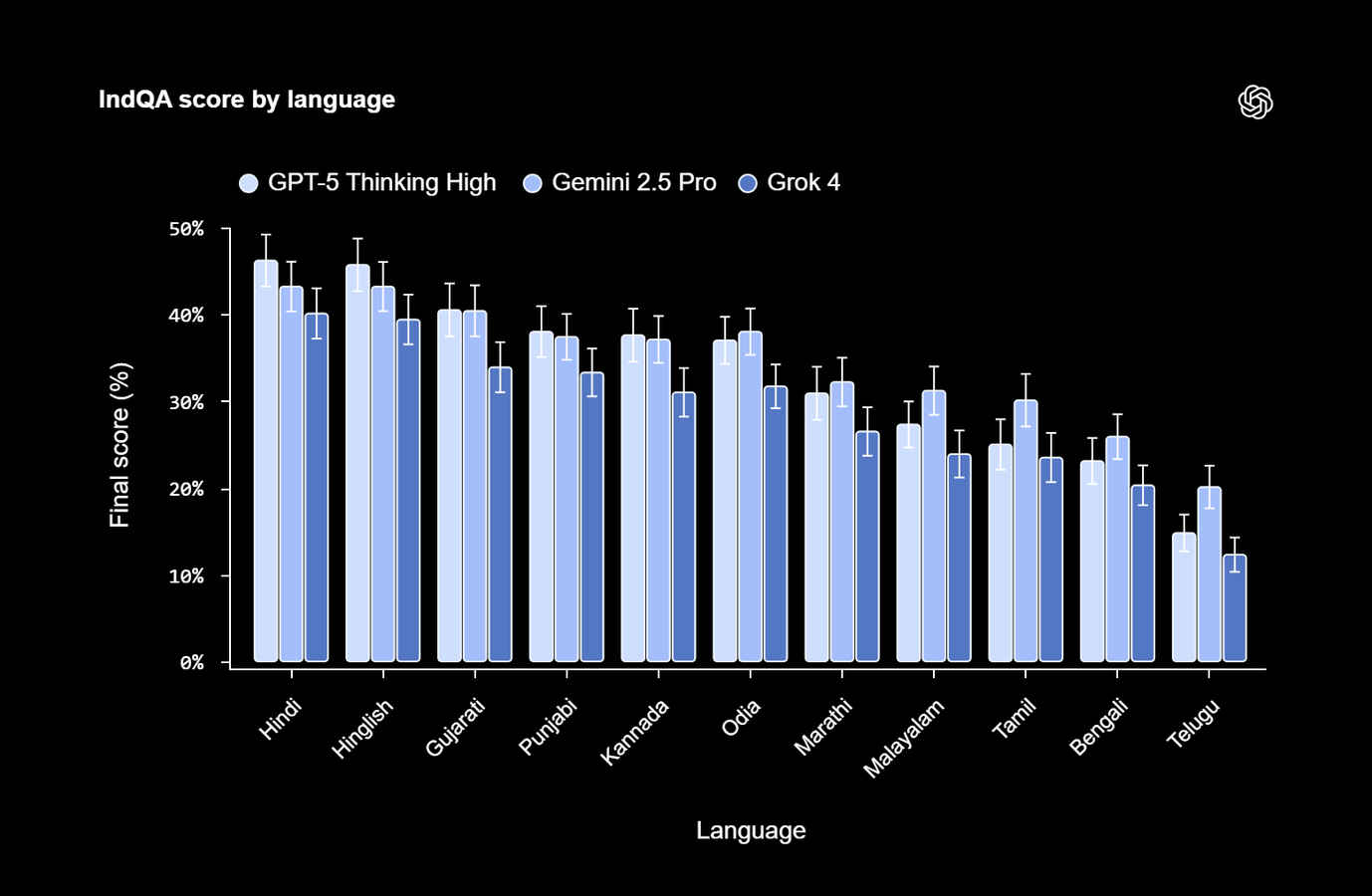
The benchmark is divided into ten cultural and knowledge domains – including politics, geography, science, social behavior, and everyday life – to ensure a holistic evaluation of an AI’s cognitive breadth in the Indian context. The dataset also spans multiple scripts and language families, covering Indo-Aryan and Dravidian languages such as Hindi, Bengali, Tamil, Telugu, Kannada, Malayalam, Marathi, Gujarati, and Odia, among others.
This diversity allows IndQA to test a model’s adaptability not only to linguistic shifts but also to the sociocultural logic embedded within regional languages, a dimension where even top-performing LLMs often falter.
The creation of IndQA is not just an Indian milestone; it’s a paradigm shift in how AI benchmarks are conceived globally. Most large-scale evaluations, such as MMLU or GSM8K, center around English-language data, making it difficult to measure model intelligence across real-world linguistic diversity.
By expanding the evaluation framework to include multilingual reasoning, OpenAI is effectively laying the foundation for “universal intelligence testing” – one that better reflects how humans actually communicate and think.
Also read: CALM: The model that thinks in ideas, not tokens
The project’s significance also extends to responsible AI development. As more AI systems are deployed in multilingual societies, IndQA offers a measurable way to test fairness, reduce bias, and enhance cultural alignment. It brings the scientific rigor needed to ensure that AI models are not just fluent, but also factually and culturally competent across languages.
OpenAI’s introduction of IndQA underscores a growing realization in the AI community: intelligence cannot be truly global until it is linguistically inclusive. While IndQA currently focuses on Indian languages, its underlying framework could inspire similar benchmarks in other multilingual regions, from Africa to Southeast Asia.
By combining linguistic diversity with scientific precision, IndQA is more than a dataset, it’s a blueprint for the next generation of AI evaluation. In doing so, OpenAI isn’t just teaching machines to understand more languages; it’s helping them understand more people.
Also read: Project Suncatcher: Google’s crazy plan to host an AI datacenter in space explained