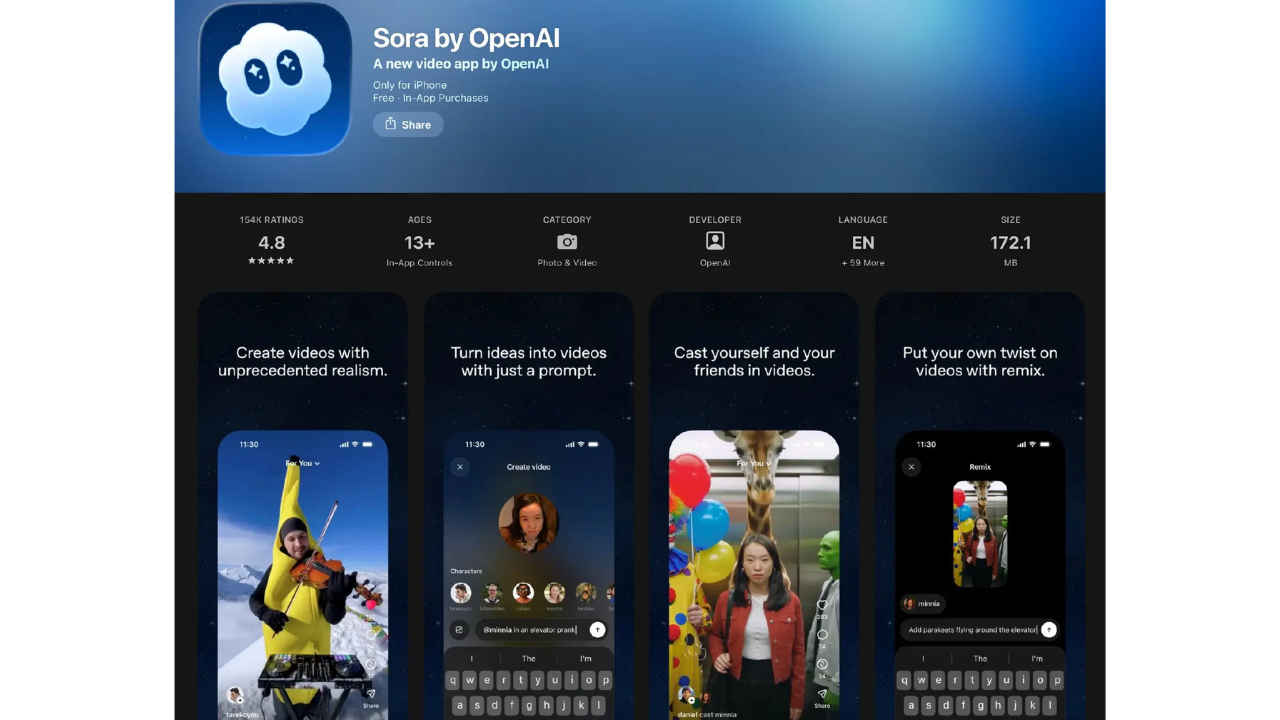
I don’t really remember the last time I used Sora but I liked the tool. It was a fun post-gaming activity for me and my friends to generate stupid clips of one another using Sora. We may have only done it twice or thrice but each time there would be some clip that Sora would generate that would make us say, “this completely changes content creation.”
Also read: OpenAI is killing Sora AI video generation app, leaves internet divided
Looking back, that did not happen at all. Content creation is still largely the same but Sora is doing its final laps before it bids farewell. I was looking at the pros and cons of Sora as a consumer when OpenAI had first rolled out the app but I never stopped to think about the cost of it all. Put simply, video generation is on the expensive side of AI usage and notoriously compute heavy. The Sora app, in its runtime of 6 months, generated about $2.1 million in in-app purchases. At the scale of OpenAI’s operations, that’s not revenue, it’s a rounding error.
But Sora wasn’t losing just money, it was losing market share as well. Sora lost momentum almost as quickly as it gained it. OpenAI seemed to be curating access. They carefully gatekept Sora and demo’d to only select creators initially. By the time they made it easily accessible to the public, competitors had raced ahead. Kling, Runway, Luma and of course Elon Musk’s Grok Image were everywhere on social media. They were nowhere near perfect but unlike Sora, they were out there for people to experiment with. Sora had its moment when it topped the App Store charts. That didn’t last long either because December 2025 saw a 32% drop in downloads according to Appfigures.
Also read: Is Dolby Cinema the upgrade Indian moviegoers actually need?
Then there was also Sam Altman declaring “code red” in December. So OpenAI stopped working on everything and focused all its resources on ChatGPT to try to find an answer to Google’s Gemini 3 and Anthropic’s Claude. This also meant that they were shifting towards enterprises, developers, analysts, businesses that actually pay. Sora didn’t fit this new agenda and was a casualty of the entire ordeal.
Burning money, falling behind competitors, and a full-blown “code red” on top of it all, more than enough had already gone wrong. But there is more. Sora had a Disney Partnership that was announced in December and that has also collapsed before it had any time to gain momentum. Then there were the copyright and deepfake concerns. The more realistic Sora became, the more uncomfortable the questions got around consent and likeness.
Looking back at Sora’s short run, I can’t say it was the tech that failed. If anything, that was the only thing that was working. OpenAI’s business model didn’t support Sora’s ambitions and by the time they made their way to the pitch, the rules of the game had already been changed.
Also read: AI is making you worse at thinking: Wharton study rings serious alarm bells