For decades, scientists have dreamed of creating a miniature version of the sun on Earth – a machine capable of producing limitless, clean energy through atomic fusion rather than fission. That dream, once confined to science fiction, is edging closer to reality – and the surprising player accelerating it is NVIDIA, best known for powering gaming graphics and artificial intelligence.
In collaboration with General Atomics and the U.S. Department of Energy, NVIDIA has developed an AI-driven digital twin of a fusion reactor. This simulation system allows scientists to model and optimize fusion experiments in seconds instead of weeks, bringing the world one step nearer to harnessing the same process that powers stars.
Also read: Wipro-IISc build India’s first AI self-driving car for Indian roads: How good is it?
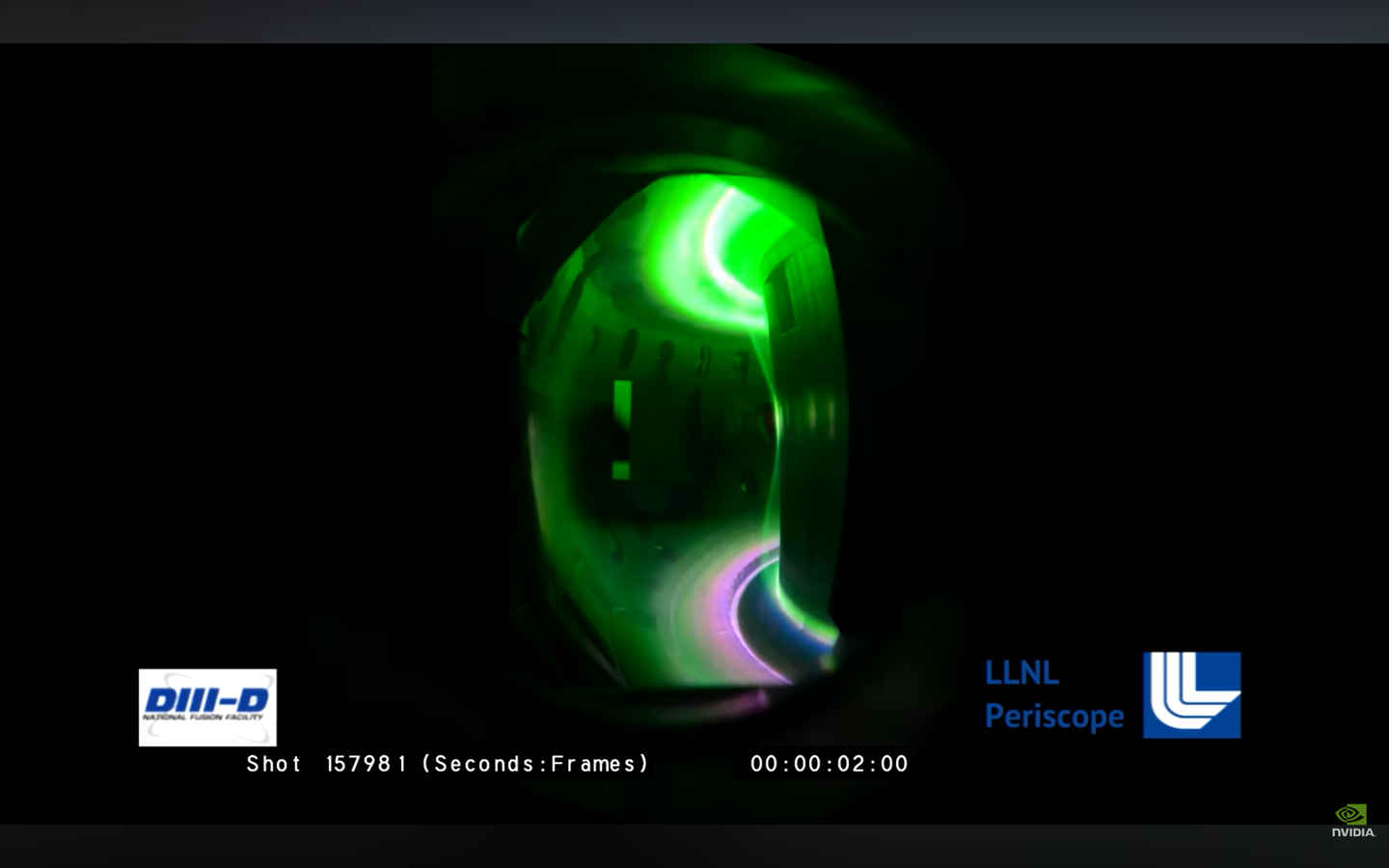
At the heart of the project is DIII-D, the largest magnetic fusion research facility in the United States, operated by General Atomics in San Diego. The DIII-D tokamak uses powerful magnetic fields to confine plasma, a superheated state of matter reaching temperatures more than 10 times hotter than the sun’s core.
Fusion depends on controlling this plasma long enough for atomic nuclei to fuse and release energy. But plasma is turbulent and unpredictable; even small instabilities can halt an experiment. Traditionally, modeling these reactions demanded supercomputers running for days. NVIDIA’s digital twin changes that.
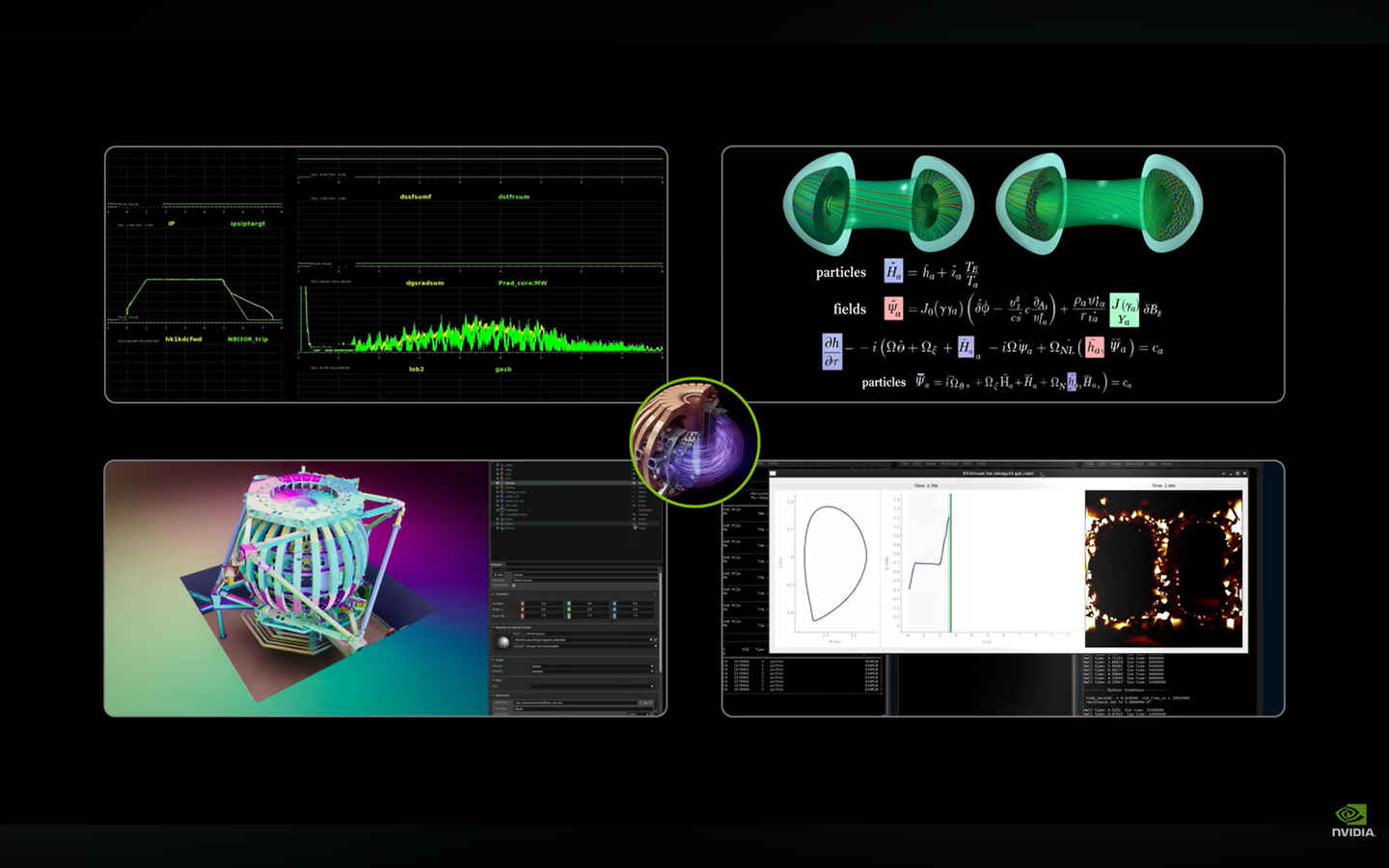
The new system uses AI surrogate models, trained on decades of plasma data, to simulate real-time conditions inside the tokamak. These include models known as EFIT, CAKE, and IONOR ORB, which help calculate plasma equilibrium, boundary shapes, and heat transport. Running on NVIDIA’s data center GPUs and the Omniverse simulation platform, the digital twin enables researchers to visualize and predict plasma behavior in real time, before they conduct physical experiments.
According to NVIDIA’s official blog, this approach allows more than 700 scientists across 100 institutions to collaborate virtually, synchronizing data from sensors at DIII-D with the digital twin to test and refine reactor conditions.
The key innovation lies in speed. NVIDIA’s surrogate models reduce the time for fusion simulations from weeks to seconds, letting researchers run thousands of test scenarios virtually. Each simulation provides insights into how magnetic fields, plasma density, or heating patterns affect stability, insights that can then be applied to real-world experiments with far less risk.
The project also taps into supercomputers at the Argonne Leadership Computing Facility and the National Energy Research Scientific Computing Center (NERSC) to handle the immense data streaming from DIII-D’s sensors. The NVIDIA blog notes that integrating this data into a digital twin “represents a shift from physics-centric to AI-driven research,” merging machine learning with traditional plasma science.
Fusion energy has long been described as the “holy grail” of clean power. Unlike nuclear fission, which splits atoms and produces long-lived radioactive waste, fusion merges light elements like hydrogen to release enormous energy without carbon emissions.
Also read: From Star Wars to Science: Astronomers discover Earth-sized planets with double sunsets
The potential is transformative. Just a few grams of fusion fuel – isotopes of hydrogen such as deuterium and tritium – could produce as much energy as several tons of fossil fuel, with minimal environmental impact.
Yet the challenges remain formidable: maintaining stable plasma long enough to achieve “net energy gain,” where more energy is produced than consumed, has never been achieved consistently. NVIDIA’s system doesn’t solve that overnight, but it dramatically accelerates progress by allowing researchers to experiment virtually, iterate faster, and understand plasma dynamics more deeply.
NVIDIA’s role in the project is a striking example of how technologies developed for gaming and AI are now driving clean-energy research. The same GPUs used to train chatbots and render 3D worlds are now running complex physics simulations of plasma interactions at unprecedented speeds.
By combining AI, simulation, and high-performance computing, NVIDIA and General Atomics are effectively turning fusion research into a data problem, one solvable through computational precision rather than brute-force experimentation.
As NVIDIA’s blog explains, “The digital twin is helping scientists test thousands of potential scenarios safely and efficiently, accelerating the path toward practical fusion energy.”
Despite the breakthroughs, fusion remains a long-term pursuit. Scaling from controlled experiments to commercial reactors will require advances in materials, reactor design, and cost management. But AI-driven simulation provides a powerful new toolset, potentially shortening decades of trial and error into years.
With climate goals tightening worldwide, the fusion race is heating up, from ITER in France to private startups across the globe. NVIDIA’s digital twin project adds a new dimension to that race, one where the power of the sun might finally be replicated not through brute energy, but through intelligent computation.
If successful, the world’s future energy source might not just be a mini-sun, but a fusion of physics and code – blazing a path toward virtually limitless clean power.
Also read: Meet NEO: Humanoid robot designed as your home assistant for ₹18 lakh