For years, the conversation around AI PCs has been dominated by familiar names – Intel, AMD, Apple – each staking claims about neural processing power and next-generation computing. But with the Snapdragon X2 Elite Extreme, Qualcomm has stepped into the centre of the arena with numbers that are hard to ignore.
Across every benchmark that matters for on-device AI – UL Procyon, Geekbench AI, TOPS figures, and even platform-level power efficiency – Qualcomm isn’t just competitive anymore. It’s out in front by margins that reshape expectations for Windows laptops.
What becomes clear when you study Qualcomm’s latest data isn’t just that the X2 Elite Extreme is fast. It’s that the definition of AI performance is shifting toward NPUs designed for sustained, efficient machine learning workloads, not brute-force GPU horsepower. From real-time computer vision to generative AI inference, the story told across these slides is consistent. That Snapdragon’s newest NPU isn’t merely keeping pace – it’s setting the pace, and rival architectures will need to rethink their approach if they plan to catch up.
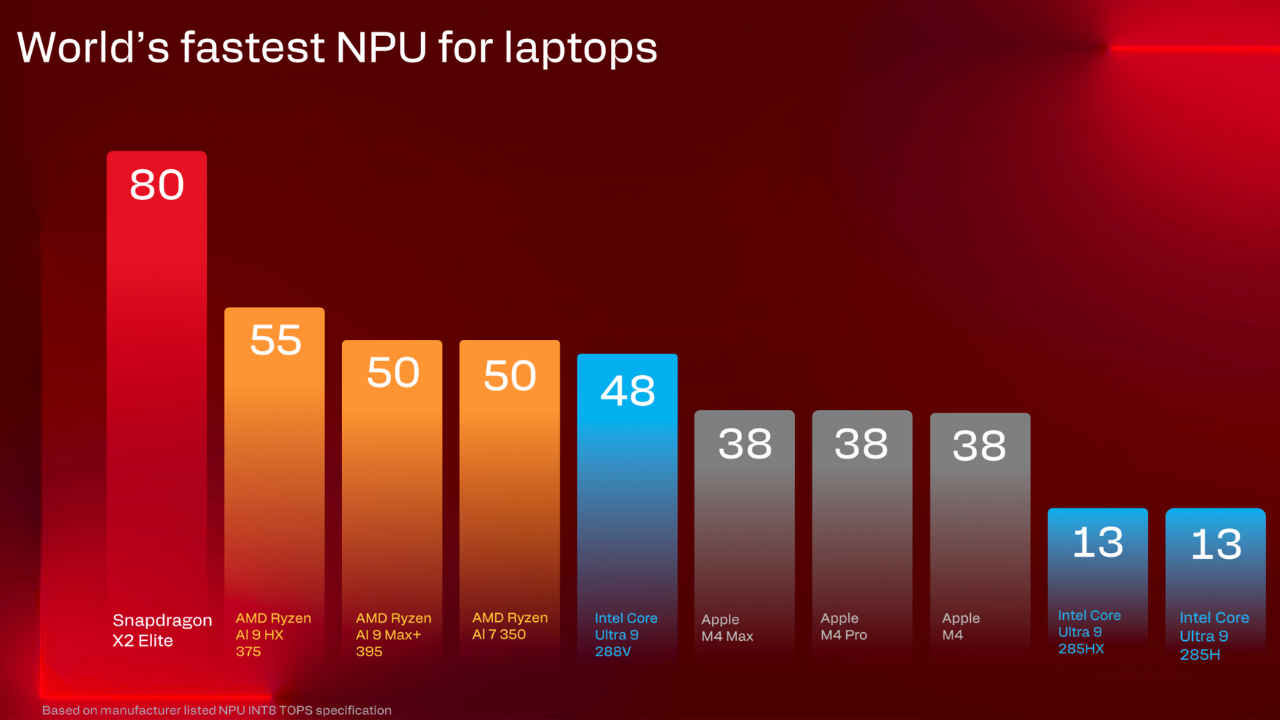
This slide illustrates how Qualcomm positions the Snapdragon X2 Elite as the top-performing laptop NPU based solely on raw TOPS capability. A tall red bar highlights its 80 TOPS, clearly exceeding the outputs of competing processors. AMD’s Ryzen AI 9 HX 375 appears next with 55 TOPS, followed by the Ryzen AI 9 Max+ 395 and AI 7 350 at 50 TOPS each. Intel’s Core Ultra 9 288V trails with 48 TOPS, while Apple’s M4 and M4 Max register 38 TOPS.
Also read: Snapdragon X2 Elite chip: Qualcomm is serious about AI PC domination!
At the lower end, Intel’s Core Ultra 9 285H and Ultra 9 285HX deliver 13 TOPS. The headline asserts Qualcomm’s leadership, though no system configuration details accompany this chart.
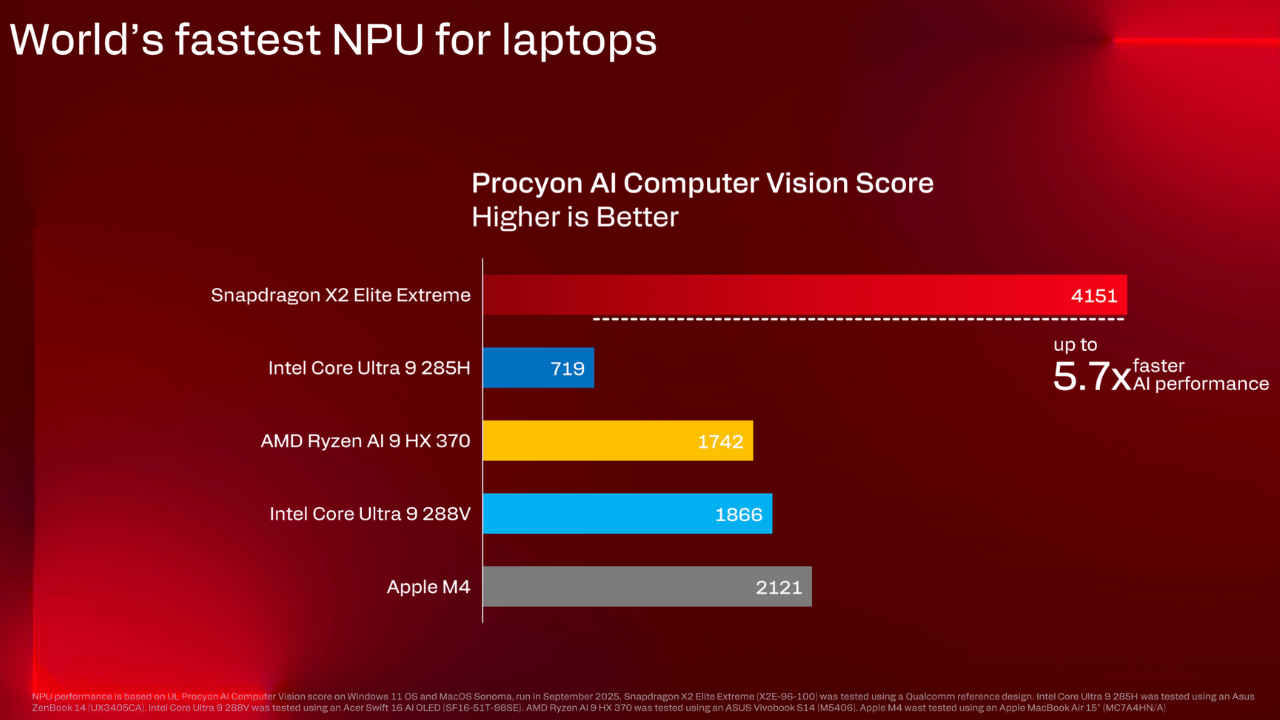
This slide shifts from theoretical performance to practical benchmarking using UL Procyon AI Computer Vision, comparing NPU-driven results across modern laptop chips. The Snapdragon X2 Elite Extreme leads decisively with a score of 4151, followed by Apple’s M4 at 2121, and Intel’s Core Ultra 9 288V at 1866. AMD’s Ryzen AI 9 HX 370 posts 1742, while Intel’s Core Ultra 9 285H comes in significantly lower at 719.
Also read: Inside Snapdragon X2 Elite’s Oryon: The CPU challenging Intel, AMD and Apple
Qualcomm highlights an “up to 5.7x faster” performance advantage relative to Intel’s 285H. This slide underscores the difference between TOPS claims and measured AI workload performance, reinforcing Qualcomm’s advantage in real testing environments.
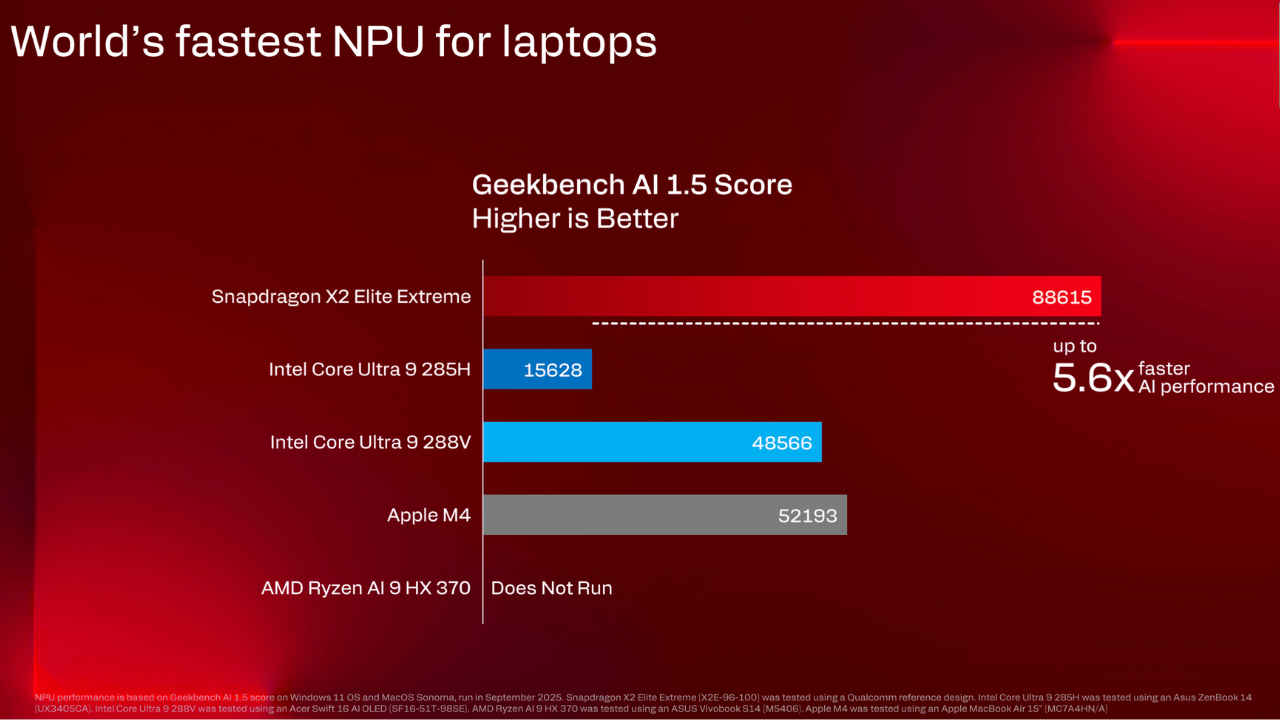
This slide presents results from Geekbench AI 1.5, reflecting broad AI inference workloads across platforms. The Snapdragon X2 Elite Extreme tops the chart with 88,615, well ahead of the Apple M4 at 52,193 and Intel’s Core Ultra 9 288V at 48,566. Intel’s Core Ultra 9 285H shows a significantly lower 15,628, while the AMD Ryzen AI 9 HX 370 is marked as not able to run this benchmark.
Qualcomm emphasizes an “up to 5.6x faster” advantage relative to Intel’s 285H. Detailed test system information is provided for all platforms, ensuring benchmarking transparency and comparability.
Also read: Snapdragon X2 Elite benchmarks: Windows 11 gaming on Adreno X2 GPU
Qualcomm provided detailed information regarding test systems for the Procyon AI Computer Vision and Geekbench AI 1.5 benchmarks. Qualcomm stated that NPU performance is based on UL Procyon Al Computer Vision score on Windows 11 OS and MacOS Sonoma, run in September 2025. Snapdragon X2 Elite Extreme (X2E-96-100) was tested using a Qualcomm reference design. Intel Core Ultra 9 285H was tested using an Asus ZenBook 14 (UX3405CA]. Intel Core Ultra 9 288V was tested using an Acer Swift 16 AI OLED (SF16-51T-98SE). AMD Ryzen Al 9 HX 370 was tested using an ASUS Vivobook S14 (M5406). Apple M4 was tested using an Apple MacBook Air 15″ (MC7A4HN/A)
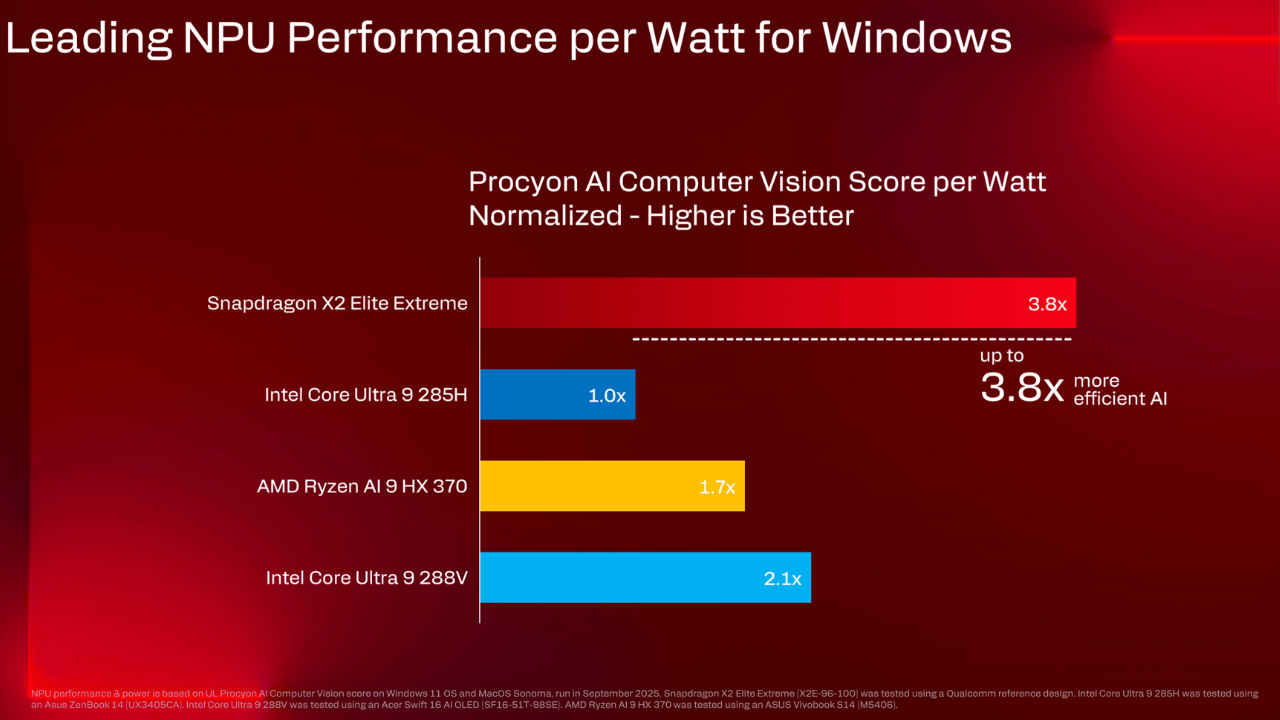
This slide focuses on AI performance efficiency, charting UL Procyon AI Computer Vision score per watt to highlight real-world performance-per-power differences. The Snapdragon X2 Elite Extreme leads with a 3.8x normalized efficiency value, followed by Intel’s Core Ultra 9 288V at 2.1x and AMD’s Ryzen AI 9 HX 370 at 1.7×. Intel’s Core Ultra 9 285H serves as the baseline at 1.0x.
Qualcomm stresses that the X2 Elite Extreme delivers “up to 3.8x more efficient AI,” reinforcing its power-efficient design for sustained on-device workloads. This slide complements raw performance graphs by emphasizing platform-level energy advantages.
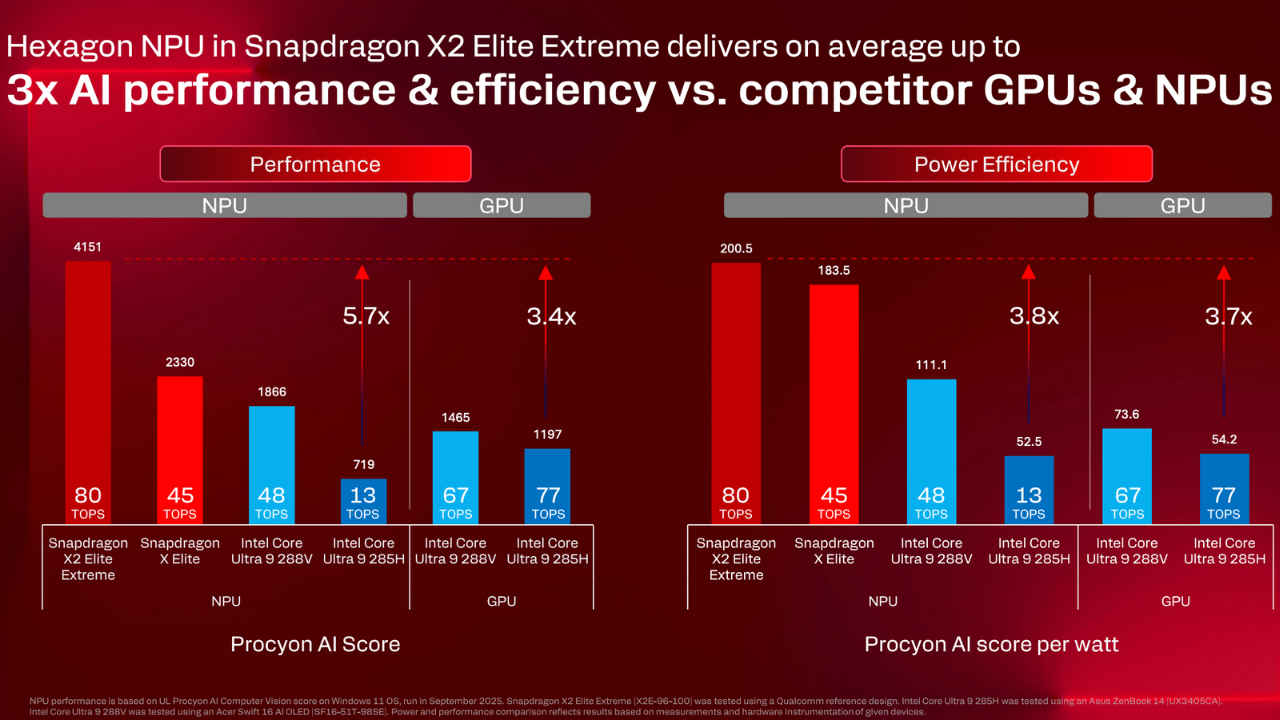
Qualcomm’s latest data positions the Snapdragon X2 Elite Extreme as a clear leader in on-device AI, outpacing both competing NPUs and integrated GPUs by wide margins. In UL Procyon AI Computer Vision tests, the Hexagon NPU posts an industry-high score of 4151, delivering up to 5.7x the performance of Intel’s Core Ultra 9 285H NPU. Even against Intel’s more capable 288V NPU, Qualcomm maintains a decisive lead. The slide also compares GPU-accelerated AI, where Intel’s integrated graphics still fall behind–underscoring that Qualcomm’s NPU isn’t just faster than rival NPUs, but faster than the GPU fallback path many Windows laptops rely on.
The efficiency numbers sharpen the contrast further. With a Procyon score-per-watt of 200.5, the Snapdragon X2 Elite Extreme delivers up to 3.8x better power efficiency than Intel’s NPUs and 3.7x better than Intel’s integrated GPUs. Qualcomm’s architecture appears tuned not only for maximum throughput but also for sustained performance within tight laptop power envelopes. The overall takeaway is simple: for Windows AI workloads, Qualcomm’s NPU currently offers the strongest blend of speed and efficiency, setting a high bar for on-device generative AI and agentic computing.
The slide compares major AI laptop processors using a chart that plots performance score against Idle-Normalized Platform Power (INPP) – a metric which is more accurate, according to Qualcomm, that measures how much total platform power a laptop consumes above its idle baseline to deliver performance. Lower INPP means the system needs less power to scale up from idle to heavy workloads, making it a strong indicator of real-world efficiency.
In this comparison, the Snapdragon X2 Elite Extreme sits at the very top of the performance axis while staying well toward the left on the INPP axis, showing the best combination of high output and low power demand. The standard X2 Elite also performs strongly, with excellent efficiency that still outclasses its x86 rivals.
Of course, remember all of this is based on Qualcomm’s own internal testing of Snapdragon X2 Elite chips versus competition. We know how Snapdragon X Elite challenged the x86 duopoly of Intel and AMD in the laptops segment just over a year ago, where Snapdragon-powered laptops have garnered significant accolades — including being featured in the 2025 edition of Oprah’s Favourite Things — in a short amount of time. We can’t wait to test final launch products based on X2 Elite early in 2026 and verify these claims ourselves with detailed testing and benchmark within our own Digit Test Centre. Until then stay tuned.
Also read: CD to floppy disk: Super slim AI PC concepts on Snapdragon X2 Elite chip