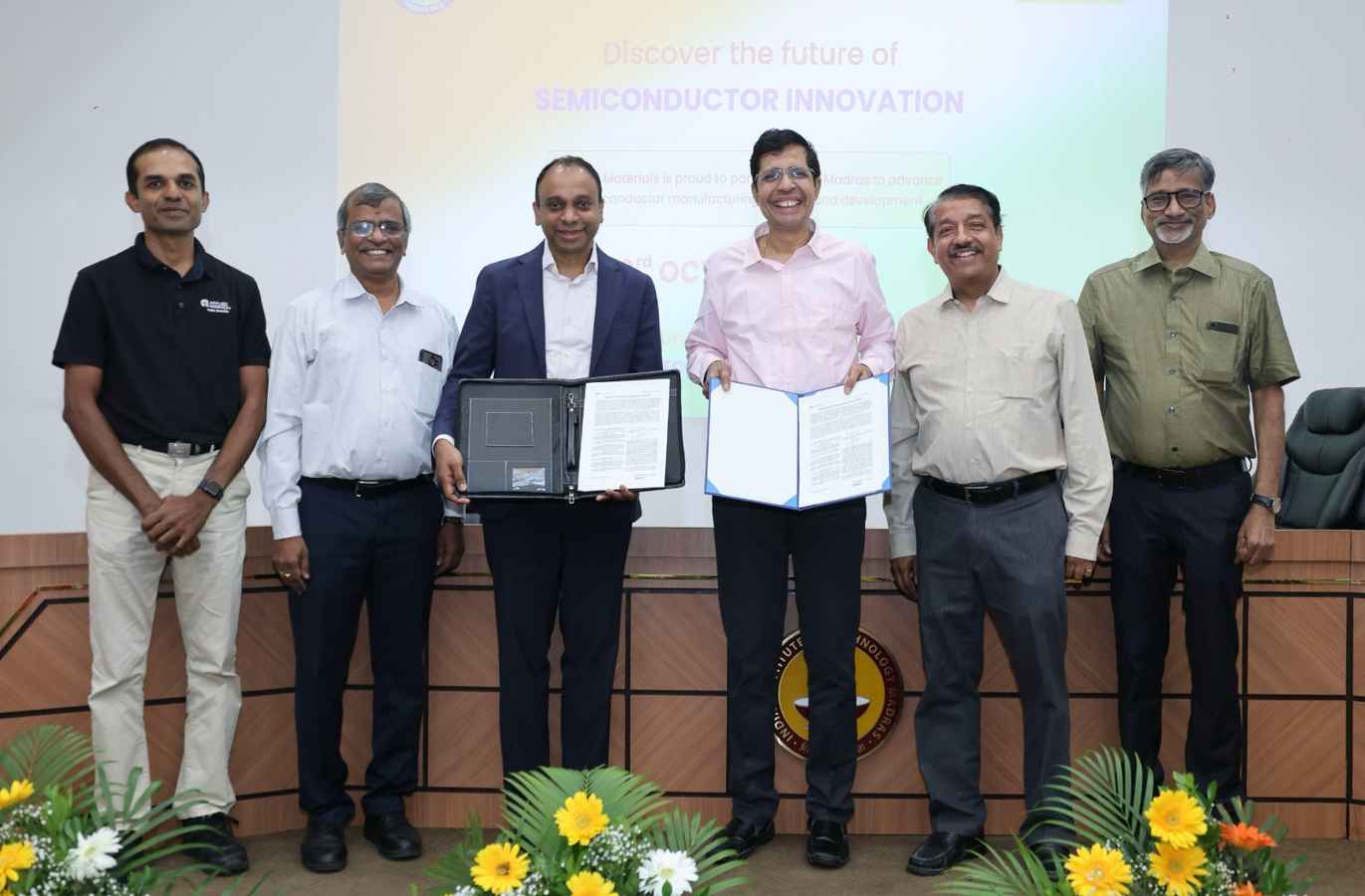
As India accelerates its semiconductor ambitions, the Indian Institute of Technology Madras (IIT Madras) has taken a decisive leap forward. The institute has expanded its strategic collaboration with Applied Materials India, marking a major milestone in semiconductor research and workforce development. At the heart of this partnership lies the deployment of AppliedTwin, a digital twin framework designed to simulate and optimise semiconductor manufacturing processes virtually, a move that could redefine how India builds its semiconductor future.
Also read: Microsoft says no to AI sexbots, as rift widens with Sam Altman’s OpenAI
The AppliedTwin framework developed by Applied Materials, Inc. serves as a digital mirror to semiconductor fabrication processes. It enables researchers to model, test, and optimise complex workflows virtually before implementing them in the physical world. By deploying the foundational software framework at IIT Madras, students and researchers can now experiment with semiconductor process design in a virtual lab environment, saving both time and infrastructure costs.
The platform combines two key software tools – ACE+, which offers multi-physics and multi-scale modelling for component and chamber-level digital twins, and TOPO+, a feature-scale simulator for topography and material behaviour. Together, these tools allow for deep process analysis, predictive design optimisation, and hands-on experimentation without the need for a functioning fabrication facility.
The deployment was launched on October 23, 2025, with a hands-on workshop that brought together over 150 students and faculty members. The session introduced participants to the digital framework and its real-world applications in semiconductor process development.
This collaboration arrives at a critical time for India’s semiconductor roadmap. IIT Madras, in partnership with the Government of Tamil Nadu, is in the process of establishing a semiconductor fabrication (FAB) facility equipped with integrated reliability and packaging capabilities. The AppliedTwin framework provides a bridge between the conceptual and operational stages of that effort, giving researchers the ability to understand process parameters and refine workflows long before the physical FAB is ready.
Also read: Zoho set to enter UPI race with Zoho Pay, its new app to take on Google Pay, PhonePe and Paytm
Prof. V. Kamakoti, Director of IIT Madras, described the partnership as a “transformative step” for India’s semiconductor mission. “The deployment of Applied Materials’ AppliedTwin framework will empower our faculty and students to accelerate concept creation, prototyping, testing, and process exploration virtually,” he said. “It will reduce R&D cost and time significantly while helping us prepare an industry-ready workforce.”
This initiative also aligns with the national effort to localise chip design and manufacturing, a strategic goal under the India Semiconductor Mission (ISM). By integrating digital twin technology into academic programs, IIT Madras is helping build a pipeline of engineers skilled in both design and process optimisation, key competencies needed for India’s semiconductor self-reliance.
Importantly, the benefits of this collaboration extend beyond the IIT Madras campus. Through Swayam Plus, the institute’s online learning platform, students from other universities, research institutions, and MSMEs will be able to access Applied Materials’ general-purpose software suite. This nationwide access aims to democratise semiconductor learning, enabling virtual experimentation for a much broader audience of aspiring engineers and researchers.
According to Avi Avula, Country President of Applied Materials India, the collaboration is about shaping both innovation and talent. “By deploying the foundational AppliedTwin framework, we are equipping future engineers and researchers with tools to engage deeply with advanced semiconductor technologies,” he said. “It strengthens workforce development and catalyses innovation through academia–industry collaborations that are essential for India’s semiconductor journey.”
This distributed learning model could prove vital as India builds its semiconductor supply chain. By connecting academia, industry, and government agencies through a shared virtual ecosystem, the partnership paves the way for more collaborative research and innovation in chip design and manufacturing.
Departments such as Materials Science and Metallurgical Engineering at IIT Madras have already expressed interest in embedding AppliedTwin into their upcoming M.Tech programs in semiconductors. This integration will expose students to virtual fabrication environments, allowing them to simulate real-world chipmaking challenges before stepping into physical labs.
The initiative is also expected to open opportunities for AI-integrated modelling, cross-institutional projects, and joint research publications between IIT Madras and Applied Materials teams. As semiconductor processes become increasingly data-driven, combining digital twin technology with AI could help India’s researchers predict process outcomes, optimise yields, and identify design flaws earlier than ever.
For India’s semiconductor ecosystem, the IIT Madras–Applied Materials collaboration is more than just a technology deployment, it’s a strategic enabler. By bridging academic research and industrial application through virtual tools, the initiative ensures that India’s semiconductor workforce develops in parallel with its manufacturing infrastructure.
As the global race for chip self-sufficiency intensifies, India’s approach stands out for its emphasis on education-led innovation. The AppliedTwin deployment reflects that philosophy: building capacity before capability, investing in knowledge before infrastructure.
In the coming years, as the IIT Madras FAB comes online and digital twins become standard in semiconductor education, this collaboration could well be remembered as a foundational step – one that brought India’s semiconductor ambitions closer to reality.
Also read: ChatGPT’s Shared Projects feature now available for all: What is it and how it works