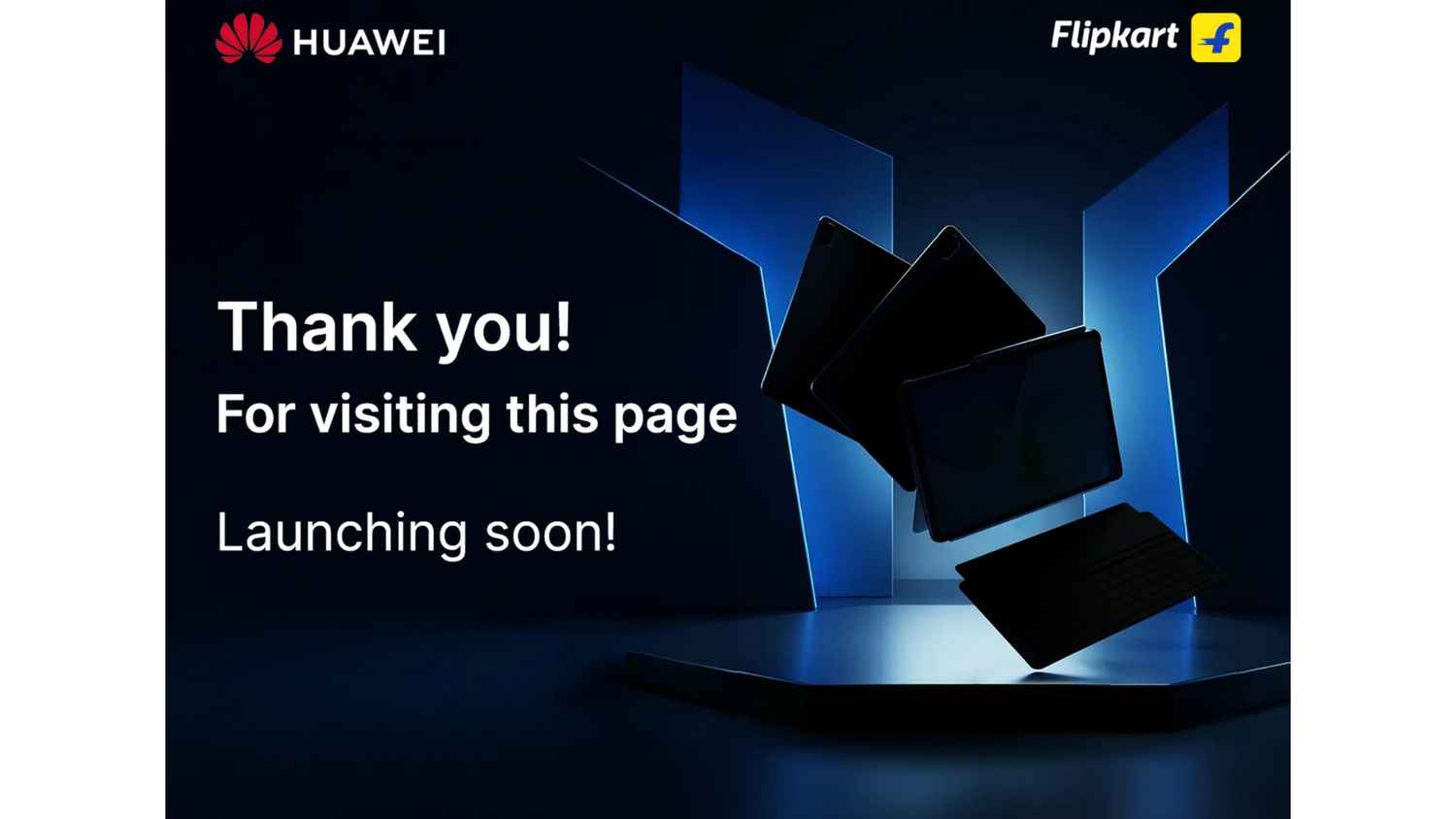
The Indian tech internet has collectively lost its mind over the supposed return of Huawei. A teaser spotted on Flipkart displays a Huawei banner with the tagline “Handy All-rounder” suggests the company may be testing a return to India through a tablet. The tablet silhouette matches the MatePad 11.5 that Huawei currently sells in international markets, which has led to speculation that the same device could be used to re-enter India.
To understand the significance of this teaser, it helps to revisit why Huawei faded from the Indian consumer electronics market in the first place. In 2019 and 2020, the U.S. government placed Huawei on an export blacklist, preventing American companies from supplying technology to the Chinese giant. One of the most important consequences was the loss of access to Google Mobile Services (GMS).
For Android devices sold outside China, GMS is essential. It includes the Play Store, Gmail, Google Maps, YouTube and the broader ecosystem that most Android users rely on daily.
Without Google services, Huawei smartphones suddenly became far less appealing in global markets, including India. Even though Huawei attempted to build its own ecosystem with Huawei Mobile Services and AppGallery, the transition proved difficult outside China.
The company gradually pulled back from several markets, including India’s smartphone market. Devices stopped launching locally, retail presence faded and the brand became almost invisible in the mainstream consumer tech conversation.
That said, Huawei never completely disappeared. Smartwatches and a few accessories continued to be sold through e-commerce platforms, though the activity was limited and relatively quiet compared to the company’s earlier smartphone push.
If Huawei is indeed returning to India, starting with a tablet is a deliberate and low-risk strategy because tablets operate in a different category from smartphones in terms of both market expectations and software reliance. While Google services are still important, tablets are often used for entertainment, reading, video calls, or light productivity rather than the full range of smartphone tasks.
The sub-Rs 30,000 tablet segment in India is also expanding with students, hybrid workers and casual content consumers are driving demand for devices that sit somewhere between a phone and a laptop. Brands like Xiaomi, Samsung, Lenovo and OnePlus already compete heavily in this space. Xiaomi and Lenovo focus on value-driven specifications, Samsung leans on brand trust and software polish, while OnePlus tries to combine performance with premium design.
The MatePad 11.5 is positioned as a mid-range productivity and entertainment tablet globally. It features an 11.5-inch IPS LCD panel with a 2.5K resolution and a 120Hz refresh rate that aims to deliver smoother scrolling and sharper visuals, particularly for media consumption.
The design follows Huawei’s familiar aesthetic: a slim metal body around 6.1 mm thick and weighing roughly 515 grams. This places it in line with other thin mid-range tablets that aim for portability.
Battery capacity includes a 10,100 mAh battery with support for 40W fast charging. For most users, that should comfortably deliver a full day of mixed usage.
The rest of the specifications are typical of tablets in this category. A 13-megapixel rear camera and an 8-megapixel front camera are included primarily for video calls and occasional document scans rather than serious photography.
Audio appears to be a stronger focus with the MatePad 11.5 featuring four speakers tuned with Huawei’s Histen audio technology, which is designed to enhance stereo separation and bass response during video playback.
In global markets, the base configuration with 8 GB of RAM and 128 GB of storage starts at around €299. Converted directly, that sits close to Rs 31,000, though local pricing in India could differ significantly depending on taxes and positioning.
According to industry chatter and comments from industry analyst Yogesh Brar, Huawei itself may not be directly operating the tablet launch in India. Instead, the distribution license reportedly belongs to a Mumbai-based company called RTC (Rajendra Trading Corporation) Group. The company is said to import Huawei products from China and sell them in India through e-commerce channels. A quick look at RTC Group’s website shows us the full range of Huawei offerings including fitness trackers suhc as Huawei Watch Fit 3,Huawei FreeClip TWS earbuds and smartwatches such as the Huawei Watch GT 6.
This setup resembles the arrangement previously used by Honor in India after Huawei sold the brand. Honor re-entered India through a similar arrangement with PSAV Global, made some noise at launch and then faded into the background because without robust after-sales support, competitive pricing that justified the ecosystem trade-off and aggressive marketing muscle, brand re-entries in India tend to sputter out. Fool me once, as they say.
For consumers, the most immediate concern becomes after-sales support. Without a clear official service infrastructure from Huawei itself, warranty claims and repairs may depend heavily on the distributor’s network.
The other major issue revolves around software, because of the U.S. restrictions, Huawei devices launched globally still do not include Google Mobile Services. Instead, they rely on Huawei’s HarmonyOS or EMUI builds paired with the AppGallery ecosystem.
In China, that model works because local apps replace many Google services. In international markets, however, the absence of the Play Store remains a significant barrier.
Despite the headlines suggesting a “Huawei return,” the situation appears closer to just launching a single tablet through an online marketplace. However, a broader return involving smartphones with Google services restored would require a fundamental shift in US trade policy and is not something anyone should hold their breath for.
For buyers considering a tablet in the near future, Huawei’s upcoming device may still be worth watching. The hardware itself appears competitive for media consumption and casual productivity. A high-resolution display, large battery and strong speaker setup make the MatePad 11.5 a capable entertainment device.
However, the software ecosystem and after-sales clarity will likely determine how successful the device becomes in India. Users who depend heavily on Google apps and services may find competing tablets from Samsung, Xiaomi or OnePlus easier to live with.
Those who mainly want a large screen for streaming, reading or basic tasks might be more open to experimenting with Huawei’s alternative ecosystem.
Either way, after several quiet years, Huawei’s name is once again entering the Indian consumer tech conversation, even if the comeback, at least for now, is unfolding one tablet at a time.