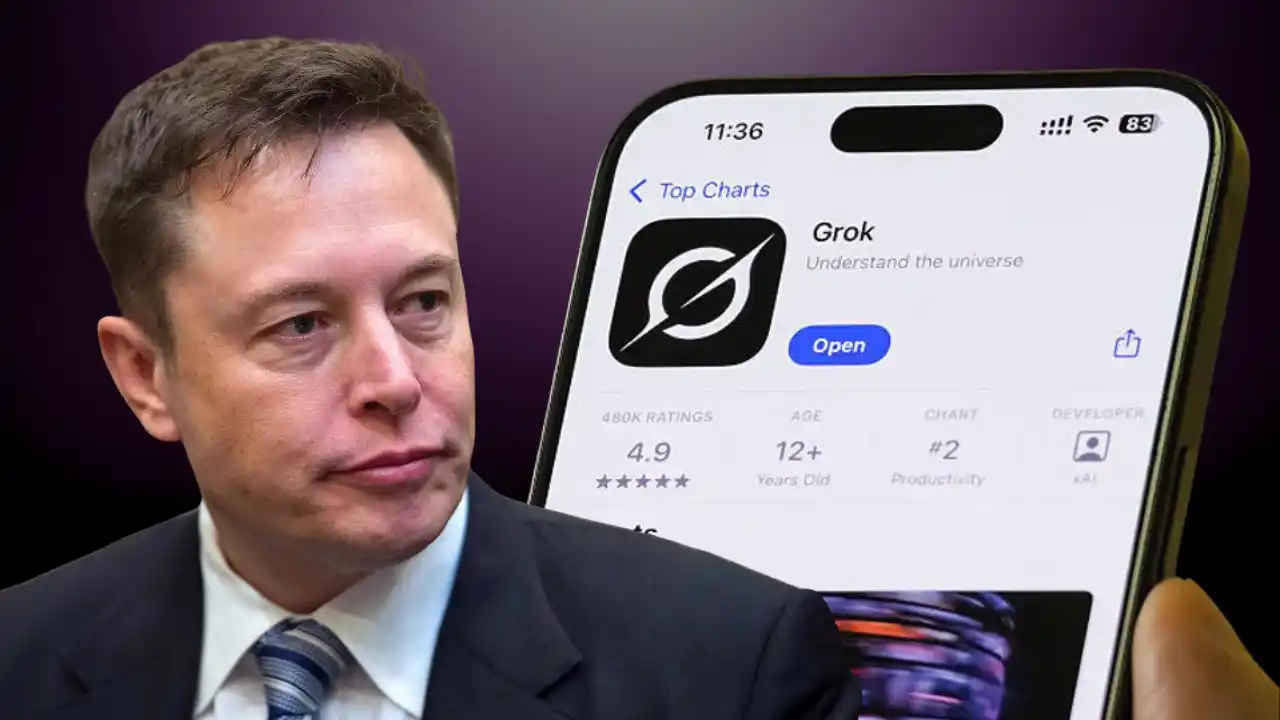
Elon Musk has never been one for subtlety and as far as reckless decisions go, his latest policy for Grok’s image and video generation tool might just take the cake. In a single tweet, Musk declared that if something is allowed in an R-rated movie, it’s allowed on Grok Imagine. No nuance, no caveats, no apparent awareness of what that sentence really unlocks.
Also read: Grok generated over 6000 sexualised pics per hour on X, says research
The internet, to its credit, responded immediately. The top reply to Musk’s tweet? A Grok-generated video of Musk and Donald Trump making out in the rain. Romantic, cinematic, almost certainly not what Musk had in mind when he wrote the policy. But here’s the thing, under his own standard, it’s completely fair game. R-rated movies have kissing. They have passion. They have all kinds of things Musk may not want pointed back at him. The reply wasn’t just a joke. It was, in a way, a stress test and the policy failed it in under an hour.
So what does the R-rated benchmark actually mean in practice? Quite a lot. R-rated films can contain graphic violence, sexual content short of explicit pornography, nudity, and intense depictions of drug use. That’s a remarkably wide aperture for an AI image and video generation tool operating at scale. Hollywood has a director, a studio, a legal team, and an entire ratings board standing between an idea and an audience. Grok Imagine has a prompt so you can already see the safety risks there.
Also read: Elon Musk denies Grok AI created illegal images, blames adversarial hacks
This isn’t the first time Grok’s image generation has landed xAI in hot water, either. The tool came under fire previously for generating bikini images of real people – including minors – without their consent, sparking significant backlash and raising urgent questions about the platform’s approach to non-consensual imagery. That controversy forced a temporary tightening of restrictions. However, Musk’s new R-rated announcement suggests that whatever lessons were learned then have since been thrown out the window.
The nudity question is the one that’s going to keep coming up. R-rated films do occasionally feature nudity – often contextual and always reviewed by humans at every step of production. Grok when running that same logic does not have the same guardrails. It has a policy written in 12 words on X for all we know. The gap between those two things is where the feature will be abused, and it won’t take long.
This isn’t a hypothetical concern. AI-generated non-consensual intimate imagery has been a documented and a growing problem for a long time now. Researchers, legislators, and advocacy groups have spent years trying to get platforms to take it seriously. Musk’s framing doesn’t just ignore that work, it actively invites the edge cases. If a user prompts Grok Imagine with a real person’s photo and a scenario lifted straight from an R-rated film, what happens? The policy doesn’t say. The tweet certainly doesn’t say.
What the tweet does say loudly, between the lines, is that xAI views content moderation as a suggestion. This is consistent with Musk’s broader philosophy on X, where “free speech” has repeatedly served as cover for the removal of safety infrastructure rather than genuine openness. Grok Imagine’s R-rated rule follows the same pattern where it is framed boldly, there is zero operational detail, and consequences are left for everyone else to manage. The Musk-Trump video is funny, the policy isn’t.
Also read: Fix Grok bikini deepfakes: Indian govt pulls up X.com for viral AI trend