Century old physics debate settled
For nearly a hundred years, one of the most celebrated minds in science, Albert Einstein, had a lingering quantum thought experiment left unresolved. Now, a team of physicists at MIT has finally answered it, and the result is clear: Einstein was wrong.
The groundbreaking study, published in Physical Review Letters, takes aim at one of the most famous and mystifying phenomena in physics, the double-slit experiment, and shows, with the cleanest test yet, that the universe doesn’t let us have it both ways. You either know what a particle is doing, or you see it behave like a wave. But never both.
Also read: Einstein Rings and the cosmic lens: How NGC 6505 is reshaping our understanding of gravity
Back in the 1920s and 30s, Einstein and fellow physicist Niels Bohr were engaged in a long-running intellectual battle about the nature of reality. At the heart of the debate was the double-slit experiment, a test where light (or particles like electrons) are fired at a screen with two slits. When unobserved, the particles form an interference pattern, as if they’re behaving like waves going through both slits at once. But the moment you try to measure which slit the particle goes through, the interference disappears. The particle behaves like, well, a particle.
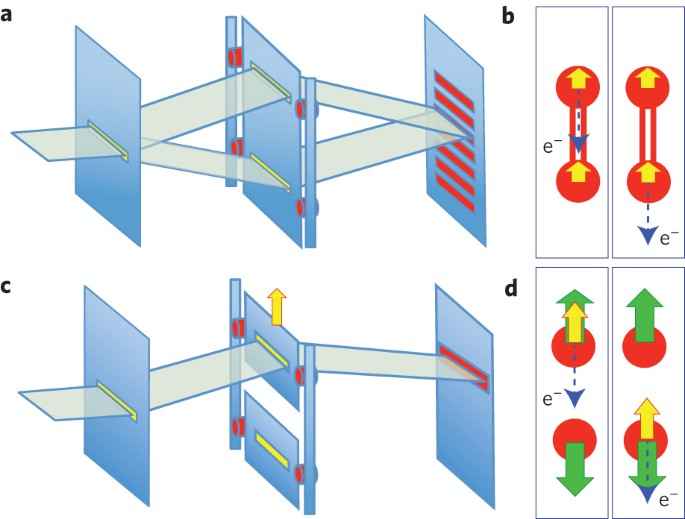
Einstein thought he’d found a loophole. He proposed a variation where the slits themselves would be mounted on springs. In theory, when a photon passed through one slit, it would give a tiny nudge to that slit, just enough to tell which path it took, but not so much that it should disturb the interference pattern. If the interference remained, while the path was also known, Einstein believed it would break quantum theory.
Bohr disagreed. He argued that even a whisper of knowledge about the photon’s path would destroy the wave-like behavior. The two giants went back and forth, but the technology to test it simply didn’t exist. Until now.
Fast forward to 2025. Using individual atoms as their “slits,” the MIT researchers recreated Einstein’s dream experiment with an almost sci-fi level of control. The atoms were suspended in place inside a vacuum chamber and single photons, particles of light, were fired at them with ultra-precise timing. Crucially, the team could control just how “fuzzy” the atoms were, tweaking the degree of quantum uncertainty in their positions.
Also read: MIT’s ChatGPT study says AI is making you dumber: Here’s how
This fuzziness turned out to be the key. When the atoms’ positions were more certain, it was easier to tell which one of the photons scattered off and just like Bohr predicted, the interference pattern vanished. When the fuzziness increased, making the atoms indistinguishable, the interference returned.
Einstein’s spring idea? It didn’t matter. Even when the atoms were no longer fixed in place, the result stayed the same. What mattered wasn’t the mechanical movement of the slits, but the information. If you could, even in theory, know which path the photon took, the wave-like behavior disappeared.
Wolfgang Ketterle, Nobel laureate and senior author of the study, called the experiment a literal realization of a thought experiment. “Einstein and Bohr would have never thought this was possible,” he said. “We have done an idealized Gedanken experiment.”
The findings don’t just settle a philosophical debate. They reinforce that the rules of quantum mechanics aren’t just strange, they’re absolute. Observation, or the potential to observe, changes reality. It’s not about our instruments; it’s about what can be known.
The experiment doesn’t rewrite quantum theory but strengthens it. It shows that even the most subtle attempts to peek behind the curtain of uncertainty will collapse the illusion. There’s no halfway state where light can be both particle and wave in full view. Bohr was right all along.
It’s also a triumph of precision. The team at MIT eliminated nearly every classical variable, no springs, no environmental noise, just pure quantum effects. It’s the kind of result that only decades of progress in atomic physics and quantum optics could deliver.
Also read: Top 5 fastest quantum computers in the world 2025