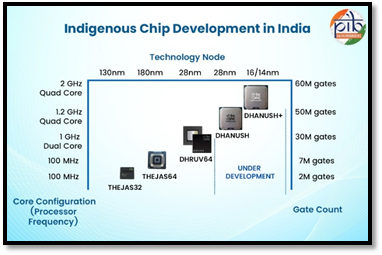
India has taken another step toward technological self-reliance with the announcement of DHRUV64, the country’s first indigenous 1.0 GHz, 64-bit dual-core microprocessor. Developed by the Centre for Development of Advanced Computing (C-DAC) under the government’s Microprocessor Development Programme, the chip is being positioned as a foundational building block for India’s domestic computing ecosystem.
At its core, DHRUV64 is about ownership. Modern computing systems, from laptops and servers to industrial controllers and automobiles, rely on processors that are largely designed and controlled by foreign companies. This dependence carries risks, ranging from supply chain disruptions to security concerns. By designing a processor in-house, India gains greater control over both performance and trust in critical digital infrastructure.
Also read: India’s Shakti: IIT Madras to develop indigenous 7-nm chip by 2028
DHRUV64 is a 64-bit processor, which means it can handle more memory and more complex workloads than older 32-bit designs. Clocked at 1.0 GHz and featuring dual cores, it is built for multitasking and stable performance rather than headline-grabbing consumer benchmarks. The government has highlighted its suitability for applications such as communications equipment, industrial automation, automotive electronics, Internet of Things systems, and strategic or mission-critical use cases.
Importantly, DHRUV64 fits into India’s growing embrace of RISC-V, an open and license-free instruction set architecture. Unlike proprietary architectures that require costly licensing, RISC-V allows researchers and companies to design chips without legal or financial barriers. This openness is central to India’s long-term ambition of nurturing a domestic semiconductor design ecosystem.
Also read: AI agents to India’s internet boom: Cloudflare highlights 5 epic things of 2025
The processor is not a standalone achievement. It builds on earlier Indian chip efforts like SHAKTI, AJIT, VIKRAM, and THEJAS, and aligns with the Digital India RISC-V (DIR-V) initiative. DIR-V aims to make India a global hub for RISC-V research, education, and product development.
DHRUV64 also complements broader policy frameworks such as the India Semiconductor Mission, the Design Linked Incentive scheme, and the Chips to Startup programme, all of which focus on developing talent, supporting startups, and encouraging industry adoption. Together, these initiatives attempt to address a long-standing gap in India’s technology stack: strong software capability without equivalent depth in hardware design.
DHRUV64 is unlikely to replace consumer CPUs from Intel, AMD, or Apple anytime soon, and that is not its immediate goal. Its importance lies in proving that India can design complex processors end-to-end and gradually deploy them in real-world systems. Such capabilities are critical for sectors where reliability, security, and sovereignty matter more than raw speed.
Looking ahead, the government has indicated that more advanced processors like Dhanush and Dhanush+ are already under development. If these efforts continue to mature, DHRUV64 may be remembered less as a final product and more as a milestone in India’s journey toward a resilient and self-sustaining semiconductor future.
Also read: I took a 10000mAh MagSafe power bank on vacation, and it wasn’t from Apple