The history of genomics has long been a story of reading a book where only every fiftieth page made sense. While the Human Genome Project gave us the full sequence of human DNA over two decades ago, we were largely illiterate in the language of the “non-coding” genome – the 98% of our genetic code that does not build proteins but dictates when, where, and how those proteins are made. This vast expanse, often dismissed as “dark matter,” is where the instructions for human life and the triggers for complex diseases are hidden. On January 28, 2026, Google DeepMind published a landmark paper in Nature detailing AlphaGenome, an AI model that finally provides a high-resolution map for this genetic wilderness.
Also read: OpenAI plans social network: Can Sam Altman stop bots from entering?
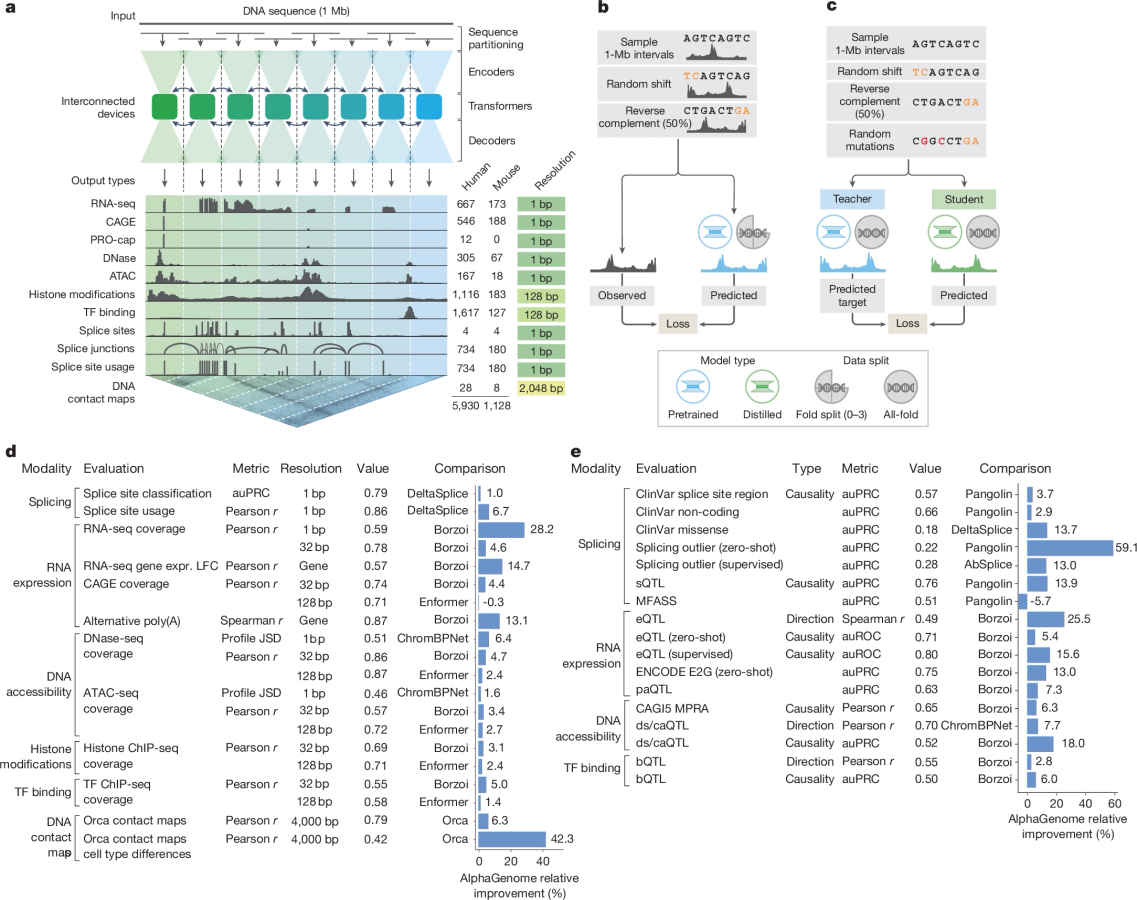
For years, computational biology was trapped in a frustrating trade-off. AI models could either focus on a tiny fragment of DNA with intense scrutiny or look at a broad landscape with blurry vision. This was a significant hurdle because human biology is inherently “long-range”; a mutation in a regulatory switch at one end of a chromosome can trigger a gene located millions of base pairs away. AlphaGenome shatters this limitation by utilizing a hybrid architecture that combines the spatial efficiency of U-Nets with the long-range “attention” of Transformers.
The result is a model capable of processing sequences up to one million base pairs long while maintaining the ability to pinpoint the biological consequence of a single-letter change. By “reading” DNA in such massive windows, AlphaGenome can observe the complex folding and interactions that govern gene expression in a way that previous models, limited to much shorter sequences, simply could not. In internal benchmarks, this allowed AlphaGenome to outperform existing state-of-the-art models in nearly every category, particularly in predicting how specific genetic variants affect gene expression.
AlphaGenome does not just look for patterns; it simulates the fundamental mechanics of life. It is trained to simultaneously predict over 7,000 distinct genetic signals across both humans and mice. This includes the incredibly complex process of RNA splicing, where cellular machinery cuts and pastes genetic instructions. Errors in this process are the root cause of devastating conditions like spinal muscular atrophy and cystic fibrosis. By explicitly modeling these “splice junctions,” AlphaGenome allows researchers to see exactly how a mutation will disrupt the final protein product before a patient ever sets foot in a lab.
Also read: Clawdbot security issues: Private messages to AI agent can leak
This predictive power turns the model into a “virtual laboratory.” Traditionally, identifying whether a rare genetic variant is harmful or benign requires years of expensive “wet lab” experimentation. AlphaGenome can evaluate the impact of these “variants of uncertain significance” in less than a second on a modern GPU. For a clinician trying to diagnose a child with a rare, undiagnosed condition, this tool moves the needle from guesswork to actionable data, identifying the specific “broken switch” responsible for the disease.
Perhaps the most significant aspect of AlphaGenome is its availability. Following the precedent set by AlphaFold, DeepMind has open-sourced the model and its code for non-commercial research. This move democratizes the front lines of genetic science. It ensures that a researcher at a university in India or a non-profit lab in Brazil has the same analytical power as a multi-billion dollar pharmaceutical company.
As we move into an era of “Agentic AI,” where models act as autonomous collaborators, AlphaGenome represents the foundational layer for the next decade of discovery. It is already being used to design synthetic “enhancers” – custom DNA sequences that can turn on a therapeutic gene in a specific organ without affecting the rest of the body. By providing the dictionary for the dark genome, AlphaGenome is not just helping us read our DNA; it is teaching us how to write a healthier future.
Also read: OpenAI’s Prism explained: Can you really vibe code science?