For years, the mechanical keyboard was the undisputed king of PC gaming peripherals. Gamers spent endless hours debating Cherry MX Reds versus Blues and obsessing over tactile bumps. But recently, a new challenger has usurped the throne in the competitive scene. Hall Effect (HE) keyboards are rapidly becoming the gold standard for esports professionals, promising a level of speed and precision that traditional mechanical switches simply cannot physically match.
Also read: Sony PS5 exclusive games to look forward to in 2026
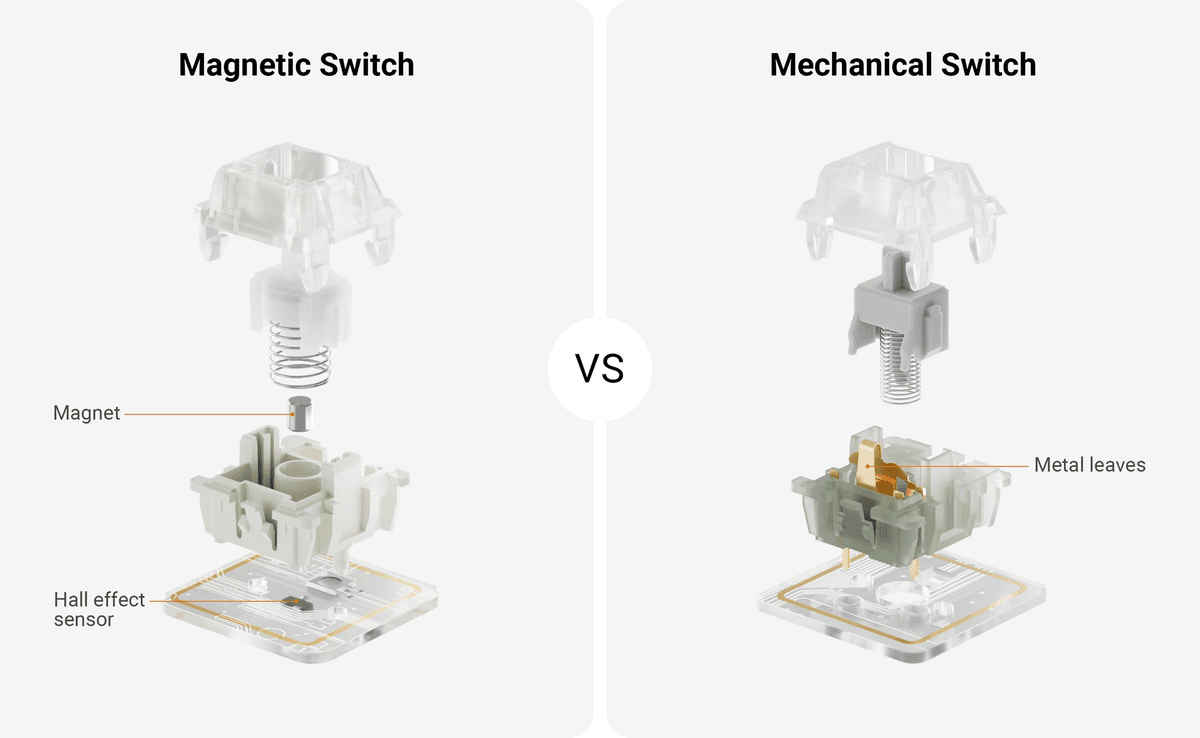
To understand why Hall Effect keyboards are superior for gaming, you must first understand the limitations of a standard mechanical switch. In a traditional keyboard, pressing a key pushes a plastic stem down until two metal contacts touch to complete a circuit. It is a binary system where the key is either off or on.
Hall Effect switches remove the metal contacts entirely. Instead, they use a magnet attached to the key stem and a sensor on the circuit board below. As you press the key, the magnet moves closer to the sensor, measuring the strength of the magnetic field. This allows the keyboard to know exactly how far down the key is pressed at any given millisecond. This analog data unlocks software features that make these keyboards special.
The primary reason to buy a Hall Effect keyboard is a feature called Rapid Trigger. On a normal mechanical keyboard, once you press a key, you must release it past a fixed reset point before you can press it again. This introduces a physical delay between actions.
Rapid Trigger eliminates this dead zone. Because the sensors constantly track the magnet’s position, the switch can reset the instant you start lifting your finger. This happens regardless of how deep the key was pressed.
Also read: ROG Ally X vs Legion Go vs MSI Claw 8 AI+: Which handheld Windows gaming PC is the best in 2025?
This is a massive advantage for first-person shooters like Counter-Strike 2 or Valorant. In these games, “counter-strafing” is a critical mechanic where you must stop moving immediately to fire an accurate shot. With Rapid Trigger, you can strafe left, lift your finger, and immediately stop. It shaves valuable milliseconds off your reaction time.
The other major advantage is adjustable actuation. Since the switch reads a range of depth, you can tell the software exactly when you want a key to register. You might set your WASD movement keys to an ultra-sensitive 0.1mm for instant response while keeping your Grenade key at a deep 3.0mm to prevent accidental misclicks. This flexibility allows a single keyboard to have a typing profile with deep actuation for work and a hair-trigger profile for gaming.
Hall Effect keyboards are not perfect. They are significantly more expensive than standard mechanical boards due to the cost of sensors. Additionally, the typing feel is almost exclusively linear. If you prefer the tactile bump or click of traditional switches, you may find HE switches smooth but somewhat lifeless.
For casual gamers playing single-player adventures, a Hall Effect keyboard is likely overkill. A good mechanical board will serve you just as well. However, if you play competitive shooters or rhythm games where every millisecond of latency dictates the winner, Hall Effect technology is objectively better. It removes the physical limitations of mechanical switches and leaves your own reaction time as the only bottleneck.
Also read: Remembering Call of Duty co-creator Vince Zampella: The major games he created