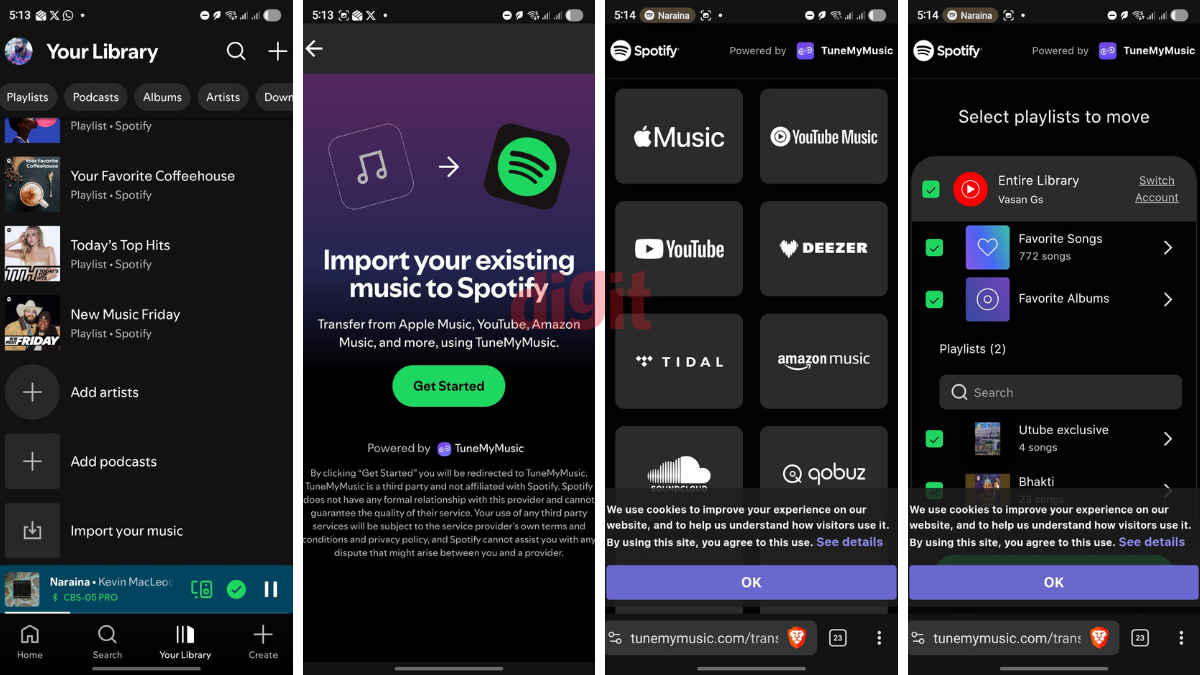
When you switch music apps, you would want to carry over your playlists, too. Rebuilding playlists manually takes hours. Some of my personal playlists on YouTube Music have 500 to 1000 songs, and my only way to transfer these playlists to my current streaming app of choice, Spotify, has been third-party migration tools. One of these tools, TuneMyMusic, is now integrated directly into the Spotify app. This should ideally remove most of the friction associated with migrating music without losing metadata. Here, I will be sharing the process and my experience using this built-in option. But if you want more control or need extra features, I have listed third-party tools like Soundiiz, FreeYourMusic, and SongShift for your perusal. Each handles metadata differently, works with different library formats, and deals with DRM rules in its own way. We will look at how these tools work, how much they cost, and which one is worth paying for if you have a large library. By the end, you will know whether the built-in Spotify option is enough or if another workflow feels smoother.
Spotify wants to reduce switching friction. If users can carry their playlists across in minutes, they are more likely to commit to Spotify without worrying about starting from scratch. Playlist portability also reduces cross-platform fragmentation, since people often use more than one service for different moods or devices. Smooth migration helps Spotify retain users and makes the onboarding journey cleaner.
Playlist transfer depends on three things: metadata, formats, and DRM.
Let’s now check out how to use these tools one by one.
Also Read: Spotify defaults to Fewer Repeats as the preferred shuffle style: What that means, why it matters
1. Open Spotify on desktop or mobile.
2. Go to ‘Import your music’ in the settings or library section. You will be directed to the TuneMyMusic website on your default mobile browser.
3. Select the service you want to import from.
4. Sign in to that platform. Give required permissions.
5. Choose the playlists you want.
6. Hit import and wait.
This could work for most users with small to medium libraries. Perhaps Spotify and TuneMyMusic will iron out the kinks, and this built-in solution will get better with time.
Meanwhile, here are some alternatives:
1. Open the Soundiiz website.
2. Create an account.
3. Connect the platforms you use, including Spotify.
4. Select the source playlist.
5. Convert or sync it to Spotify.
6. Review the match results and confirm.
Soundiiz suits users with large, multi-platform libraries. Auto-sync is worth it if you keep switching between apps and want your playlists consistent everywhere.
1. Install the app on Windows, macOS, Android, or iOS.
2. Open the app and pick a source service.
3. Log in to both platforms.
4. Select playlists or full libraries.
5. Start the transfer.
6. Check the failed matches list and replace songs if needed.
FreeYourMusic is ideal if you have a large library and want a one-time payment instead of a recurring subscription. Speed is good, but metadata accuracy varies with niche tracks.
1. Install SongShift from the App Store.
2. Connect Spotify and the source service.
3. Choose a playlist to shift.
4. Review matches for errors.
5. Confirm the transfer.
SongShift is best for Apple users who want a quick, lightweight way to move playlists without complications. It is not built for massive libraries.
For most people, Spotify’s integrated TuneMyMusic tool is enough. It handles common playlists smoothly, keeps metadata intact, and avoids the hassle of extra logins.
If you need more control and are ready to pay up, you can try the premium versions of Soundiiz, TuneMyMusic and FreeYourMusic. If you are an iOS user, try SongShift. The least annoying workflow for Spotify users would be the built-in import option.
So, if you are moving thousands of tracks or switching between services often, a premium tool is worth it. If you only need a one-time import, stick to Spotify’s native option.
Keep reading Digit.in for similar stories.
Also Read: Spotify app gets videos, lyrics, queue management on Apple TV