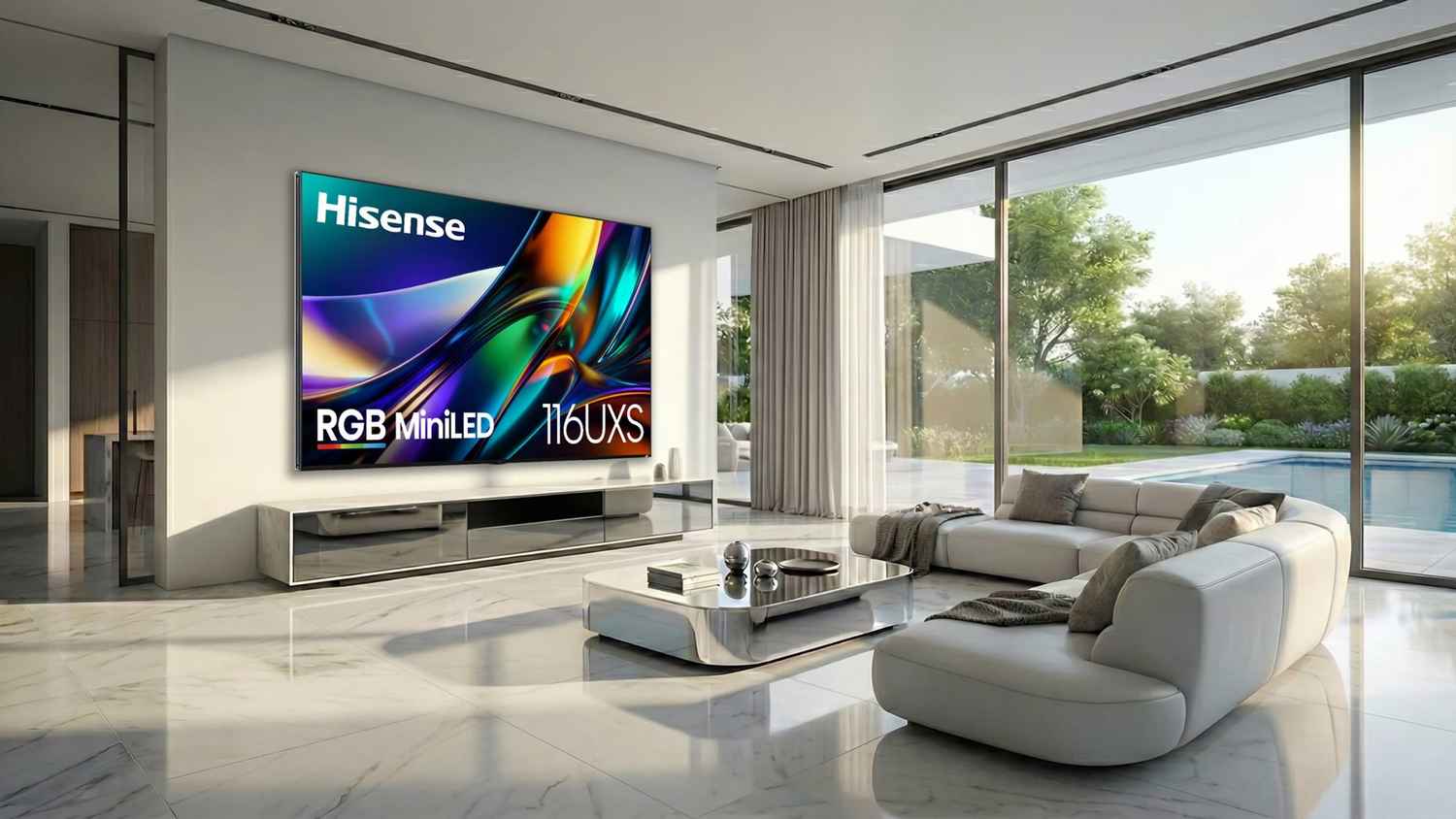
Hisense announced new flagship display products at CES 2026 in Las Vegas, led by the 116UXS RGB Mini LED TV and the XR10 TriChroma laser projector. The company positioned the launches as part of a broader shift toward ‘human-centric display technology’, rather than simple hardware spec upgrades. The focus is clearer picture quality, greater comfort for long viewing sessions, and more advanced smart-TV experiences.
The headline technology this year is RGB Mini LED evo. Hisense calls it a system-level evolution of its existing RGB MiniLED architecture. Instead of relying on higher brightness or more dimming zones alone, the company has redesigned the backlight.
Alongside the traditional red, green, and blue LEDs, the new platform adds a Sky Blue–Cyan fourth LED. According to Hisense, this helps fill an area of the light spectrum that standard backlights often miss, improving colour realism in skies, water, and other cyan-green tones.
Colour control now reaches 134-bit precision, while colour coverage is said to exceed 110% of the BT.2020 colour space. Hisense also claims professional-grade colour accuracy at around Delta E 0.6. The company says the revised light-source design can reduce potentially harmful blue-light output by up to 80%, which should make large-screen viewing easier on the eyes.
The first product built on this platform is the new 116-inch 116UXS TV. Hisense describes the TV as a move toward ‘structure-driven innovation’ that prioritises colour fidelity, visual comfort, and everyday usability on ultra-large screens.
Also Read: LG G6, C6, B6 unveiled at CES 2026 along with LG W6 wallpaper OLED TV: Details
Alongside TVs, Hisense also expanded its TriChroma laser lineup. The new XR10 laser projector makes its global debut at CES 2026. It delivers up to 6,000 ANSI lumens and supports projection sizes of up to 300 inches, targeting dedicated home-cinema environments where brightness, colour stability, and long-term performance matter.
Together, the company says RGB Mini LED TVs for the living room and TriChroma laser projectors for theatre rooms form its large-screen strategy for premium households.
Beyond hardware, Hisense also detailed changes to its software ecosystem. From 1 January 2026, the VIDAA platform will be renamed simply V, while VIDAA OS becomes HomeOS.
Through a strategic partnership with Microsoft, Hisense plans to integrate Copilot’s generative AI into HomeOS. The goal is to improve search, recommendations, and TV interactions. The collaboration also extends to Xbox cloud gaming, allowing users to access console-quality games directly on compatible Hisense TVs without buying a separate console.
We will update this story with pricing, availability, and regional launch plans once Hisense confirms details for specific markets. Keep reading Digit.in for similar CES stories.
Also Read: Amazon updates Fire TV UI, unveils Ember Artline TV as Samsung’s The Frame rival