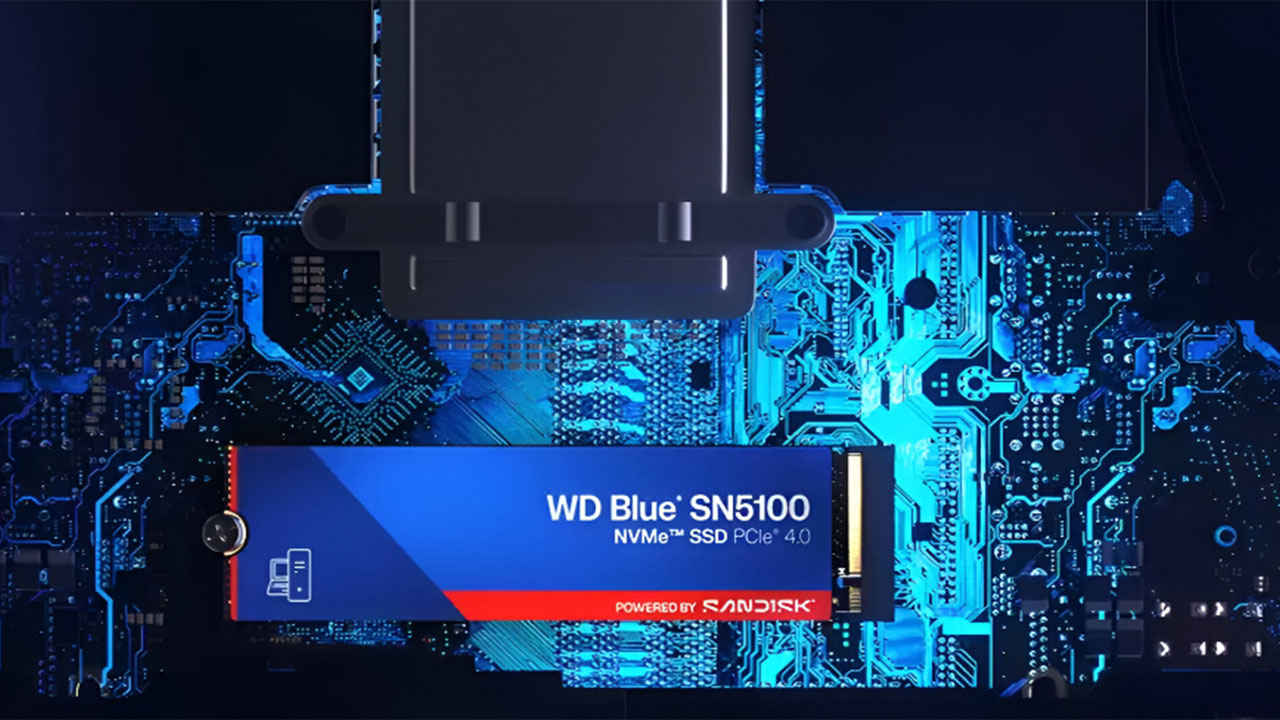
WD Blue SN5100 NVMe SSD
Western Digital has unveiled the WD Blue SN5100 NVMe SSD, a PCIe Gen4 M.2 2280 drive aimed at creators and professionals. The notable improvement is with sequential read speeds going up to 7,100 MB/s on the 1 TB and 2 TB models, with writes up to 6,700 MB/s, plus random performance peaking at 1M read IOPS and 1.3M write IOPS. Capacities span 500 GB to 4 TB, there is a five-year limited warranty, and the drive leans on SanDisk’s nCache 4.0 and next-gen 3D CBA QLC NAND. The WD SN5100 starts at Rs 3999 for the 500 GB variant.
Compared with last year’s WD Blue SN5000, the SN5100 pushes sequential reads from a top end of 5,500 MB/s on the 4 TB SN5000 to as high as 7,100 MB/s on 1 TB and 2 TB SN5100 SKUs, with sequential writes rising from up to 5,000 MB/s to 6,700 MB/s. Random throughput also steps up, from a maximum 900K write IOPS on the 4 TB SN5000 to as much as 1.3M on the WD Blue SN5100. On paper, that is a sizeable uplift for large project loads and asset streaming in creative apps.
The generational context is equally interesting when you factor in the older WD Blue SN580. That drive brought PCIe Gen4 to the WD Blue range with up to 4,150 MB/s reads and writes on the 1 TB and 2 TB models, alongside 600K read and 750K write IOPS. Against the SN580, the new SN5100 is a clear step forward on sequential and random performance, especially for high-queue workloads.
Endurance figures remain familiar. Like the SN5000, Western Digital rates the SN5100 at up to 1,200 TBW for the 4 TB variant, scaling down to 300 TBW at 500 GB. The form factor stays M.2 2280, and the warranty is five years. The range still covers 500 GB through 4 TB. In short, you get the same capacity ladder and TBW ceilings as before, so the big change is speed rather than rated longevity.
There is one notable architectural shift. The WD Blue SN5100 uses SanDisk 3D CBA QLC across the stack, paired with SanDisk nCache 4.0. The SN5000 line mixed WD’s TLC and QLC parts depending on SKU, while the SN580 was TLC-based. The move to QLC enables high capacities and the quoted throughput, particularly when the SLC cache is in play, although buyers focused on sustained, cache-exhausted writes will want to watch independent testing for behaviour under prolonged heavy transfers. Officially, Western Digital has kept TBW ratings level, which suggests confidence in this generation of QLC for client workloads.
SSDs that transition from TLC or traditional QLC to CBA QLC offer significant improvements in capacity, performance, and efficiency. CBA QLC leverages a specialised bonding of the CMOS logic and NAND array, allowing for higher bit densities ranging up to 2 Tb per die and over 200 layers, making SSDs more cost-effective and capable of packing far greater storage into the same footprint. Users can expect faster NAND I/O speeds, with sequential write speeds up to 30% higher and improved read latency by about 15%. This architecture also optimises endurance and reliability, narrowing the gap between QLC and TLC, with advanced caching and error correction resulting in cycle lives reaching or exceeding 3,000 writes, which outperforms many older TLC models. For consumers and enterprises, this means affordable terabyte-scale SSDs, improved real-world speed, and enhanced reliability for read-heavy and mixed workloads.
Power and software touchpoints are consistent, with a few nuances. The SN5100 lists idle sleep around 4 to 4.5 mW, which is slightly below the SN5000’s 5 mW PS5 state. Acronis True Image is still included for migration, and you get to use the included SanDisk dashboard for monitoring and upgrading the firmware.
The WD Blue SN5100 is the speed-focused refresh many expected. It convincingly outpaces the SN5000 and SN580 on sequential and random metrics, keeps the same capacity options and warranty, and maintains the endurance figures.