SanDisk Extreme Fit USB Type C Flash Drive
USB flash drives are easy to overlook in 2026. There’s great 4G and 5G wireless connectivity in the country and everyone has easy access to cheap cloud storage. Yet, portable SSDs and flash drives continue to have a place in the midst of all this. Flash media companies have been offering value additions for the better part of the decade to not have their offerings be relegated to simple commodities. And some companies have been experimenting with form-factors to cater to every single need that arises in the market. The SanDisk Extreme Fit USB-C Flash Drive is one such offering that comes in the smallest of form-factors currently selling in the market.
SanDisk is positioning this as a plug-and-stay solution, and that description is as accurate as it gets. The drive is designed for USB-C devices including laptops, tablets, and other compatible hardware, while offering capacities ranging from 64 GB all the way up to 1 TB. The unit we received ships with 512 GB of rated capacity, though the formatted usable space comes in at roughly 460GB in FAT32. Officially, SanDisk claims read speeds of up to 400 MB/s on the 128 GB to 1 TB variants, over a USB 3.2 Gen 1 interface, while write speeds are simply described as a bit lower.
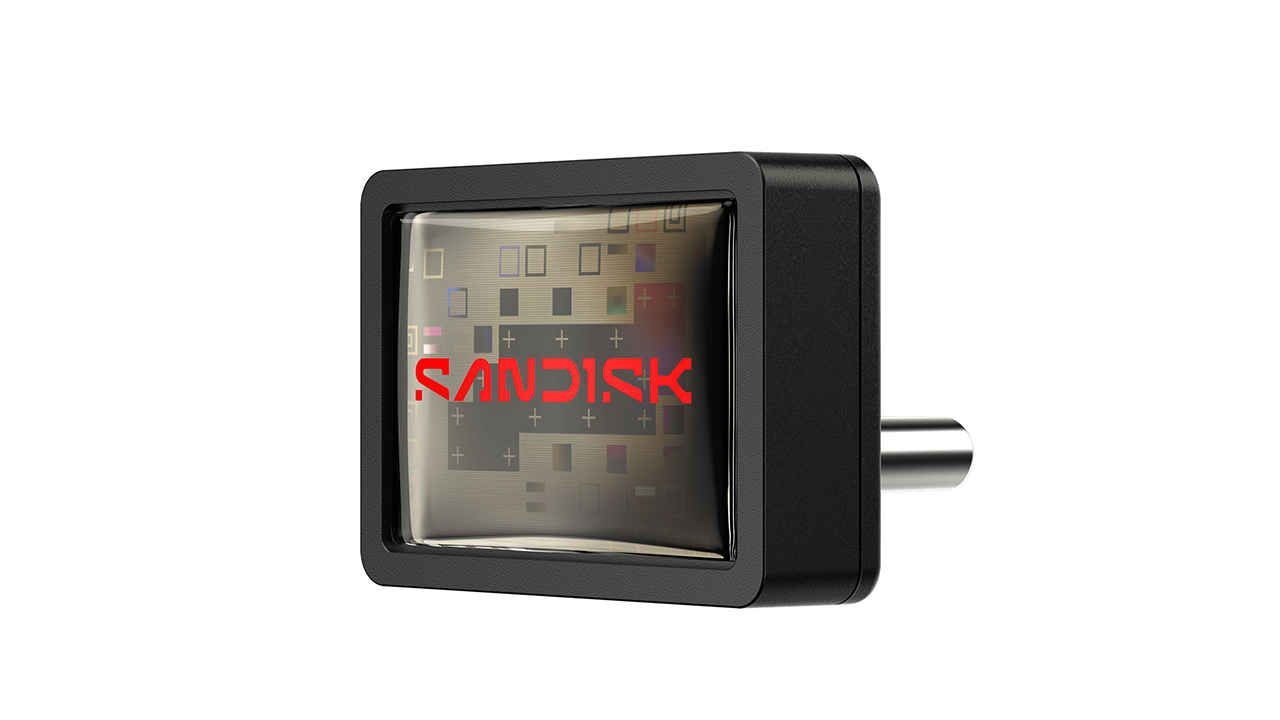
The biggest selling point is the fact that it comes in an extremely compact form factor. You’d be forgiven for mistaking it for a simple USB Type–C port cover. SanDisk says this is its smallest USB-C flash drive with up to 1 TB of capacity, and the dimensions explain why. At just 18.50 x 15.70 x 13.60 mm and weighing 3g, the Extreme Fit is built to disappear into the side of a notebook or tablet rather than stick out like a typical thumb drive.
That has practical value beyond aesthetics. A low-profile design makes more sense for users who want semi-permanent storage expansion on ultraportables, 2-in-1s, or compact desktops with front USB-C access. It is also easier to leave in place when carrying a laptop in and out of a bag. For creators and office users moving documents, images, presentations, and media files across machines, that convenience matters as much as headline throughput.
SanDisk is also pitching the drive as a broad compatibility option, with support listed for iPadOS 15 and above, macOS 12 Monterey and above, and Windows 10 or newer. The SanDisk Memory Zone app is available for Windows and Mac systems to help organise, manage, and back up files. That does not make this an advanced workflow product in the same sense as a portable SSD, but it does make it more user-friendly for people who want straightforward local storage without overthinking the process.
The appeal of a product like this depends on expectations. The Extreme Fit USB-C is not trying to replace a high-end external SSD for 4K multicam editing or constant heavy write workloads. Instead, it sits in a more practical middle ground. It is compact enough to remain attached, fast enough to handle common file transfers briskly, and available in capacities that make sense for students, professionals, and casual creators alike. SanDisk offers it in 64 GB, 128 GB, 256 GB, 512 GB, and 1 TB versions.
In daily use, that means the drive makes the most sense as a neat expansion option for light media libraries, document archives, transfer duties, and offline backups. On machines with limited internal storage, especially tablets and thin laptops, that kind of extra room can be more useful than it first appears. It is the sort of drive that can store massive presentation decks, a photo dump from a recent shoot, game installers, or a travel library of movies and music without becoming one more gadget to manage.
The fact that it ships formatted as FAT32 is helpful because it keeps things broadly compatible, but also comes with the usual file system trade-offs. Users dealing with very large single files may eventually want to reformat depending on their device ecosystem and workflow.
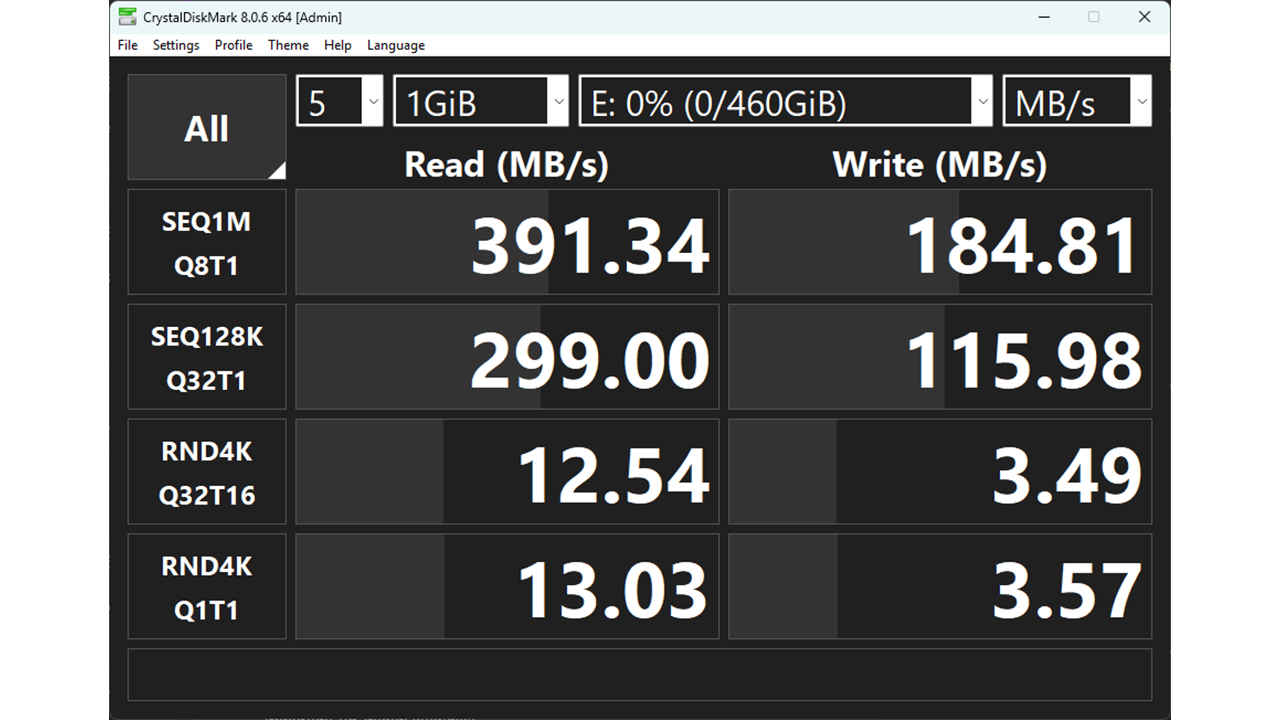
Performance is where you get to see the real picture. In CrystalDiskMark, the SanDisk Extreme Fit drive delivered a sequential read speed of 391.34 MB/s and a sequential write speed of 184.81 MB/s in the SEQ1M Q8T1 test. That is close to SanDisk’s advertised 400 MB/s read ceiling for the higher-capacity variants, so the drive is broadly landing where its official spec suggests it should on reads. SanDisk does not explicitly mention the write speeds on the data sheet, and we can see why. At about half the stated read speed, the writes, are markedly lower.
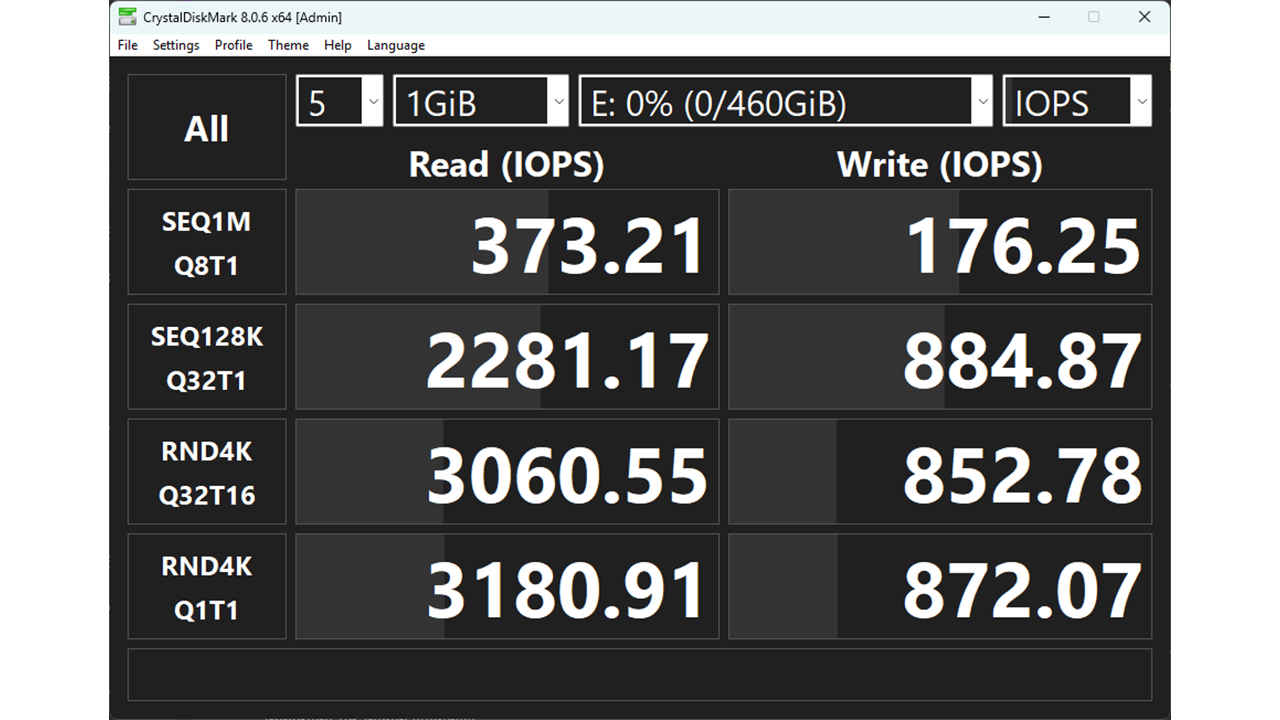
The secondary sequential result, SEQ128K Q32T1, came in at 299 MB/s read and 115.98 MB/s write. Random performance is understandably much lower, with RND4K Q32T16 posting 12.54 MB/s read and 3.49 MB/s write, while RND4K Q1T1 registered 13.03 MB/s read and 3.57 MB/s write. The accompanying IOPS figures back that up, showing this is competent for general flash drive use, but not built for sustained heavy small-file write workloads.
Latency tells a similar story. The standout figure here is the RND4K Q1T1 read latency of 314.23 microseconds, which is fairly tidy for a compact flash drive, but write latency rises much more sharply under pressure. In plain terms, the drive feels best suited to moving large files, carrying media, and handling typical office or academic storage tasks rather than pretending to be a miniature workstation-class SSD.
That is not necessarily a criticism. In fact, it is quite a sensible performance profile for a product of this size. Read performance is the priority for quick access to stored files, and on that front the Extreme Fit does a respectable job. If the workload is mostly reading back videos, opening project folders, or copying a batch of photos from one device to another, it should feel adequately brisk. And this also goes on to prove that the Extreme Fit doesn’t make existing External Portable SSDs obsolete.
The SanDisk Extreme Fit USB-C Flash Drive works because it understands its role. It is not glamorous, and it does not need to be. What it offers is a genuinely tiny footprint, sensible USB-C convenience, respectable sequential read performance, and capacities high enough to make it useful as always-attached storage for modern devices. SanDisk also backs it with a five-year limited warranty, which adds some reassurance for something designed to stay plugged in regularly.
For users who want the speed and endurance of a proper external SSD, this will not be the final answer. But for those who simply want discreet storage expansion in an almost invisible package, the Extreme Fit looks like a well-judged modern flash drive. It is small, practical, and fast enough where it matters most.