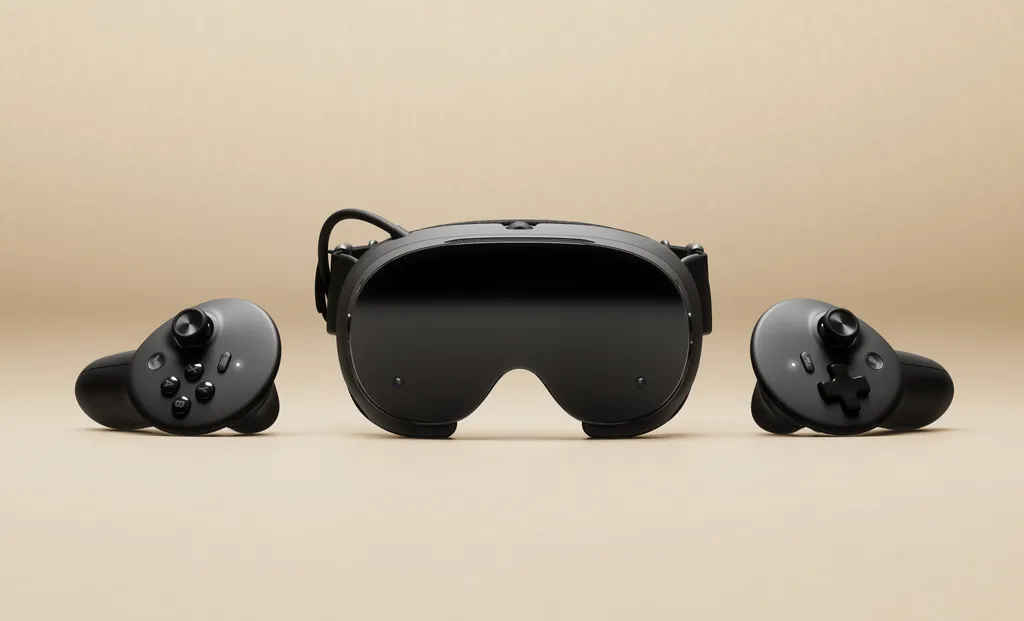
Valve has announced the Steam Frame, a standalone VR headset built to stream PC games with low latency and run Steam titles locally. It runs on a Snapdragon 8 Gen 3 chip and SteamOS. It is aimed at PC gamers who want high-end VR without cables or the need to stay tethered to a desktop. It brings a light 185g core unit, 2160 x 2160 per-eye LCD panels, eye tracking, Wi-Fi 7, and a dedicated low-latency Wi-Fi 6E adapter in the box. Its standout feature is seamless wireless streaming from a PC, supported by a custom dongle that minimises lag. The headset is set to launch in early 2026, and global availability is expected. As for pricing, the company hasn’t disclosed a figure, but has told The Verge that pricing could fall below the 2019 Index headset, which sold for $999 (about Rs 90,000) with controllers and base stations. At that price, the Frame positions itself between mainstream devices like the Meta Quest 3 (about Rs 60,000) and premium ones like the Samsung Galaxy XR (close to Rs 1,60,000) and Apple Vision Pro (roughly Rs 3,10,000). All four headsets share pancake lenses, standalone performance and mixed-reality features, but the differences in display tech, tracking, processing power and ecosystem matter if you intend to buy one. Let’s find out those spec differences here.
Only Meta Quest 3 is currently available in India. You will have to import the rest of the ones.
Unlike its predecessor, the Valve Index, which required a wired connection and external base stations, the Steam Frame supports full wireless VR. The newcomer has a native SteamOS, allowing for playing games locally.
Frame can also stream games from a PC through a bundled Wi-Fi dongle. You just need to plug it into your PC and enjoy streaming. This option matters because PC VR workloads can be heavier than what standalone headsets can handle locally.
Local performance is more complicated. The Snapdragon 8 Gen 3 is fast, and SteamOS on ARM can emulate x86 Windows games, but Valve warns that high-end titles won’t run at Steam Deck levels. Still, the promise of running a large portion of the Steam library natively sets the Frame apart from other headsets that rely on curated app stores.
| Category | Steam Frame | Meta Quest 3 | Apple Vision Pro | Samsung Galaxy XR |
|---|---|---|---|---|
| Launch / availability | Early 2026 | October 2023 | October 2025 | October 2025 |
| Starting price | TBA (below Index expected) | $499.99 | $3,499 | $1,799.99 |
| Weight (core / full) | 185 g (core), 440 g (with strap/rear battery) | 515 g | 750–800 g | 545 g |
| OS | SteamOS (Arm) | Horizon OS | visionOS | Android XR |
| Display type | LCD, pancake lenses | LCD, pancake lenses | Micro-OLED, pancake lenses | Micro-OLED, pancake lenses |
| Resolution (per eye) | 2160 × 2160 | 2064 × 2208 | 3660 × 3200 | ≈4K per eye (3,552 × 3,840 reported) |
| Refresh rate | 72–144 Hz (144 Hz experimental) | 72 / 90 / 120 Hz | 90 / 96 / 100 / 120 Hz | 60 / 72 (default) / up to 90 Hz |
| Processor | Snapdragon 8 Gen 3 | Snapdragon XR2 Gen 2 | Apple M5 | Snapdragon XR2 Plus Gen 2 |
| RAM / storage | 16 GB / 256 GB or 1 TB, microSD | 8 GB / 128 or 512 GB | 16 GB / 256, 512 GB, 1 TB | 16 GB / 256 GB |
| Connectivity | Wi-Fi 7, includes Wi-Fi 6E adapter (dongle) | Wi-Fi 6E | Wi-Fi 6 | Wi-Fi 7 |
| Tracking & sensors | 4 outward monochrome cams, 2 interior eye cams, IR illuminator | 2 RGB cams, inside-out tracking | 6 world-facing cams, LiDAR, TrueDepth, 4 eye cams | 6 world-facing cams, depth sensor, 4 eye cams |
| Passthrough | Monochrome passthrough | Colour passthrough | Advanced colour passthrough | Colour passthrough |
| Eye tracking | Yes | No | Yes | Yes |
| Battery (typical) | 21.6 WHr cell | 19.44 WHr cell | Up to 2.5 hours general use | Up to 2 hours general use |
The Apple Vision Pro and Samsung Galaxy XR use micro-OLED panels with far higher pixel counts than the Frame or Quest 3. The Frame’s LCD panels are still high resolution for gaming, and its pancake lenses reduce bulk, but micro-OLED generally wins on contrast, black levels and perceived sharpness. For gamers who prioritise a smoother frame rate, the Frame’s variable refresh rate within a range of 72–120 Hz may be tempting. The Steam headset can also hit a 144 Hz refresh rate with an experimental setting.
Apple’s M5 is the most powerful SoC here for native apps and spatial computing. Steam’s valve uses a full flat modern high-end mobile SoC. This is followed by Snapdragon XR2 Plus Gen 2 in the Samsung headset and the Meta headset’s XR2 Gen 2.
Valve’s Snapdragon 8 Gen 3 lets SteamOS run Arm builds and implement real-time x86 recompiler technology to expand Steam compatibility. So, while Vision Pro and Galaxy XR target premium mixed-reality apps and Quest 3 targets broad app support, Frame targets the Steam ecosystem with a PC streaming option.
Apple leads on sensor support, including LiDAR, multiple world-facing cameras and refined depth mapping, which fuels precise spatial apps. Samsung and Valve include sophisticated eye tracking. Quest 3 offers capable inside-out tracking and colour passthrough, but lacks eye tracking. For mixed-reality tasks that require accurate depth or object mapping, Vision Pro and Galaxy XR have the advantage. For fast, low-latency controller tracking and PC VR, Frame’s setup, including the Wi-Fi dongle, could be compelling for gamers.
The Frame’s 21.6 Whr battery (built into the headstrap) and light core unit appear to be among the more comfortable choices when measured by on-head weight, though a full head-strap and rear battery could make it heavier. The company hasn’t given a runtime, though. It just says the battery life ‘will be much more variable, depending on the game and its settings.’
Quest 3, with its 19.4 WHr battery, is estimated to run between 2.2 to 2.5 hours, on average, but again, this can depend on the use case.
Meanwhile, Vision Pro and Galaxy XR with higher resolution displays and sensors, and their battery figures reflect that trade-off.
Still and all, for extended VR use, one may have to rely on frequent charges or even external batteries, whichever applicable.
Valve’s Steam Frame is the most interesting entrant for PC-focused VR because of its streaming-first design and native Steam support. It will not replace specialised mixed-reality devices for creators or professionals, and it will not beat Vision Pro or Galaxy XR for display quality, but it may open up a new medium for how Steam users access their libraries away from a desk. Value, comfort and use case will determine the best spatial headset for most buyers. We will keep an eye on Valve’s pricing and see if we get a chance to test it.
Stay tethered to Digit.in for similar stories.
Also Read: Meta Ray Ban Gen 1 smart glasses set to widely release in India on 21 November: Price, availability