The budget wearable market in India is fiercely competitive, and design differentiation and marketing can often make or break perceptions. GoBoult (previously Boult) is a leading player in this space, and the company recently introduced their Mustang Stallion smartwatch. I was invited to its quirky launch event and got a unit of the Stallion for use. It is positioned as the flagship of GoBoult’s official Ford Mustang-licensed smartwatch lineup in India, with a launch price of Rs 3,999 and a standard retail price expected around Rs 4,999.
The Stallion smartwatch sits above other Mustang models like the Racer and Muscle, leaning heavily on automotive-inspired design and a premium narrative even in a budget bracket. So, I spent one week with it to understand how it performs beyond the marketing claims and specs. And what follows is my experience with it on daily use.
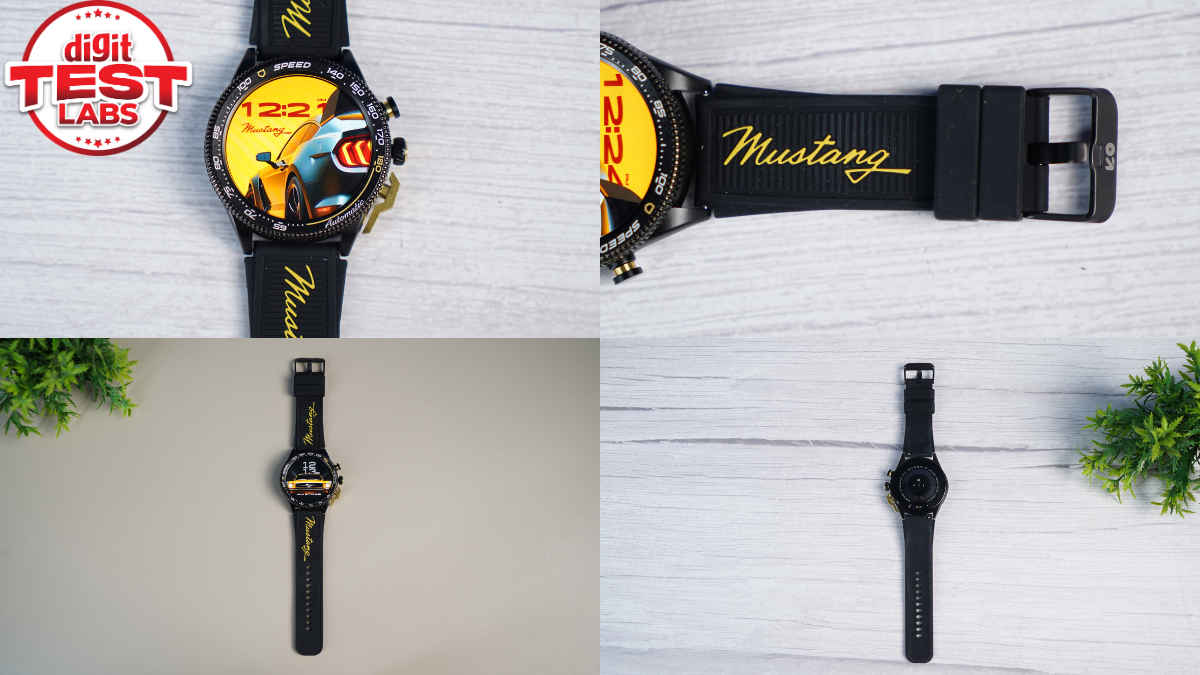
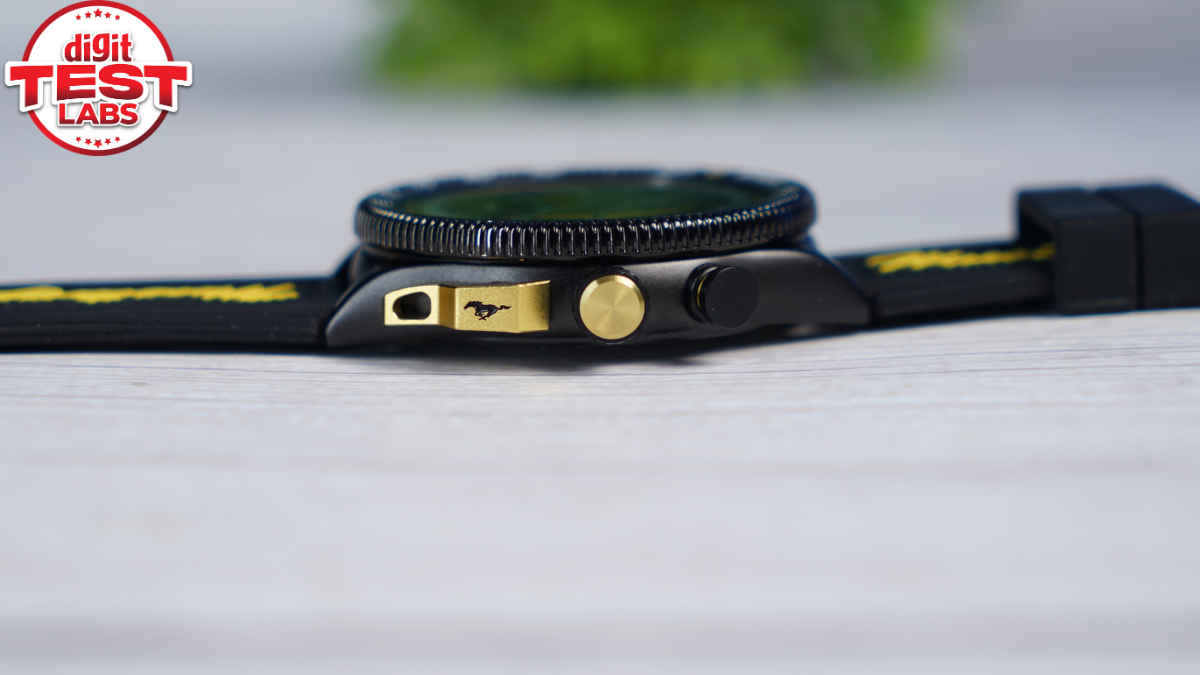
The Stallion’s overall aesthetic is unabashedly bold, with a large dial, chunky buttons on the right side, a physical rotating bezel and coloured buttons along with the Mustang logo on the strap. It attracts glances and can work well with sporty or casual wear. You can pick it in Turbo Orange and Nitro Black (with yellow accents).
The metallic case is solid and heavy, with a substantial presence on my lean wrist. I don’t mind wearing them throughout the day, but I wouldn’t like wearing them for sleep tracking. The buttons are pronounced, and while lifting weights, they do press against the back of the hand. I noticed unintended menu triggers due to this.
The mechanical bezel can be rotated to change watch faces. It is tactile with some flimsiness to its motion. A friend of mine loved rotating it.
The strap quality is good, and it secures well, but again, I would have liked it more if it were plain black. The same applies to the rest of the design language.
What I like, though, is that the Stallion smartwatch is rated IP67 for dust and water resistance. Which means it can handle rain and accidental submersion, but it’s not suited for swimming.
So the Stallion looks intentionally big and flashy, and looks can be subjective. But those colour accents, the choice of fonts for the Mustang branding, the speedometer-like print on the bezel, and the various in-box goodies may appeal to Mustang fans or buyers who prefer loud styling on their wrist.
Also Read: Apple Beats Powerbeats Fit review: Secure workout earbuds that also work for everyday use
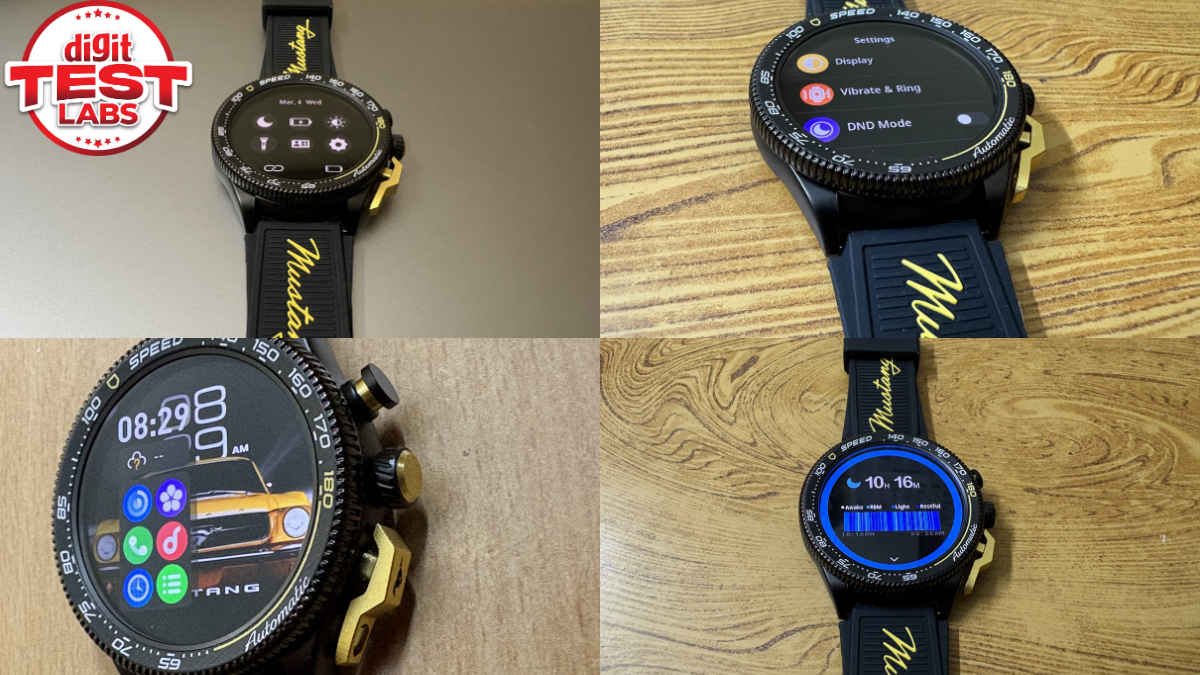
Within that tactile bezel, the Stallion features a 1.43-inch AMOLED touchscreen with 700 nits peak brightness. It offers readable text, vibrant colours, deep blacks, and a useful Always-On Display (AOD). It is legible even under midday sun. The built-in watch faces are tailored for Mustang fans, and one or two of them are relatively sober. They switch quickly with each rotation.
The general animations and transitions are smooth on this UI. Touch responsiveness is good. I didn’t have a problem quickly starting a workout to compare its results against a more premium Android smartwatch.
The navigation options are also easy to learn. On the homescreen, swipe down to open quick settings, swipe up to open the unread messages tray, swipe left to open different widgets like activity rings, sleep metrics, heart rate, SpO2 readings, and weather. Swiping left on the main screen shows a vertical banner of some apps.
You can tap the topmost button called Piston Head to turn on and off the screen and go to the previous screen. Pressing and holding it for a few seconds shows you the power-off menu. Every time you power on or power off the device, there is an engine startup sound. I couldn’t find a setting to disable that.
You can tap the button below it called the Crown to jump to the preceding screen, but while on the homescreen, its purpose is to open the main app menu. The app menu is a vertical list. Pressing and holding the crown button opens the default voice assistant on your phone. In my case, that’s Gemini, and I could get it to check the weather, open Spotify, etc. Quite useful.
And finally, tapping the third button, named Ignition Lever, you can open the workout menu. Pressing and holding it shows you the recent workout data.
So even though the mechanical bezel is not very utilitarian, the touch interface and the three buttons make up for it.
The Stallion pairing was very easy with the GoBoult Fit app. It supports Bluetooth 5.3, and I didn’t have any connectivity issues as long as the phone stays in proximity to the watch. You can make calls, thanks to the built-in mic and speaker setup. The recipient could hear me properly, and I could hear them, but I felt the voice was too low for a loud environment.
The music playback from your phone can be listened to through the watch’s speaker, but the quality is tinny and metallic.
Notifications arrive reliably for calls, messages and alerts from the apps you have enabled in the GoBoult app settings. However, emojis and complex scripts don’t show up as intended.
You get other nice-to-have features like weather, female cycle, find phone, calculator, games, etc.
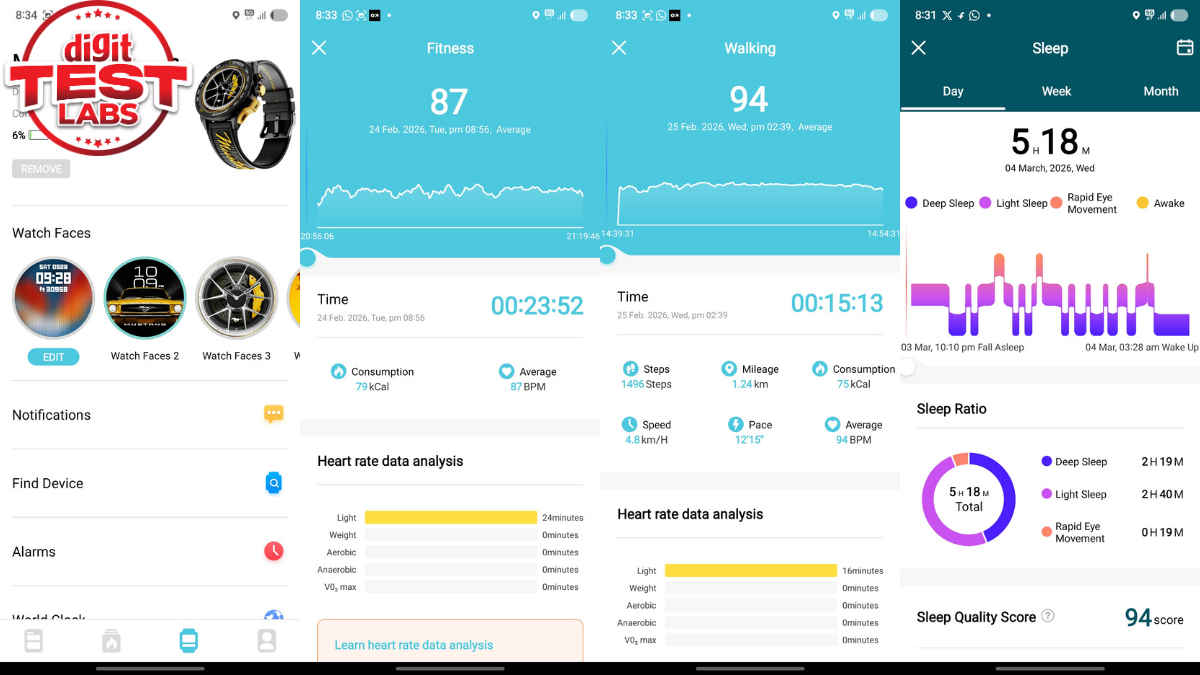
On the phone, the GoBoult Fit app offers useful insights and customisation. The app presents activity history, watch face customisation and other settings. In my week of use, data syncing was generally stable but occasionally required manually opening the app to refresh data.
Watch face options are plentiful. The Face Gallery in the app has over 200 custom options, but only one of the downloaded ones can be kept on the watch. This feels a bit restrictive.
GoBoult lists an extensive set of health tracking features, including continuous heart rate, blood oxygen (SpO2), blood pressure, stress tracking and sleep monitoring, alongside 120+ sport modes.
The heart rate sensor and blood oxygen meter work reliably. I compared it to a more expensive Android smartwatch, and the results were consistent and only deviated by 2-3 points. You can also measure your blood pressure and stress with the GoBoult smartwatch.
Sleep tracking works, but if you wake up in between, the tracking stops. Even if you fall asleep again, the next stretch of sleep is not recorded.
Besides the health trackers, a broad catalogue of sports modes means there is something for most people out there.
All of these and the Stallion can last for days thanks to a 300mAh battery inside. It is claimed to run for up to 7 days. If you use AOD and other features quite often, then the battery life could be shorter. Anyway, after several days of using it on and off, the battery hasn’t died on me yet, and I haven’t had to use its magnetic pogo-pin-based charger (Type A end). The watch is said to fully charge in 1 hour and 6 minutes.
In the sub-Rs5,000 segment, regular design smartwatches crowd the market. While many of these competitors also come with an AMOLED display, Bluetooth calling, and a load of trackers and features, the GoBoult Mustang Stallion also leans on the same playbook of standout design. But beyond that flashiness lies a solid smartwatch with pretty useful features and health tracking. True, its mechanical bezel could have been a more functional implementation, and its design may not be everyone’s cup of tea. But, this watch will most appeal to users prioritising useful features wrapped in a bold design within an affordable package.
Keep reading Digit.in for similar stories.
Also Read: I trusted the V-Guard Crystal TT 100 Plus stabiliser to protect my TV: Here’s how it held up