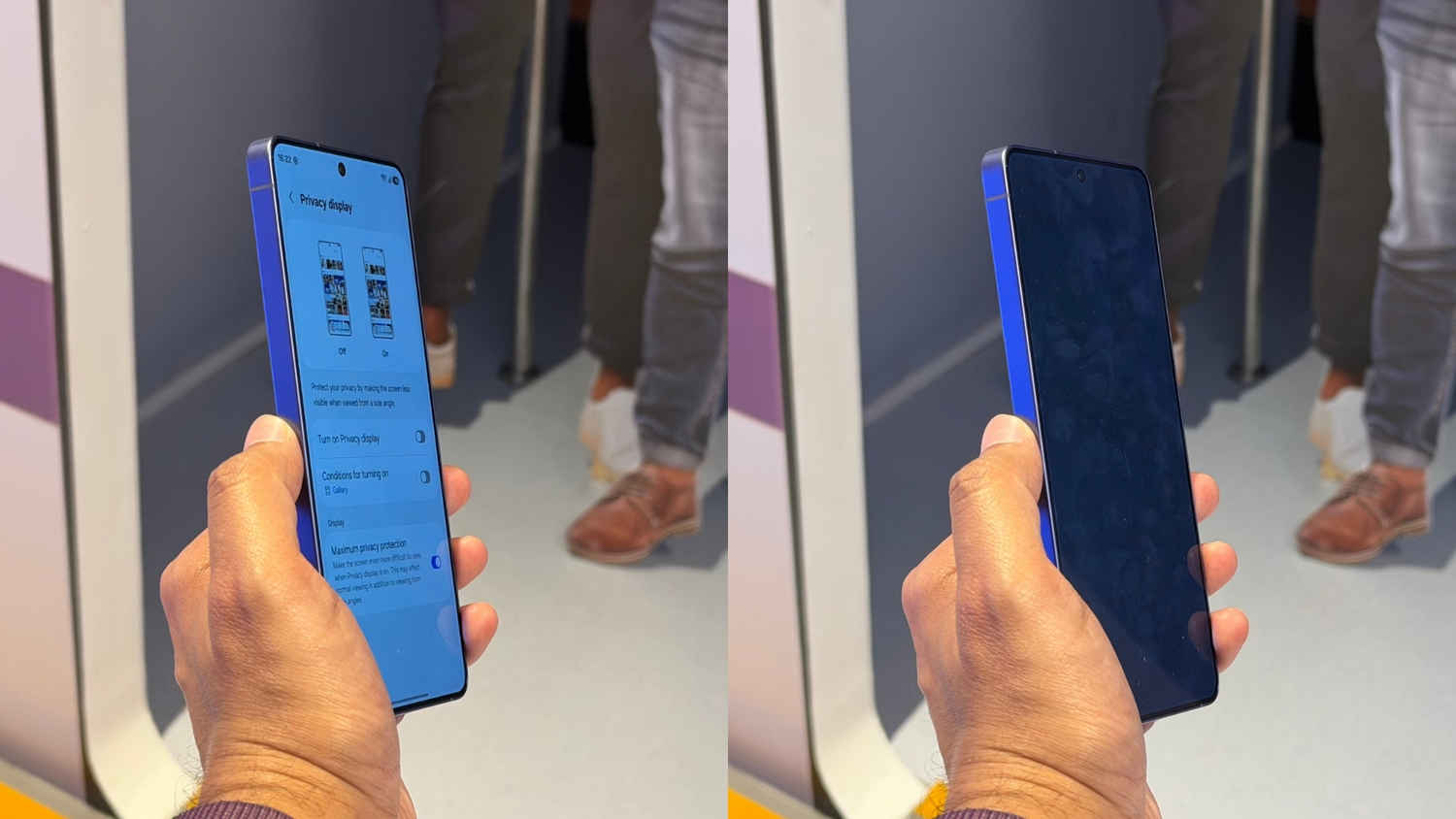
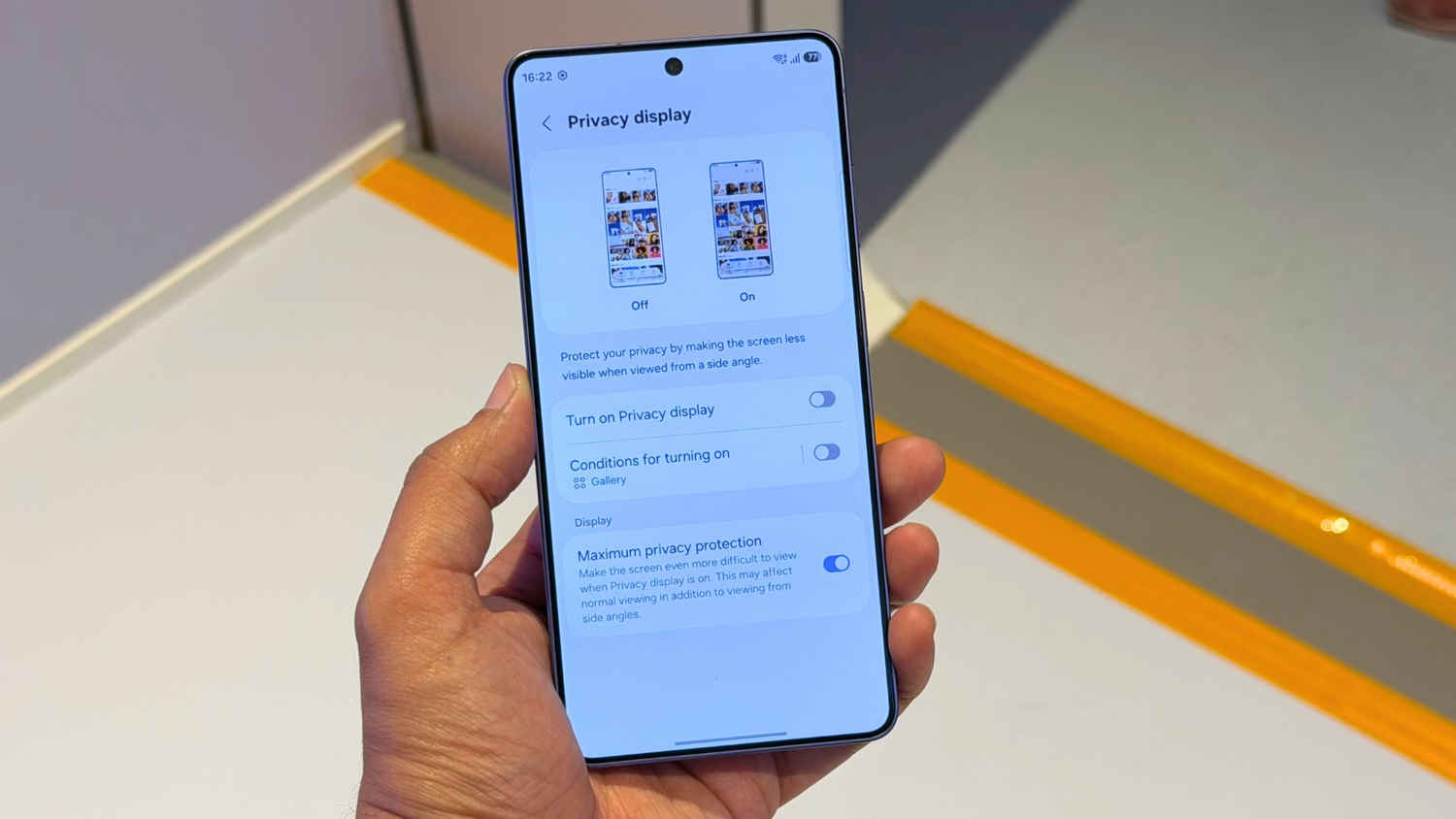
For more than a decade, phone privacy has meant accepting a compromise. Either you let your messages glow freely for any eavesdropper sitting next to you on the metro, or you slap a privacy tempered glass on your screen and live with the dull, slightly muddy look of a permanently filtered display. These third-party filters, while effective at blocking side views, typically come at the cost of dimmed brightness, grainy textures, and permanent colour distortion. With the launch of the Galaxy S26 Ultra (starting at Rs 1,39,999), Samsung is attempting to break this compromise so you’re unbothered by the idea of a peeping Tom casually scanning a banking OTP. Instead of adding a privacy layer on top of the screen, it has built one into the OLED panel itself.
The traditional privacy tempered glass relies on light-blocking layers. It embeds microscopic vertical structures inside the film. Think of them as tiny blinds. Light travelling straight ahead passes through. Light travelling at wider angles gets blocked.
While they secure the screen, the effect is permanent; even when you are alone in your living room, your screen remains dim and the viewing angles are restricted.
The S26 Ultra’s approach is fundamentally different. Samsung describes it as “privacy at the pixel level”. Marketing language aside, what that really means is that the display itself changes how it emits light when privacy mode is activated.
What that means is that this isn’t a stick-on filter, but a switchable optical system embedded inside the OLED stack.
Unlike LCDs, which can manipulate a backlight, OLED pixels are self-emissive. There’s no backlight to manipulate, which makes this harder. Samsung demoed its Flex Magic Pixel technology at MWC 2024 and the Privacy Display on S26 Ultra is its coming of age.
According to Ice Universe, the S26 Ultra uses two optical “gates” embedded in the display stack.
A standard OLED spreads light broadly in a wide cone. This is known as Lambertian emission. It’s why OLED panels look good from almost any angle. To block a snoop sitting at an angle, you need to compress that cone into something narrower and forward-facing.
In the S26 Ultra’s inactive state, the liquid crystal layer above the diffraction structure has matching refractive indices with the surrounding materials. Light passes through normally. The panel behaves like a standard AMOLED.
When privacy mode is activated, voltage reorients the liquid crystal molecules. That changes the refractive index alignment. Wide-angle light is redirected or diffracted away from its original path. It’s no longer travelling cleanly toward the edges of the display.
That redirected light then hits a secondary layer made up of micro-prism structures. Light arriving at extreme angles fails to escape the surface and reflects back into the panel through total internal reflection. In simple terms, it doesn’t make it out to the person trying to snoop from the side.
Meanwhile, light travelling straight toward you passes through the central geometry of the prism structure and exits in a compressed, forward-facing beam. The viewing cone shrinks.
The result is a display that looks normal from the front and noticeably dimmer from the side. If Ice Universe’s breakdown is correct, this is not a simple film substitute. It is switchable refractive index modulation combined with directional light shaping.
This is where the S26 Ultra quietly pulls ahead of tempered glass. Because a physical screen protector covers the entire glass, it is an “all-or-nothing” solution.
Samsung’s hardware-level integration allows the device to limit viewing angles on specific regions of the screen. For example:
Most of the time, you don’t need maximum privacy. You just need the part of your screen containing sensitive information to stop broadcasting itself. That’s something tempered glass simply cannot do.
Let’s be realistic. Despite the marketing narrative, Samsung’s technical documentation includes necessary caveats. The Privacy Screen system narrows the viewing cone. It does not make your screen disappear.
At high brightness levels in a dark room, some light leakage will still occur. A determined eavesdropper at the right angle may catch glimpses. Samsung itself acknowledges that hat “some information may still be visible depending on the viewing environment,” such as ambient light levels and viewing position.
That’s physics. It is an exercise in optical narrowing, reducing the “cone of legibility” rather than achieving a total blackout from the side.
In practice, this means the S26 Ultra reduces casual snooping significantly. It does not defeat someone deliberately trying to spy from two inches away.
The impact on battery life remains a point of interest. While Samsung claims the power draw is minimal, physics dictates that reshaping light emission requires precise energy management.
However, by using Colour Filter on Encapsulation (CoE) technology, which improves light transmittance and removes the traditional polariser, it increases transmittance and may offset some losses introduced by the privacy layer.
Still, if you leave privacy mode on all day, you will consume slightly more power than in standard mode. There’s no free light manipulation. Most people won’t care, but some might notice.
A privacy tempered glass permanently reduces brightness and clarity but costs very little.
The S26 Ultra’s integrated system preserves full display quality when disabled, activates only when needed, and offers localised control. It also adds complexity, potential battery cost, and exists only on the most expensive model.
If you’ve always hated how privacy films dull your screen, this is a meaningful improvement.
If you’ve never used one and don’t worry about onlookers in public spaces, this feature alone won’t justify an Ultra purchase.
| Feature | Privacy Tempered Glass | Galaxy S26 Ultra Privacy Display |
|---|---|---|
| Always On | Yes | No |
| Brightness Loss | Permanent | Likely minimal |
| Color Distortion | Common | Not when off |
| Toggle | No | Yes |
| App-Based Trigger | No | Yes |
| Partial Screen Control | No | Yes |
| Thickness Impact | Adds layer | Integrated |
| AI Integration | No | Yes |
While the technology is a milestone for mobile OLEDs, its rollout remains exclusive to the Galaxy S26 Ultra. Privacy is not a luxury concern and it affects everyone from commuters to students to office workers. Yet Samsung’s decision to limit this hardware to the S26 Ultra raises a pertinent question on the democratisation of privacy.
There might be manufacturing constraints or deliberate product segmentation. Specialised OLED stacks are anyway expensive and harder to produce and yield rates may not support mass rollout yet.
But when a company such as Samsung positions privacy as a core value, locking its most visible privacy feature behind the highest price tier raises eyebrows. Whether this technology eventually scales down to the standard S26 and S26+ models will likely depend on the manufacturing yields of these specialised OLED stacks. If it doesn’t, it starts to look like privacy has a price bracket.
Sure, it is a practical innovation that addresses a real-world problem, but its ultimate success will depend on whether the “pixel-level” protection eventually meets a “wallet-level” reality for the broader market.
Read More: Samsung Galaxy S26 Ultra launched: Here’s what’s new over Galaxy S25 Ultra