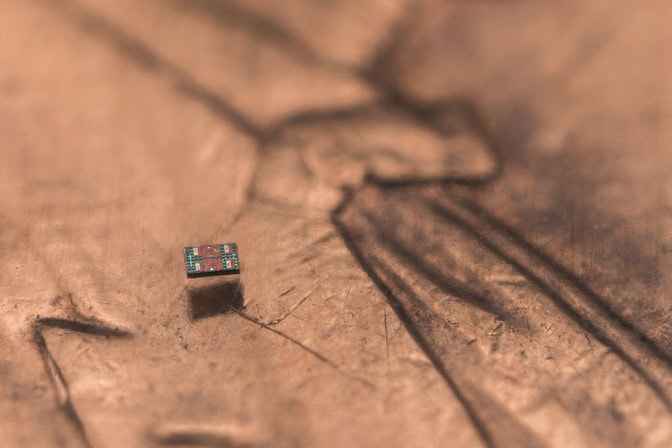
In a lab experiment that sounds closer to science fiction than engineering, researchers have unveiled what they describe as the world’s smallest fully programmable robot. Measuring just fractions of a millimetre and smaller than a grain of sand, this tiny machine can sense its environment, make decisions, and perform tasks autonomously. Developed by teams at the University of Pennsylvania and the University of Michigan, the robot marks a major leap in microrobotics, where size constraints have long limited intelligence and control.
Despite its near invisibility to the naked eye, this robot is not a passive micro-device. It is a complete system. It has computing, sensing, power, and movement capabilities packed into a structure that could one day be mass-produced at extremely low cost. Here are five of the most remarkable things it can already do.
Also read: Google CC AI assistant explained: Reads emails and calendars to give you a daily morning brief
Unlike earlier microscopic machines that relied on external control, this robot carries its own onboard computing system. That allows it to process information and follow programmed instructions independently. At this scale, even simple decision-making is a breakthrough, since traditional processors and memory components are far too large. The robot’s ability to execute logic on its own opens the door to true autonomy at microscopic sizes.
Conventional motors do not work at this scale because fluid resistance overwhelms mechanical motion. Instead, the robot moves using electrical forces. By generating an electric field, it pushes charged particles in the surrounding liquid, which in turn propels the robot forward. This elegant solution allows controlled movement in fluid environments, where many future applications are expected to exist.
There are no batteries onboard. Power comes from light. Tiny photovoltaic components harvest energy from external light sources, which also double as a way to program the robot’s behavior. By flashing specific light patterns, researchers can upload instructions and activate functions. This wireless power and programming method avoids the need for physical connections that would be impossible at this scale.
Also read: Makop Ransomware targets India: What the new attack means and how to stay safe
Even at its microscopic size, the robot can detect differences in temperature around it. When it senses a change, it can alter its movement or behavior accordingly. This makes it responsive rather than purely mechanical, a key requirement for future uses in environments that are complex or constantly changing.
Perhaps the most surprising aspect is cost. Researchers believe that, at scale, each robot could be produced for around one cent. That makes swarm applications realistic. Instead of relying on a single complex machine, thousands or even millions of these robots could work together, performing tasks cooperatively and redundantly.
While practical deployment is still years away, the implications are enormous. From monitoring individual cells inside the human body to assembling microscopic components in manufacturing, these tiny programmable robots hint at a future where intelligence exists at scales we once thought impossible.
Also read: India becoming world’s most important AI developer hub, says GitHub