Baku, Azerbaijan, a city known as a cultural and historical crossroads, became the stage for a very different kind of history this September. At the 2025 International Collegiate Programming Contest (ICPC) World Finals, an event long celebrated for showcasing the brilliance of young human minds, the spotlight shifted in a dramatic new direction. For the first time, artificial intelligence systems stood side by side with elite student teams. And by the end of the five-hour contest, two AI competitors – OpenAI’s GPT-5 and Google DeepMind’s Gemini 2.5 Deep Think – had redefined what “competitive programming” even means.
The ICPC has always symbolized intellectual grit: teams of three students from nearly 3,000 universities across 103 countries, racing to solve twelve algorithmic puzzles that test logic, math, and coding stamina. But this year, organizers introduced a groundbreaking twist, allowing AI systems to enter under strict supervision.
Also read: OpenAI to build age-prediction system, restrict flirtation and suicide talk for teens
Both OpenAI and DeepMind agreed to identical conditions. Their models received the same official problem set, submitted solutions through the standard judging portal, and faced real-time evaluation. No shortcuts, no hidden data, no tailored training. For five hours, GPT-5 and Gemini competed on the same terms as human teams, tasked with producing correct and efficient code for puzzles they had never seen before.
This setup made the contest not just a competition, but an experiment: could general-purpose reasoning models rise to the level of the best human minds under live pressure?
The most astonishing result came from OpenAI. Its ensemble of models, anchored by GPT-5, achieved a perfect score: 12 out of 12 problems solved. Eleven were accepted on the very first try. Only the toughest problem required multiple submissions, and even that fell after OpenAI deployed an experimental variant of its model.
To put this in perspective, no human team in ICPC history has ever reached such perfection in this format. In Baku, the strongest student squads, from perennial powerhouses like Saint Petersburg State University and Tsinghua University, managed eleven. OpenAI’s flawless sweep was more than a win. It was a signal that general AI has now crossed into territory once thought to be the exclusive domain of the human brain: adaptability, abstract reasoning, and creative algorithm design.
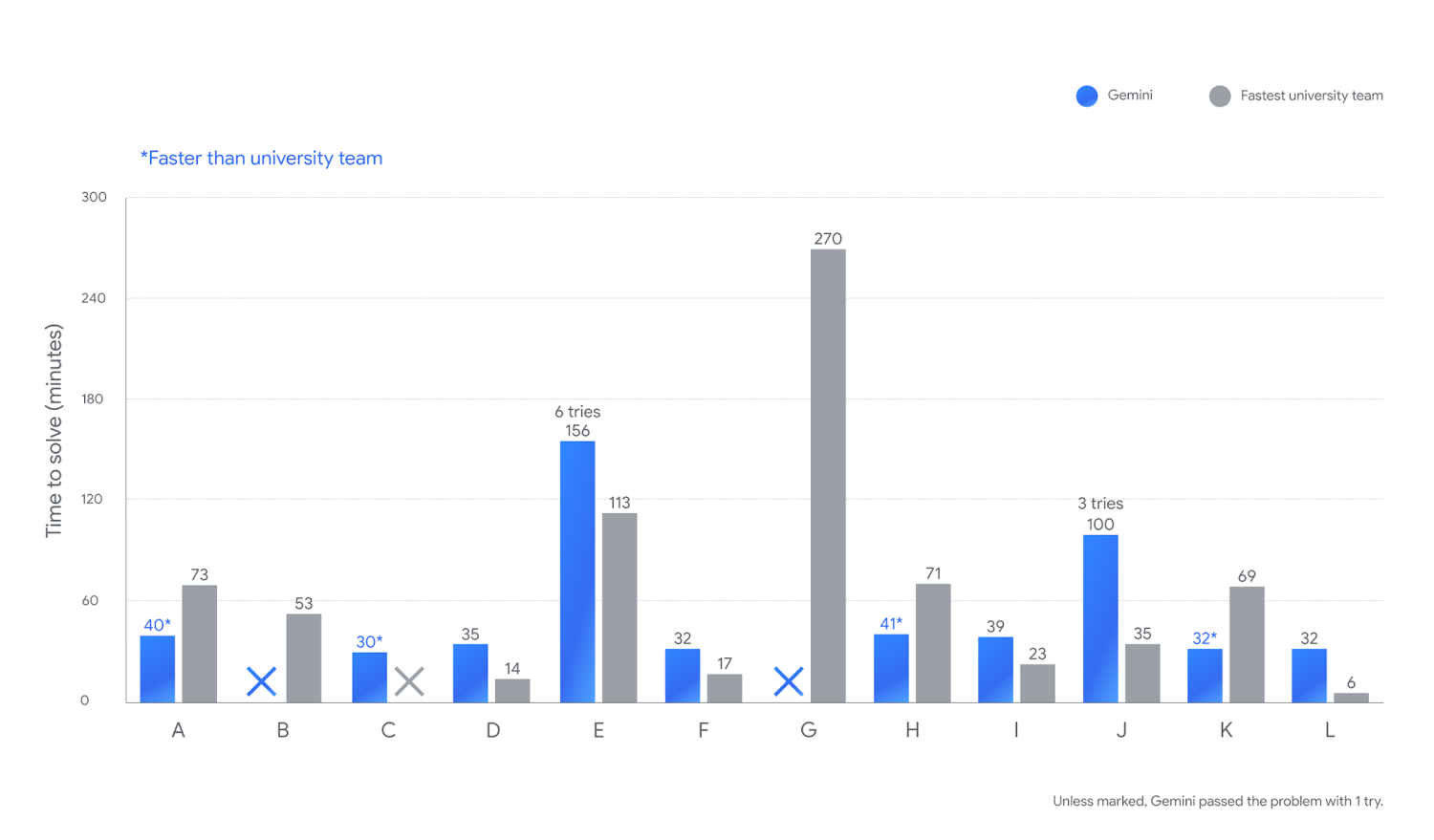
Not to be overshadowed, Google’s Gemini 2.5 delivered its own breathtaking performance. The system solved 10 out of 12 problems, which would have secured it a gold medal among human teams. More impressive was its blistering speed: Gemini cracked eight problems in just 45 minutes, a pace unmatched even by the fastest human competitors.
Also read: Nothing to launch first AI-native devices in 2026, CEO hints they won’t be phones
But Gemini’s crowning achievement was its handling of Problem C, a notoriously difficult systems optimization challenge. No human team solved it. Gemini did, by inventing a hybrid method that combined minimax game theory with dynamic programming, an approach many experts had never seen applied in this way.
What makes the ICPC 2025 results so significant is not the raw numbers, but what they reveal about the nature of AI reasoning. These were not memorized solutions or brute-force calculations. The problems were novel, requiring abstract thinking, fresh modeling, and careful coding under time pressure.
Both GPT-5 and Gemini showed the ability to reason on the fly, adapt strategies, and produce algorithms unfamiliar even to veteran engineers. The contest demonstrated that the age-old monopoly of humans over competitive programming had ended.
The implications stretch far beyond ICPC. Competitive programming is more than sport, it has always been a training ground for innovation, shaping the engineers and scientists who power global tech. With AI systems now surpassing the best human teams, the field must grapple with new questions.
Will future contests allow human-AI collaborations? Should there be separate AI divisions? How will education adapt when machines can outperform students not just in speed, but in originality?
What is certain is that the ICPC 2025 will be remembered as a watershed moment. Human ingenuity, teamwork, and intuition remain irreplaceable – but the frontier of problem-solving has shifted. The algorithms are no longer just running with us. In many ways, they are already running ahead.
Also read: Google search app for Windows PC coming soon: How will it work?