Ever since it released the Snapdragon X Elite in 2024, Qualcomm’s stated that its ambitions in the PC market have always been bold. The company set out to prove that ARM-based Windows laptops could be powerful, efficient, and competitive to rival x86 systems from Intel and AMD.
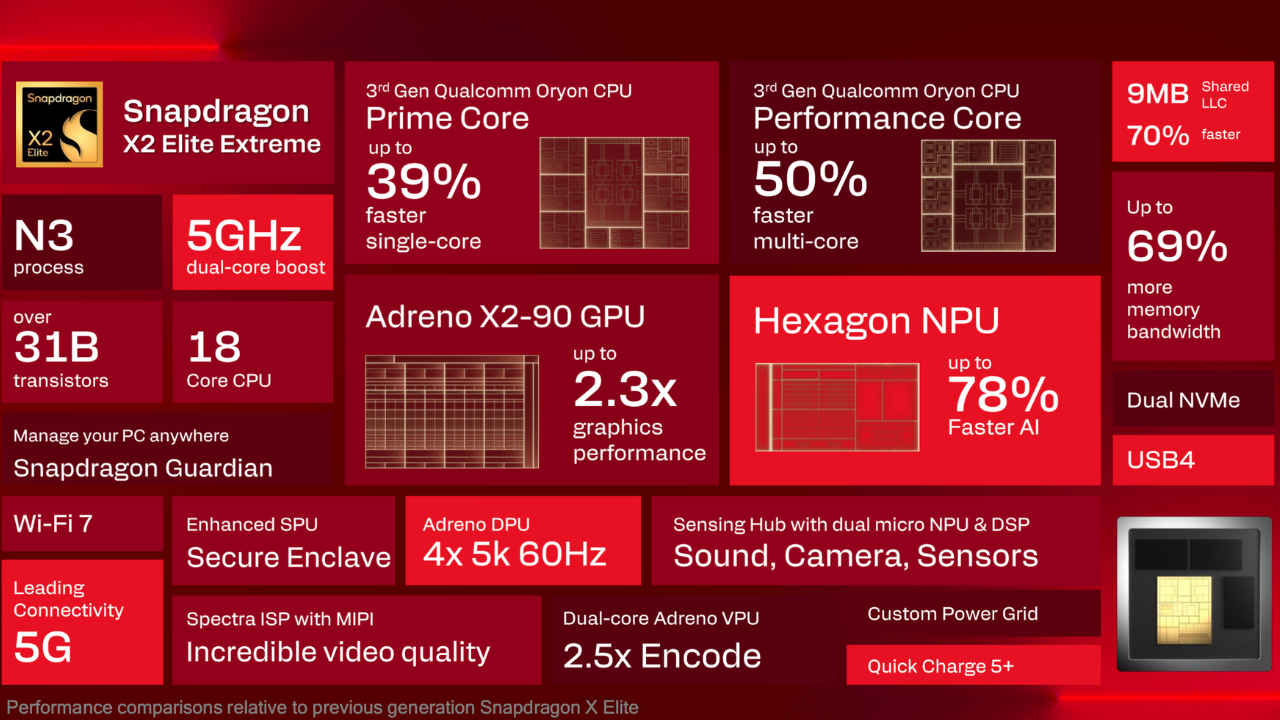
One look at its successor, the Snapdragon X2 Elite, demystified in great detail at Qualcomm’s 2025 architecture deep dive in November 2025, makes it crystal clear that it’s more than a spec bump. Built on TSMC’s 3nm (N3 process node), and available in 12-core and 18-core (X2 Elite Extreme) configurations, it’s an aggressive doubling down on what a PC SoC needs to be in the age of multimodal AI, persistent on-device copilots, and high-efficiency AI agents running locally around the clock.
At the heart of the platform is a redesigned compute subsystem integrating a new Oryon CPU cluster, next-gen Adreno GPU, an upgraded Hexagon NPU, high-bandwidth memory pathways, smarter power delivery, and a connectivity suite that borrows heavily from Qualcomm’s exemplary mobile heritage. It’s all stitched together into a unified architecture built for delivering maximum performance at minimum power draw, and performance per watt that Qualcomm claims is best in class.
At the heart of the SoC is a refined Oryon CPU cluster delivering higher peak and sustained performance over the first-gen X Elite. According to Qualcomm, the 3rd gen Oryon CPU on the Snapdragon X2 Elite chip sports a refined microarchitecture with deeper instruction-level parallelism and enhanced caching hierarchy for lower-latency memory access.
There’s increased focus in its design and layout for efficient power-state transitions for better battery life for all-day compute workloads. Optimized thermal behaviour, letting laptops stay fanless longer as well.
Also read: Qualcomm introduces Snapdragon X2 Elite and X2 Elite Extreme putting Intel and AMD on alert
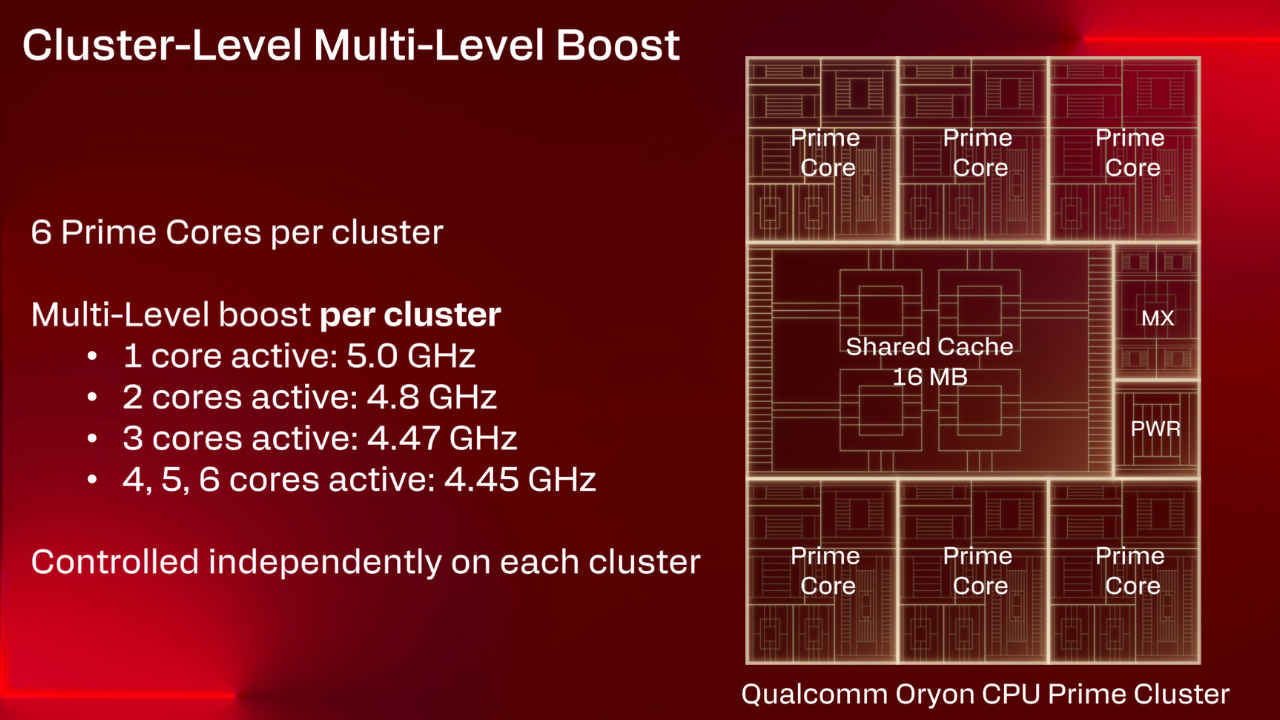
Depending on the load, the Oryon CPU’s prime core clusters can have any number of cores active – when only a single core is active it can run at 5-GHz, when two cores are active the frequency drops to 4.8-GHz, when three cores are running it further drops to 4.47-GHz, and finally it bottoms out at 4.45-GHz whenever there are more than three active cores running on the CPU. That’s quite fast, in case you didn’t notice!
Compared to Snapdragon X Elite (the predecessor), single core performance has gone up by almost 40% and performance core numbers have improved by up to 50% in Snapdragon X2 Elite’s Oryon CPU, according to Qualcomm.
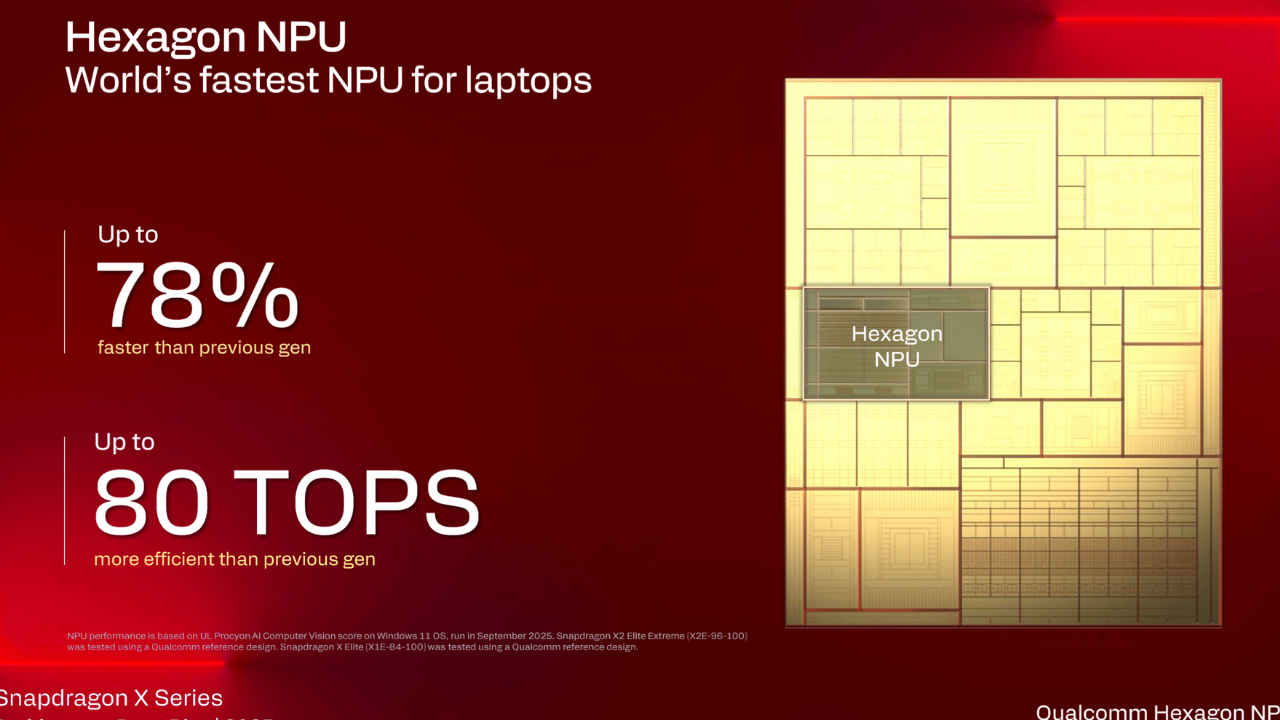
Paired with the 3rd gen Oryon CPU on the Snapdragon X2 Elite chip is an upgraded Hexagon NPU, now clearly positioned as the “primary engine” for everyday AI tasks. With as much as 80 TOPS more efficient than previous gen and 78% faster in processing throughput, the new Hexagon NPU is laying down the marker for all kinds of AI workloads expected on a Windows 11 laptop in 2026 and beyond.
The NPU’s expanded tensor engine capabilities allows it to not only better handle multi-modal and agentic AI models, but do that at significantly lower power consumption during sustained inference activities on the Qualcomm Snapdragon X2 elite chip.
Without a shadow of doubt, the NPU is the centre-piece of all AI-related tasks. Everything from running large language models locally or doing on-device transcription and translation tasks, to video and audio enhancement using AI or letting background assistant-style agents crunch work on your behalf, almost all of it will knock at the NPU’s door on Windows 11 laptops running on Snapdragon X2 Elite chips.
Not just for the Hexagon NPU alone, Qualcomm highlights significant gains in inference throughput, lower power draw, and smoother switching between CPU/GPU/NPU depending on the AI workload type. What this essentially translates to the everyday laptop users is that AI runs more often, more intelligently, and more efficiently on the Snapdragon X2 Elite chip.
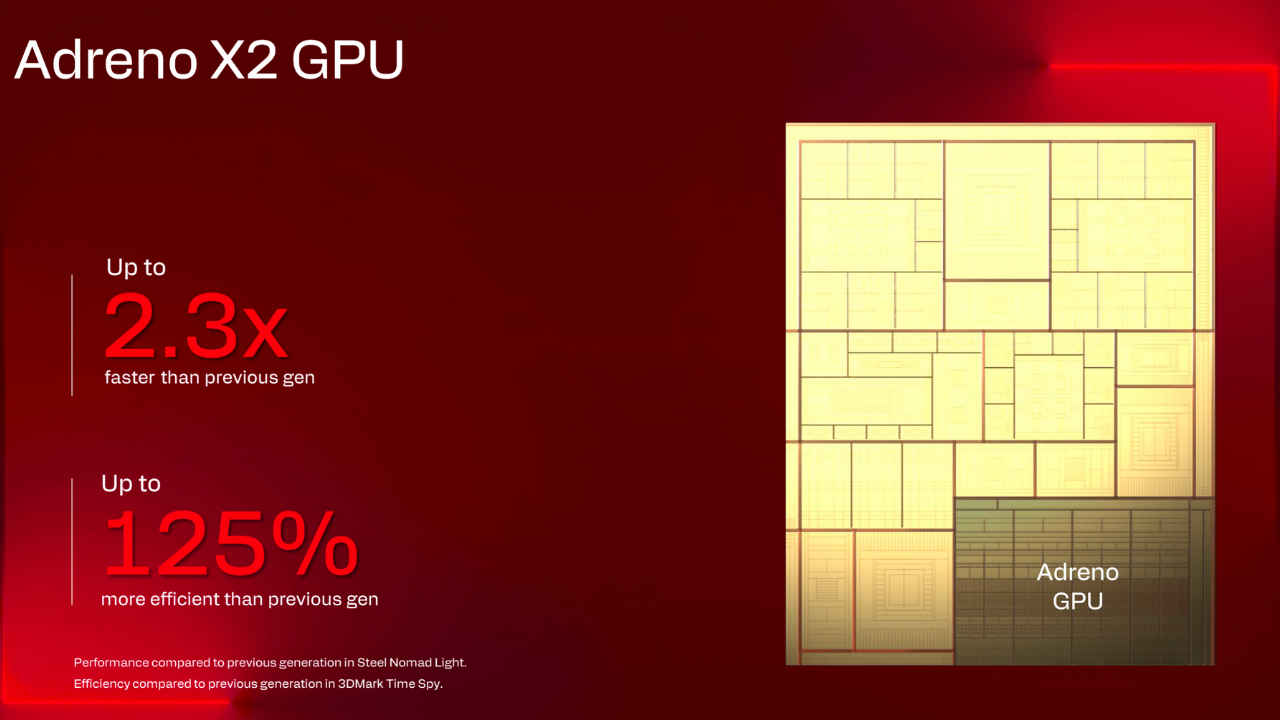
The next-gen Adreno X2 GPU inside the Snapdragon X2 Elite aims for balanced performance instead of raw gaming horsepower at the cost of battery efficiency. Qualcomm’s focus in this regard is visible in its Adreno X2 GPU design priorities, which is all about high efficiency, sustained stability, and strong AI parallel compute.
The Adreno X2 GPU isn’t just responsible for graphics processing, but also runs AI workloads (whenever the NPU is overloaded), vision inference and display composition, among other things. Its integration with the memory subsystem and NPU allows Snapdragon X2 Elite laptops to offload AI tasks to whichever engine is most efficient at any given moment.
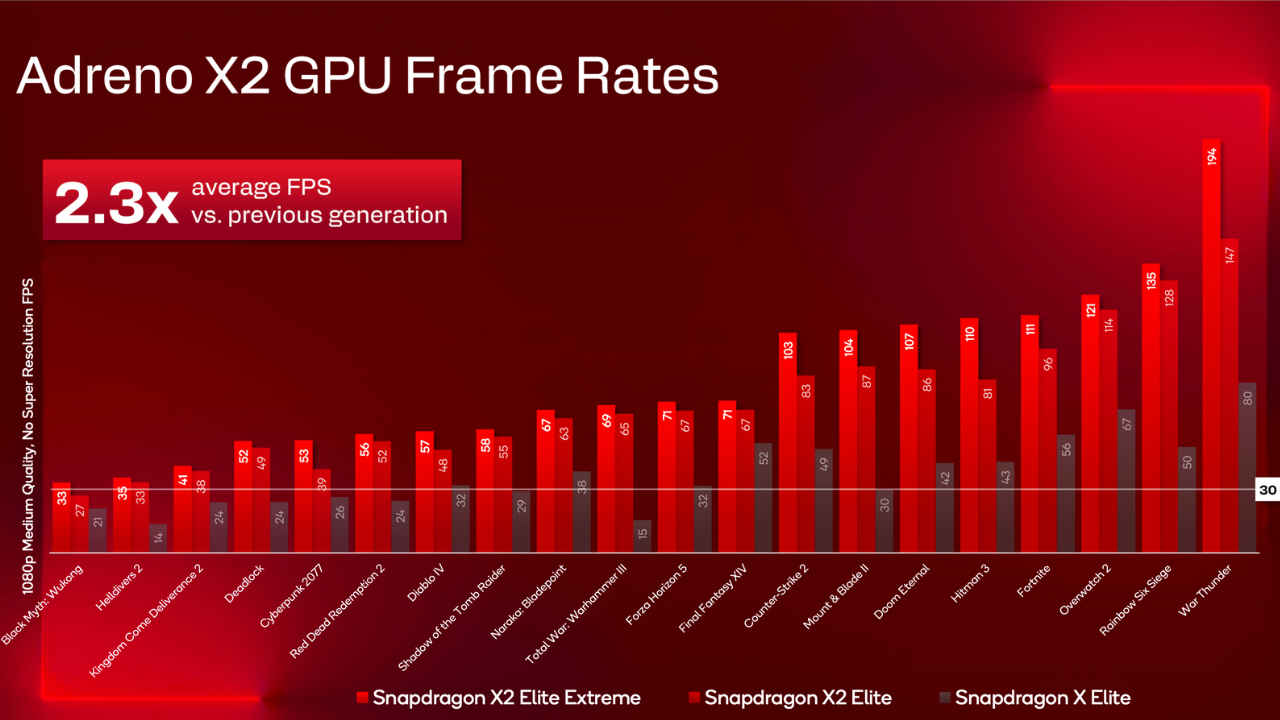
In the raw graphics and gaming department, the Snapdragon X2 Elite shows it’s truly raised its performance game compared to last-gen Snapdragon X Elite chips. According to Qualcomm, for popular battle-royale games like Fortnite and Overwatch 2, the Snapdragon X2 Elite as well as X2 Elite Extreme laptop configurations returned between 80-90 fps and over 100 fps, respectively.
Even latest demanding and AAA titles like Black Myth Wukong, Helldivers 2 and Cyberpunk 2077 managed to clock over 30 fps at 1080p medium settings. Overall, Qualcomm is claiming more than double the performance improvements on Snapdragon X2 Elite vs X Elite.
One of the clearest structural insights from the Qualcomm architecture deep dive into the Snapdragon X2 Elite chips is the upgraded memory subsystem. The newer SoC has high-speed LPDDR memory controllers, more efficient fabric interconnect and improved cache coherency across compute blocks.
This is critical to ensure that the CPU, GPU, and NPU of the Snapdragon X2 Elite SoC all have fast access to shared data without bottlenecks, which is an increasingly necessary requirement for AI workloads that blend instructions across heterogeneous processors.
Qualcomm’s platform overview of the new Snapdragon X2 Elite makes it abundantly clear how the chip retains the company’s signature advantage – something that Intel, AMD or even Apple don’t have right now. Which is the tight integration of 5G, Wi-Fi 7, Bluetooth, and Location-aware services. This is only possible due to Qualcomm’s legacy mobile and telecom radio heritage.
This enables always-connected PC experiences, better standby power performance, and seamless multi-device connectivity, all of which are features Qualcomm has refined through over a decade of mobile chip leadership.
Qualcomm also points out enhancements to its power delivery blocks, signaling that power routing and gating have been redesigned for consistency and efficiency across compute clusters.
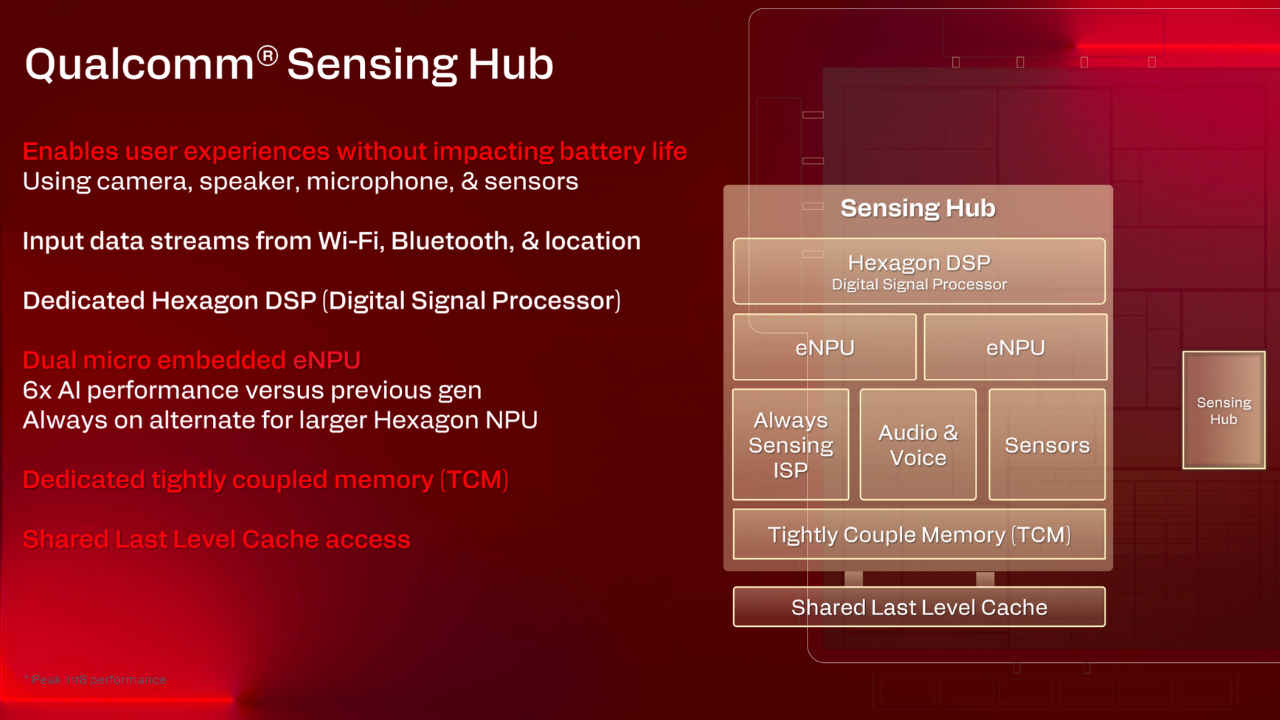
There’s granular voltage/frequency adjustments, thermal-aware task scheduling, and more importantly adaptive power domains across CPU, GPU, NPU, ISP, and display. This allows laptops based on the Snapdragon X2 Elite to deliver high peak performance when needed but sip power during everyday productivity or AI background processes.
The Snapdragon X2 Elite represents Qualcomm’s most confident swing yet at redefining the Windows PC. As far as I’m concerned it tries to marry the best of both worlds, mobile and PC, to try and reshape the AI PC paradigm.
The X2 Elite has the efficiency of a mobile SoC, while still delivering the compute heft of a modern-day AI-ready laptop processor. It’s built for AI accelerated workloads on the edge like never before, thanks to a next-gen NPU, all while having the always-on connectivity stack of a flagship smartphone.
Qualcomm believes that AI will be running on your PC all the time, in the background, and the chip must be built for that reality. With the Snapdragon X2 Elite, Qualcomm is not just keeping pace with the AI PC revolution – it is helping define what the next phase should look like.
Also read: Qualcomm hints at 6G rollout by 2028, says AI will soon be everywhere