Indian Semiconductor chips
For decades, the global semiconductor industry has been dominated by a handful of technological giants, with supply chains spanning continents and design hubs concentrated in Silicon Valley and East Asia. However, a quiet revolution is brewing in India, spearheaded by academic institutions, research labs, and government initiatives. The “Made in India Chips” program, prominently displayed at events like SEMICON India, signals a decisive shift towards self-reliance in this critical technology. Far from being a singular product, this initiative is a mosaic of specialized chips, each addressing unique challenges and propelling India into a new era of technological sovereignty.
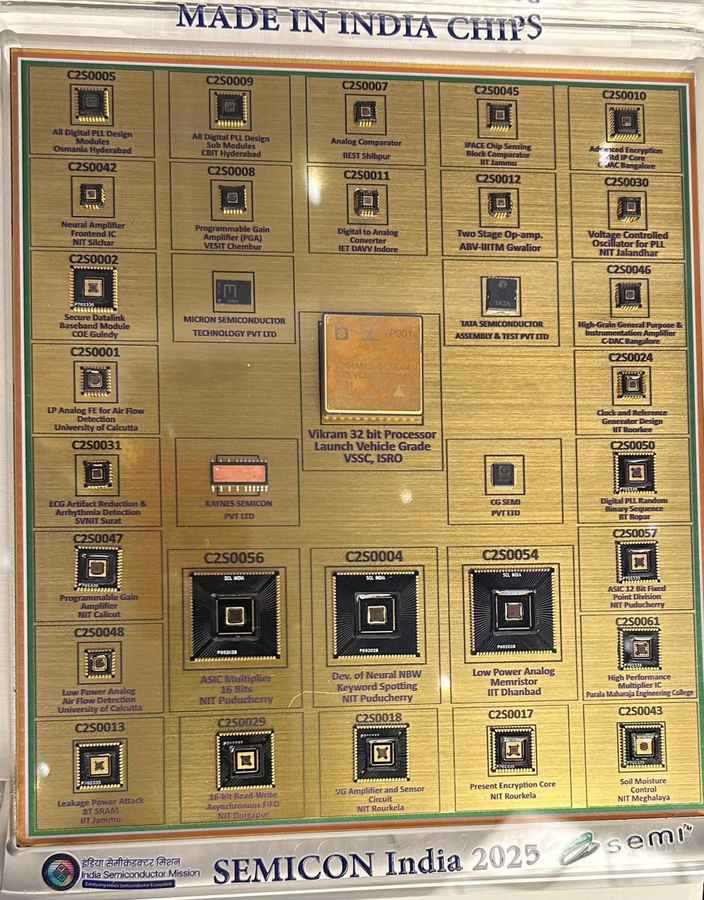
The accompanying display, showcasing a variety of chips developed within India, offers a fascinating glimpse into this burgeoning ecosystem. Let’s delve into some of these groundbreaking innovations and their profound implications.
At the heart of India’s indigenous chip efforts lies the Vikram-32 Processor, a 32-bit microprocessor developed by the Indian Space Research Organisation (ISRO). This isn’t just another chip; it’s a testament to India’s ambition in space and defense. Unlike the processors found in our smartphones or laptops, the Vikram-32 is engineered to be “space-grade.” This means it can withstand the harshest environments imaginable: the vacuum of space, extreme radiation exposure, wild temperature swings from -55°C to 125°C, and the violent vibrations of a rocket launch.
Also read: GenAI effect: US college students are questioning value of higher education due to AI
Its primary role is nothing short of mission-critical: serving as the intelligent brain for India’s launch vehicles and satellites. It meticulously handles navigation, control, and mission management, executing complex, real-time calculations to ensure precision and stability in orbit. The development of Vikram-32 signifies a massive leap in securing India’s strategic autonomy in space, reducing dependence on foreign components that can be both costly and come with geopolitical implications.
Among the featured innovations is an All-Digital PLL Design from Osmania University. A Phase-Locked Loop (PLL) is a foundational circuit in modern electronics, essentially acting as a frequency and phase synchronizer. It generates an output signal whose phase is locked to the phase of an input signal, ensuring stable and precise timing.
The “all-digital” aspect is significant. By implementing PLLs entirely with digital components, they become more robust against electrical noise, easier to integrate into complex digital systems, and less susceptible to manufacturing variations that plague analog counterparts. These chips are indispensable for applications requiring accurate clock generation, such as in microprocessors, communication systems, and high-speed data transfer.
The future of medicine and human-computer interaction is also being forged in India. NIT Silchar’s Neural Amplifier chip is a prime example. This highly specialized, low-noise amplifier is designed to detect and magnify the incredibly weak electrical signals produced by neurons – the fundamental units of our brain and nervous system.
Also read: From free calls to India’s AI revolution: 5 highlights from RIL AGM 2025
Neural amplifiers are crucial components in advanced medical devices. They are used in neural recording systems for studying brain activity, in diagnostic tools for neurological disorders like epilepsy, and critically, in the burgeoning field of brain-computer interfaces (BCIs) and neuroprosthetics, where they can help restore lost functions or enable direct control of external devices with thought.
In an increasingly interconnected world, data security is paramount. IIIT Jabalpur’s Advanced Encryption Chip addresses this critical need by building cryptographic capabilities directly into hardware. This chip is designed to perform encryption and decryption algorithms at high speeds, offering a robust defense against unauthorized access and cyber threats.
Hardware-based encryption is inherently more secure and faster than software-based solutions, as it is less vulnerable to software exploits and can process data much more efficiently. Such chips are vital for safeguarding sensitive information in national defense systems, secure communication networks, financial transactions, and critical infrastructure.
The display also highlights ASICs (Application-Specific Integrated Circuits), exemplified by the “ASIC Multiplier” from NIT Puducherry. Unlike general-purpose processors, ASICs are custom-designed for a single, specific task. This specialization allows them to achieve unparalleled performance, power efficiency, and compactness for their intended function.
An ASIC Multiplier, for instance, is engineered solely to perform multiplication operations with extreme speed, making it invaluable in digital signal processing, graphics rendering, and any application requiring rapid, repetitive calculations. The development of ASICs underscores India’s capability to create highly optimized, bespoke silicon solutions for niche yet demanding requirements.
The “Made in India Chips” initiative, encompassing projects from ISRO’s space-grade processors to specialized circuits for medical, security, and computing applications, represents a strategic national endeavor. It’s an investment in intellectual capital, a commitment to technological independence, and a bold step towards securing India’s place as a significant player in the global semiconductor landscape. As these chips move from research labs to real-world deployment, they promise to power a future where India not only consumes technology but also innovates and produces it, fostering a truly “Aatmanirbhar Bharat” – a self-reliant India.
Also read: What is GIGW 3.0: Indian govt’s design guidelines for official websites and apps