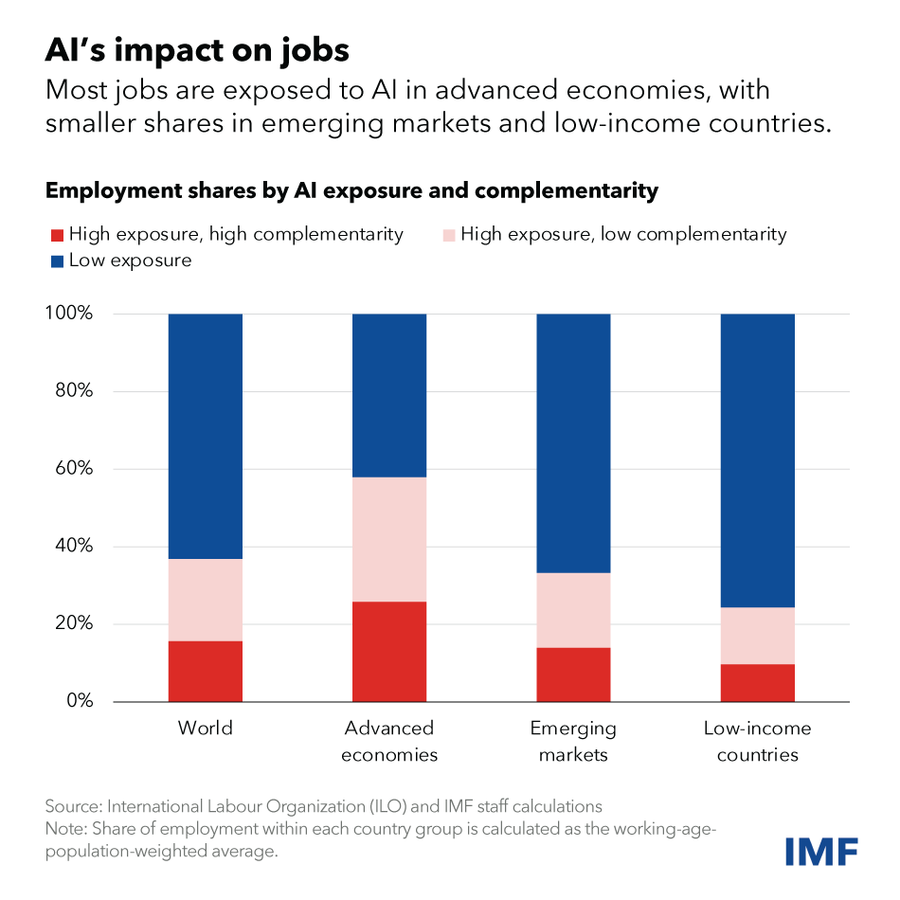
When Jensen Huang stands before an Indian audience and evokes the “Internet Era,” he isn’t just selling hardware; he is invoking a cultural core memory. For India, the internet wasn’t just a technology, it was the ladder that pulled millions into the middle class, turning cities like Bengaluru and Hyderabad into global nerve centers. By framing AI data centers as the next great job engine, Huang is betting that physical infrastructure will ignite a second industrial revolution. But this optimism collides head-on with a more clinical reality from the IMF, whose warnings of a 40% job displacement suggest that the very technology Huang is building might automate the ladder out from under the next generation of Indian workers.
Also read: Claude Opus 4.6 vs GPT-5.3 Codex: Who is leading the coding agent race
The tension between these two perspectives lies in the definition of “work.” The IMF’s warning that AI could disrupt 40% of global jobs is rooted in the reality of the software and service layer. For a nation like India, which became the world’s back office by mastering routine cognitive tasks, the IMF’s stance feels like an urgent alarm. They are highlighting a “white-collar” vulnerability where the very skills we spent decades honing – coding, basic analysis, and customer support – are now being handled by the models Nvidia’s chips power. From this perspective, the “reality” is a painful transition where the displacement of the old happens faster than the creation of the new.
Also read: Amazon MGM’s AI Studio explained: Generative video as a tool for film and TV productions
Huang’s vision, however, shifts the focus from the screen to the soil. By calling AI data centres the “new factories,” he is arguing that we are moving into a phase of “structural labor.” He suggests that the sheer scale of investment required, driven by India’s aggressive 20-year tax holidays and $200 billion targets, will necessitate a massive, multi-disciplinary workforce. This isn’t just hype for the sake of selling H100s; it’s a recognition that you cannot have a digital revolution without a physical one. To Huang, the “job boom” is real because a data centre is a high-voltage, high-maintenance facility that triggers a ripple effect through construction, power management, and local supply chains, effectively mimicking the job-heavy industrialization India has long sought.
The bridge between these two views is the “downstream” reality. While a data centre might only employ a few hundred people to keep the servers humming, the compute power it provides is meant to be the oxygen for a million new startups. This is where Huang’s “Internet Era” comparison is put to the test. The internet didn’t just create “internet jobs”; it enabled every other business to function differently. If India can use this localized compute to build “Agentic AI” services that solve domestic problems in agriculture or healthcare, then Huang’s boom becomes a tangible reality. However, if we only build the “land” (the data centres) without the “crops” (the AI applications), the IMF’s displacement fears will dominate the narrative.
Ultimately, we have to move past the binary of “jobs created versus jobs lost.” The reality emerging in 2026 is that the labor market is being re-indexed. Nvidia’s “boom” is a structural reality – the money is flowing, the concrete is being poured, and the hardware is arriving. But the IMF’s “displacement” is the human reality – the friction of a workforce that must pivot from being “doers of tasks” to “architects of agents.” Huang provides the roadmap for the country’s GDP, but the IMF provides the warning for the country’s people. The “boom” will likely happen, but it will look less like a crowded office and more like a high-tech utility network, fundamentally changing what it means to “work in tech” in India.
Also read: Sam Altman defends ChatGPT ads, calls Anthropic dishonest: Here’s what happened