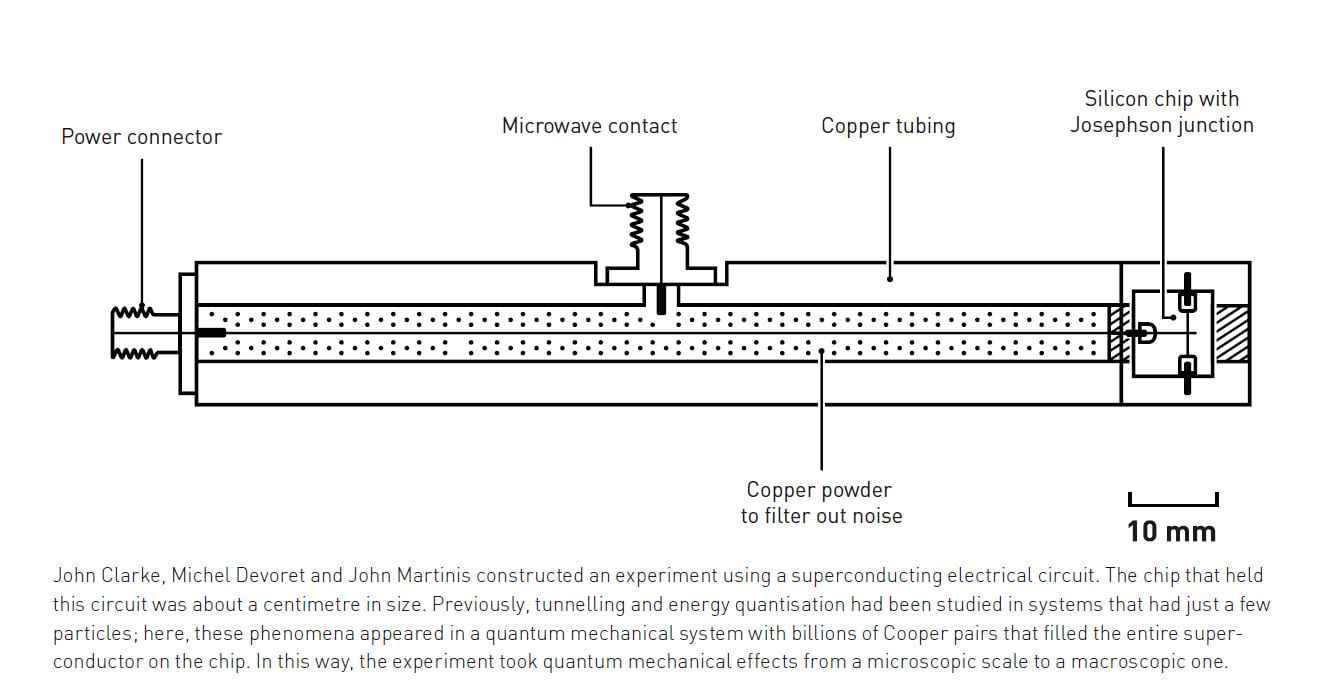
The 2025 Nobel Prize in Physics has been awarded to three physicists whose pioneering experiments helped transform quantum physics from abstract theory into tangible technology. John Clarke, Michel H. Devoret, and John M. Martinis share this year’s prize “for the discovery of macroscopic quantum mechanical tunnelling and energy quantisation in an electric circuit.”
In simpler terms – they proved that circuits we can hold in our hands can behave like atoms. That discovery, made decades ago, became the bedrock of today’s quantum computing revolution.
Also read: Elon Musk’s xAI is developing a fully AI-made game set to launch in 2026: Here’s what we know
For much of the 20th century, quantum mechanics was confined to the microscopic realm – particles, atoms, and photons. But in the early 1980s, Clarke and his collaborators asked a question that seemed almost philosophical: Can large, engineered systems exhibit quantum behaviour too?
Using a device known as a Josephson junction – two superconductors separated by an ultrathin insulator – the team demonstrated that even an electrical circuit could display quantum tunnelling and quantised energy levels, phenomena previously seen only in atomic-scale systems.
Their work showed that quantum rules don’t stop at the atomic scale; under the right conditions, they can govern the behaviour of macroscopic objects too. That insight was revolutionary.
While their original experiments were driven by pure curiosity, the implications were immense. By proving that circuits can mimic atoms, they paved the way for the superconducting qubits that power modern quantum computers from Google, IBM, and others.
A superconducting qubit, the quantum analogue of a digital bit, relies on precisely the same physics Clarke, Devoret, and Martinis uncovered. It can exist in multiple states simultaneously (a property known as superposition) and maintain coherence long enough to perform quantum calculations.
Also read: Noise Cancellation Explained: ANC or ENC?
John M. Martinis, in fact, would later go on to lead Google’s Quantum AI team, which in 2019 claimed “quantum supremacy” – the first demonstration of a quantum processor outperforming a classical supercomputer on a specific task. Michel Devoret became one of the key architects of circuit quantum electrodynamics (cQED), developing qubit designs that improved stability and error correction. John Clarke, the senior physicist at UC Berkeley, mentored both and helped shape an entire generation of experimental quantum scientists.
The Nobel Committee described the trio’s work as “a landmark in our understanding of how quantum mechanics manifests in the macroscopic world.”
But beyond its academic brilliance, the discovery has real-world impact. Every time researchers test a new quantum processor or design a new superconducting qubit, they’re building on principles first proven in those early experiments.
Their research essentially merged physics and engineering, transforming “quantum weirdness” into something programmable, a blueprint for machines that could one day outperform classical supercomputers by orders of magnitude.
It’s been nearly 40 years since the laureates first observed quantum tunnelling in circuits. At the time, few imagined it would lead to practical technology. But like many Nobel-winning breakthroughs, its true significance unfolded over decades.
Today, their legacy is embedded in the very fabric of quantum research, from national labs to startup foundries working to scale quantum chips.
The 11 million Swedish kronor prize is shared equally among the three laureates. Yet their impact is far greater: they turned an experimental curiosity into a foundation stone for one of the most promising fields in modern science.
Quantum computing is no longer science fiction. Companies worldwide are racing to make quantum processors commercially viable, aiming for breakthroughs in cryptography, AI optimisation, material science, and drug discovery.
The 2025 Nobel Prize underscores that these advances aren’t just engineering milestones – they are the direct continuation of fundamental physics. As computing enters the quantum era, the line between physics and technology grows ever thinner.