For all the progress made by large language models, most AI systems still share a fundamental weakness. They are static. Once trained, they rely on fixed behaviors and rigid tool use, which limits how well they perform outside controlled environments. New research published in December 2025 by researchers from top institutions including Stanford, Harvard, Princeton, UC Berkeley, Georgia Tech argues that static AI agents are no longer sufficient for real-world intelligence.
The study focuses on agentic AI, a class of systems designed not just to respond to prompts but to plan, decide, and act using external tools such as search engines, databases, code executors, or memory systems. These agents resemble digital workers more than chatbots. They decompose tasks into steps, select tools, interpret results, and decide what to do next. The issue is that many existing agents are locked into the same strategies they learned during training.
Also read: AI and LLMs still suck at scientific discovery, new study reveals exactly why
The researchers make a simple but powerful claim. Intelligence in real-world settings is inseparable from adaptation. Environments change constantly. APIs break, information becomes outdated, tools evolve, and user needs shift. An agent that cannot adjust its reasoning or tool usage will eventually fail, regardless of how advanced its underlying model may be.
Most deployed AI agents today operate with frozen decision-making policies. They may call tools, but they do so in predefined ways learned during training. This works well in benchmarks but poorly in live settings, where uncertainty and novelty are unavoidable.
The study highlights that real intelligence depends on feedback. Humans improve by observing what works and what does not, then adjusting behavior accordingly. Without a similar mechanism, AI agents struggle to recover from errors, repeat inefficient strategies, or misuse tools. This gap becomes especially visible in long-running tasks such as research, coding, or operational workflows.
Also read: Google Chrome and Safari are falling behind, these are top 5 AI browsers of 2025
The researchers argue that adaptation should not be treated as an optional upgrade. It is a core requirement for agentic systems that are expected to operate autonomously over time.
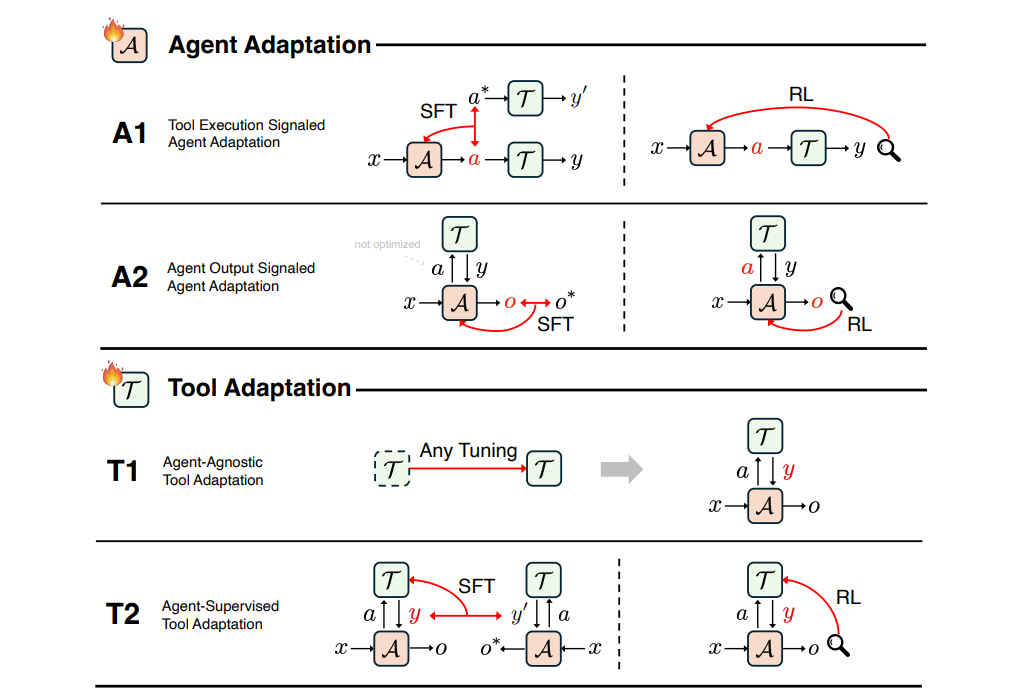
To make adaptation more concrete, the paper introduces a structured framework that breaks it down into four distinct approaches. These are based on two questions: what is being adapted, and where the feedback signal comes from.
In the first approach, the agent itself is adapted using feedback from tool execution. If a tool call succeeds or fails, that signal is used to improve future decisions. Over time, the agent learns when and how to use tools more effectively.
The second approach adapts the agent based on the quality of its final output. Instead of focusing on individual steps, the system learns from whether the end result is correct or useful.
The third approach shifts adaptation away from the agent and onto the tools. Tools such as retrievers or planners are improved independently, while the agent remains unchanged.
The fourth approach adapts tools using signals derived from the agent’s behavior. The agent stays frozen, but tools learn to better support its needs. The study emphasizes trade-offs. Adapting agents can be costly and risky, while adapting tools is cheaper but may limit long-term gains. The most effective systems will likely combine multiple strategies.
The larger message is clear. The future of AI will not be defined only by larger models, but by systems that can learn after deployment. Adaptation is what turns AI agents from impressive demos into reliable real-world intelligence.
Also read: OpenAI reveals how ChatGPT’s thoughts can be monitored, and why it matters