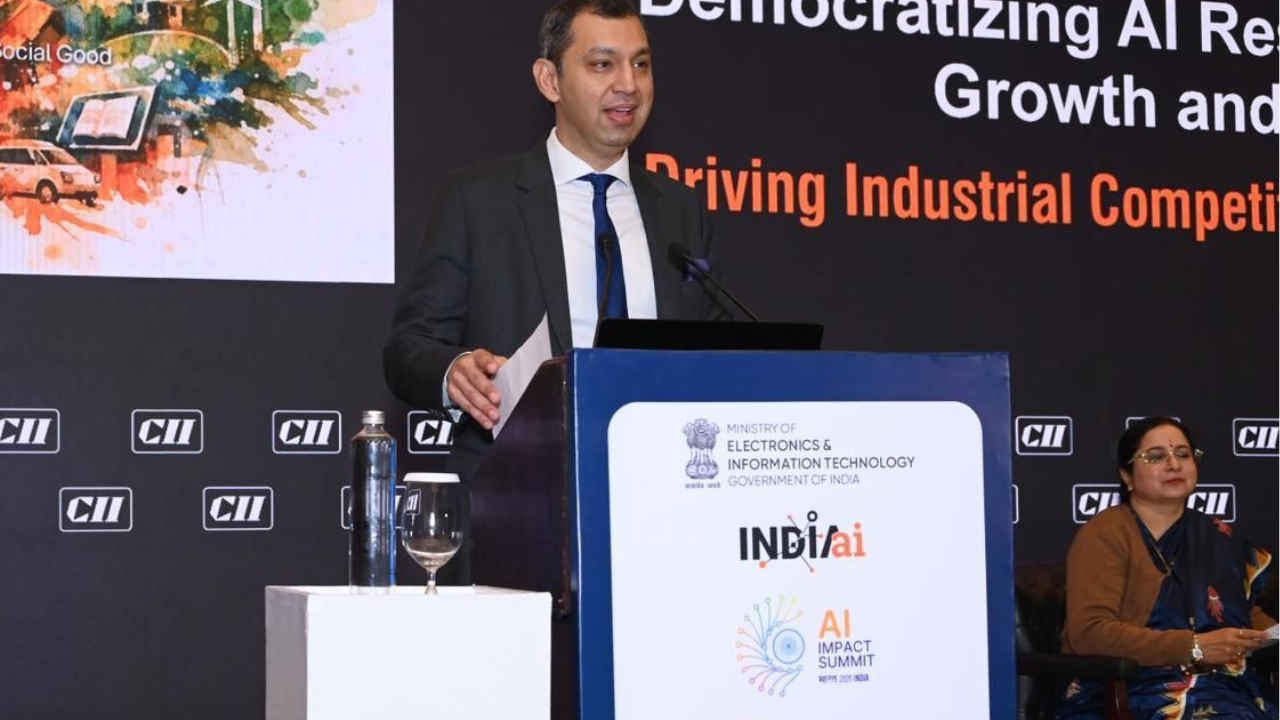
Puneet Chandok’s video message from Day One of the India AI Impact Summit 2026 doesn’t sound like a routine corporate update. More of a sophisticated rallying cry.
“Every technology wave asks us the same question,” the Microsoft India & South Asia president says in the clip. “Who does the technology truly work for and who does it benefit?”
Chandok doesn’t take too long to deliver his decisive take. “With AI, India has a once-in-a-generation opportunity to answer this question differently by designing AI for our people, for the planet and for the shared progress of every Indian citizen right from the start,”
In classic Microsoft fashion, the framing is expansive. But Chandok’s remarks aren’t operating in isolation. They’re part of a broader narrative that Satya Nadella has been building across his Microsoft AI Tour stops in Bengaluru and Mumbai through 2025. According to Nadella, India will not just adopt AI at scale, it could define how the world deploys it – a sentiment echoed by Chandok at the beginning of India AI Impact Summit 2026.
Chandok’s argument begins with India’s digital public infrastructure success. “India has shown the world the power of digital public infrastructure,” he says. “We’ve unlocked inclusion at population scale in our country but the next leap for all of us, the next leap for India is even bigger.”
That next leap, in his telling, is straightforward. “AI is the public infrastructure for India. AI that amplifies human capability for every Indian across education, healthcare, agriculture, governance.” This is the same framing Nadella leaned into during his India AI Tour. Where AI isn’t merely a technology stack, but as an economic and societal multiplier.
Also read: Yotta to Adani: India building sovereign, frontier AI with Global South relevance
Microsoft’s CEO has repeatedly positioned India as one of the most consequential markets for AI deployment, backed by the company’s largest-ever investment in Asia – $17.5 billion over four years to build infrastructure, skills and sovereign AI capabilities in the country.
Microsoft’s logic implies that if AI is going to be deployed at citizen scale anywhere, it will be in India. And if it works here, it can work across the Global South.
Chandok’s messaging mirrors that conviction almost line-for-line. “At Microsoft, our conviction is clear. We want to make India truly AI first,” he says. “We must scale AI responsibly in our country, scale millions of Indians for an AI-powered economy and build sovereign trusted platforms that India can rely on, truly rely on for its most critical needs.”
Also read: Global AI commons: India’s most ambitious tech diplomacy pitch yet
That emphasis on scale – and responsibility – is where Microsoft’s India strategy becomes visible. It’s also where Nadella’s repeated messaging on “trusted, sovereign and inclusive AI” finds its on-ground articulation. Microsoft’s push in India has focused as much on skilling and sector partnerships as on models and compute, embedding AI across healthcare, financial services, agriculture and governance.
Chandok captures that ambition in his closing lines, delivered less like corporate positioning and more like a national call-to-action.
“My message to every Indian right now is one of confidence and responsibility,” he says. “If we get this right, and we will get this right, we won’t just adopt AI at scale. We will define how the world builds AI that is inclusive, sustainable and trusted.”
That, ultimately, is the Microsoft thesis for India. The place where AI’s largest real-world impact – at population scale – will be designed, tested and proven.
Also read: MahaCrimeOS AI: Maharashtra and Microsoft partner to solve crime faster