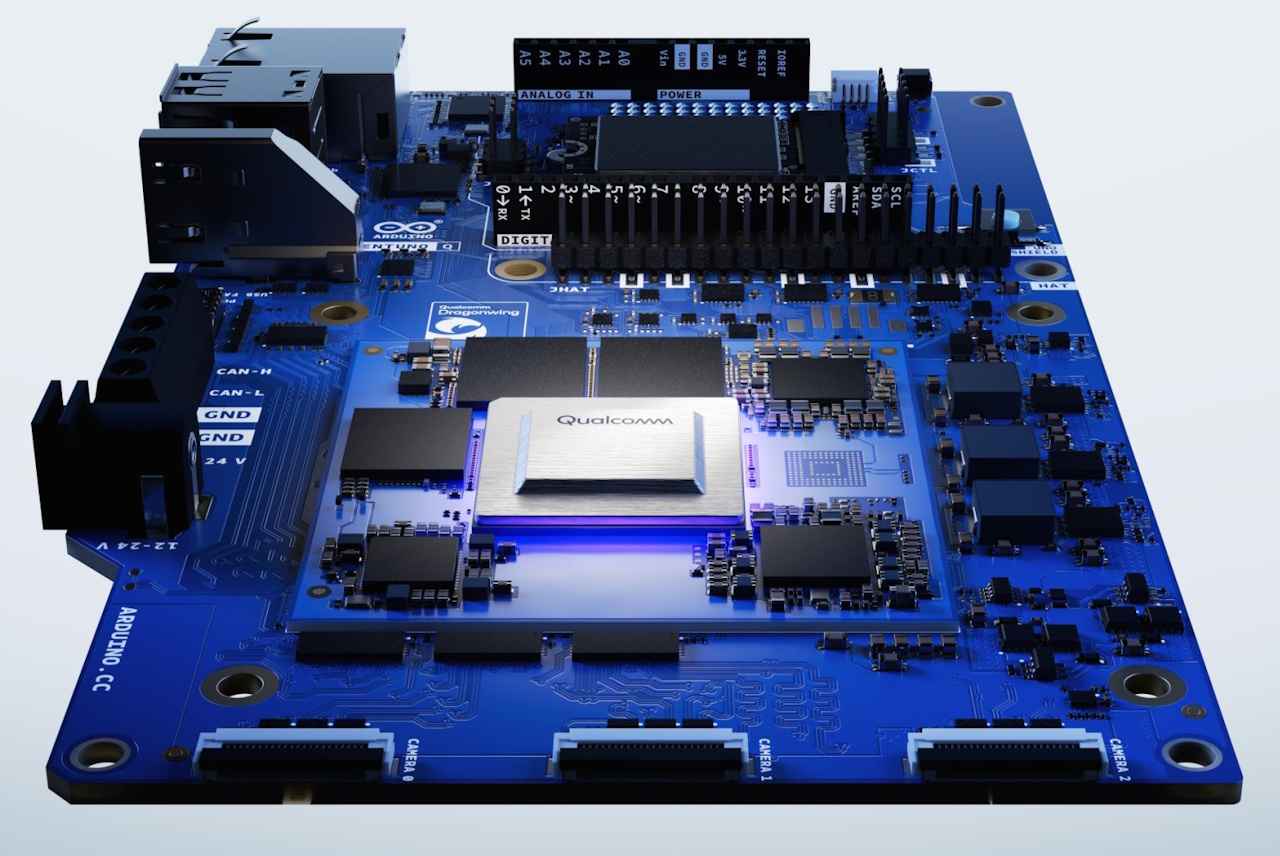
Back in school, I spent more hours than I can count hunched over an Arduino Uno – blinking LEDs, wiring up sensors, and building clunky robots that barely worked but felt like magic. The Uno was humble, simple, and perfectly matched to what a curious student needed. So when Arduino announced the Ventuno Q, powered by Qualcomm’s Dragonwing IQ8, I felt that same spark, except this time, the ambitions are anything but humble.A
Also read: Copilot Cowork: AI-Powered Task Automation for Microsoft 365 Users
The Ventuno Q is Arduino’s most powerful board to date, and it’s built for a very different era. Where the Uno taught a generation to think in circuits, the Ventuno Q is designed to think in AI models – running large language models, vision AI, and generative workloads entirely offline, no cloud connection required.
At the heart of the board is Qualcomm’s Dragonwing IQ8 SoC, which brings a neural processing unit capable of 40 dense TOPS. That’s serious edge AI performance in a maker-friendly form factor. Paired with an 8-core Kryo Gen 6 CPU, Adreno 623 GPU, 16GB of LPDDR5 RAM, and 64GB of eMMC storage, this is essentially a capable Linux computer that also happens to speak fluent Arduino.
Also read: SanDisk Extreme Fit USB-C Flash Drive: Practical, portable, and properly tiny
That dual-brain architecture is what makes the Ventuno Q genuinely interesting. Alongside the Qualcomm SoC sits a dedicated STM32H5 microcontroller, an Arm Cortex-M33, handling real-time motor control and low-latency actuation. In practice, this means you can run a vision AI model on one brain while the other precisely controls a robotic arm. That combination has been notoriously difficult to achieve on a single affordable board, until now.
Connectivity is equally well-specced. The board includes Wi-Fi 6, Bluetooth 5.3, 2.5Gb Ethernet, CAN-FD, PWM, MIPI-CSI camera ports, and an M.2 NVMe Gen 4 expansion slot. It’s ROS 2 compatible, works with standard Arduino shields, Raspberry Pi HATs, and Qwiic sensors, making it easy to drop into existing project setups.
Software support spans Ubuntu/Debian Linux on the main processor and Arduino Core on Zephyr OS on the microcontroller, with the Arduino App Lab environment handling AI model deployment and integration with Edge Impulse Studio for custom model training.
The Ventuno Q arrives in Q2 2026, priced under $300. For makers, roboticists, and anyone who once stayed up late debugging a breadboard, it’s well worth the wait.
Also read: ChatGPT, Grok, and Claude were asked to commit academic fraud, here’s how they responded