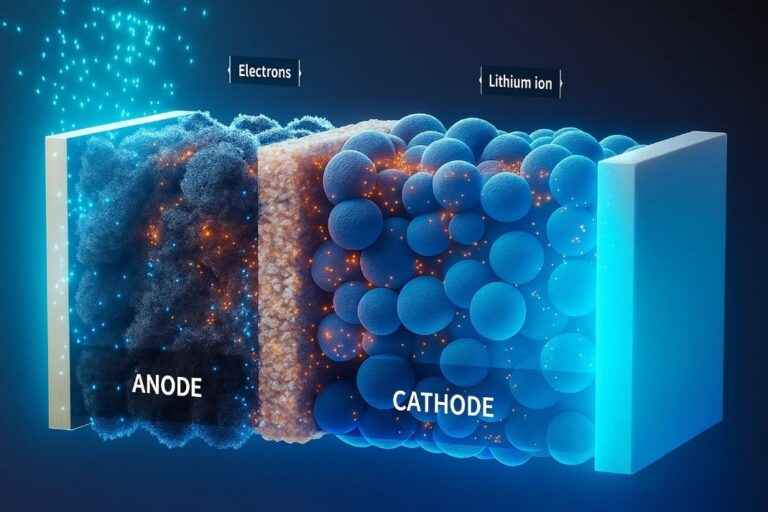
If there’s one thing everyone wants more of, it’s battery life. Phones are faster, laptops are thinner, displays are brighter, but the battery inside hasn’t evolved at the same pace. That might finally change. A new wave of lithium-ion batteries using silicon-based anodes is showing a potential energy density boost of up to 250%, and it’s not just theoretical lab magic. This breakthrough could reshape the next generation of smartphones, laptops, and even electric vehicles.
Also read: GPT-5.1 Codex Max explained: OpenAI’s most powerful coding model yet
To understand why silicon anodes are such a big deal, it helps to revisit how today’s batteries work. Nearly every device you own runs on lithium-ion cells with graphite anodes. Graphite has done the job for decades, but it’s capped by a fixed lithium storage limit. Silicon, meanwhile, can store almost ten times more lithium.
So why didn’t we switch earlier?
Because silicon expands massively, up to 300%, when it charges. This caused batteries to crack or degrade rapidly, making them unusable for commercial products. Scientists have spent more than a decade trying to stabilise silicon through coatings, nanostructures, flexible supports, and silicon–carbon hybrids.
Now, researchers and startups say they’ve cracked the code.
Modern silicon-anode designs use porous structures or nano-engineered particles that allow expansion without breaking. With durability finally under control, the full advantage of silicon becomes accessible: significantly higher energy density in the same form factor.
Let’s start with the device you check a hundred times a day, your phone. With silicon-anode batteries:
The practical impact is that your next phone wouldn’t just feel faster, it would stay alive long enough to actually enjoy those features.
Laptops stand to gain even more. Today’s best ultrabooks promise 10–15 hours on a single charge. A silicon-anode battery could push that beyond 20 hours, without increasing weight or size. Or manufacturers might reduce battery size to create lighter ultrabooks, slimmer creator machines and gaming laptops with more room for cooling and performance hardware.
Also read: Yann LeCun leaving Meta: AI expert’s next project is extremely ambitious
This is one of those rare upgrades that benefits both portability and power.
The impact won’t be limited to the usual suspects. Smartwatches could run for a week, tablets could last an entire trip, wireless earbuds might go weeks between charges and even EVs will eventually tap into these advances for longer range and faster charging.
Battery life is a bottleneck everywhere, silicon is a way to unlock all of it.
Of course, breakthroughs on paper take time to reach factories. Mass production, safety testing, cost optimisation, and supply-chain prep don’t happen overnight. Early versions may offer partial silicon blends rather than the full 250% jump.
Also read: CD to floppy disk: Super slim AI PC concepts on Snapdragon X2 Elite chip