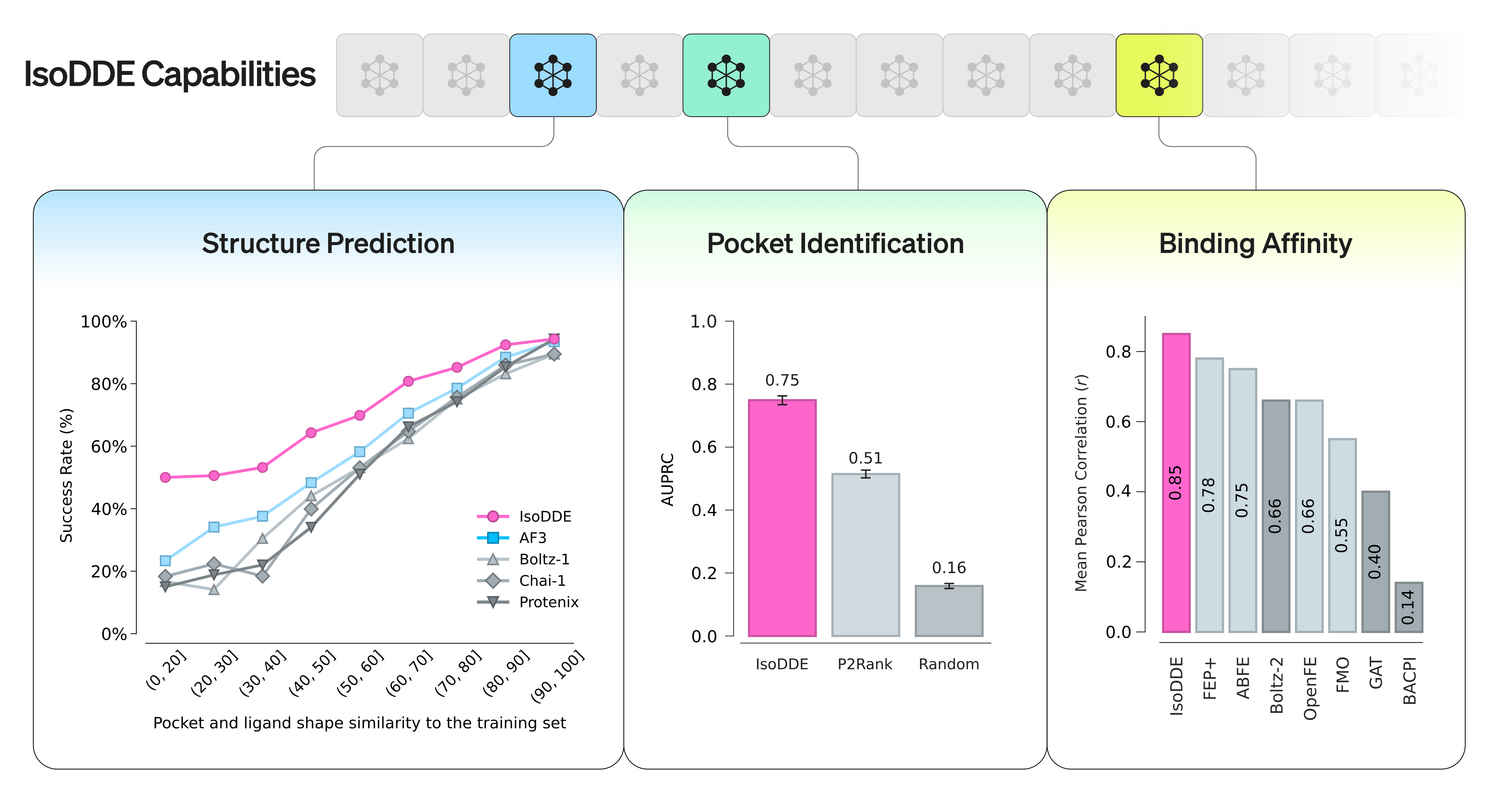
The unveiling of the Isomorphic Labs Drug Design Engine (IsoDDE) represents a fundamental shift from merely predicting the shape of biological life to actively engineering its functions. While AlphaFold 3 set the standard for modeling the structure of life’s building blocks, it often hit a wall when faced with entirely novel chemical space or the complex dynamics of how molecules actually interact under physiological conditions. IsoDDE addresses these limitations by doubling down on “generalization,” the ability for an AI to accurately handle biological systems it has never encountered in its training data. This leap is most evident in the system’s capacity to model “induced fits” and “cryptic pockets,” where proteins change shape to accommodate a drug. By mastering these nuances, IsoDDE effectively bridges the gap between a static 3D picture and a functional, effective medicine.
Also read: NVIDIA and Samsung building the world’s most intelligent chip factory
One of the most significant upgrades in IsoDDE is its ability to predict binding affinity—the strength with which a drug attaches to its target, with a precision that was previously the sole domain of slow, expensive physics simulations. While AlphaFold 3 focused on the “where” and “what” of protein geometry, IsoDDE provides the “how well,” outperforming current deep-learning methods and matching gold-standard physics-based tools like FEP+ across major public benchmarks. It achieves this at a fraction of the time and cost, and critically, it does not require a pre-existing experimental crystal structure to begin its work. This capability allows researchers to rapidly rank thousands of potential molecules in seconds, identifying the most promising candidates for optimization without the need for exhaustive lab-based trial and error.
IsoDDE also introduces a massive leap in the development of biologics, outperforming AlphaFold 3 by 2.3x in predicting antibody-antigen interfaces. It specifically masters the CDR-H3 loop, which is notoriously difficult to predict due to its high variability, thereby unlocking new possibilities for creating antibodies from scratch on a computer. Beyond antibodies, the engine features a “blind” pocket identification capability that can scan a protein sequence to find potential drug-binding sites without any prior hints. This was recently proven in the case of the protein cereblon, where IsoDDE successfully re-discovered a hidden pocket that had remained unknown to scientists for over a decade. By identifying these uncharacterized pockets using only an amino acid sequence, IsoDDE is essentially expanding the “ligandable proteome,” turning once “undruggable” targets into viable opportunities for new therapies.
| Feature | AlphaFold 3 (2024) | IsoDDE (2026) |
| Primary Goal | Predict 3D structure | Rational Drug Design |
| Novel Systems | Struggles with “unseen” data | 2x more accurate (Generalization) |
| Binding Affinity | Indirect/Structural | New Gold Standard (Matches Physics-based) |
| Antibodies | ~10% high-accuracy success | 2.3x improvement over AF3 |
| Pockets | Usually requires a ligand | “Blind” discovery from sequence alone |
| Speed | Seconds | Seconds |
Also read: India AI Impact Summit 2026: Organisers warn about fake registrations and fees