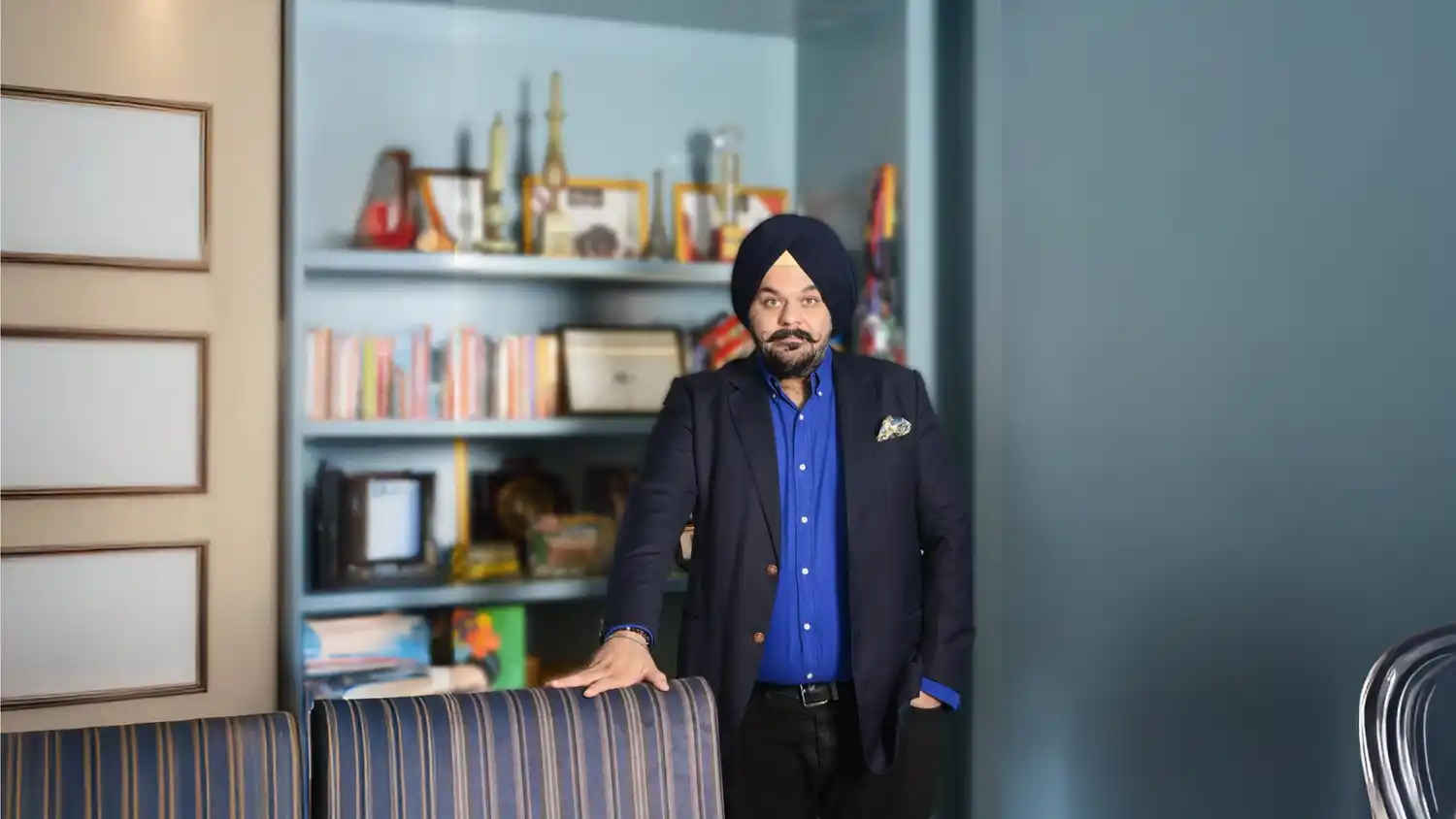
I recently sat with Sebastien Crombez, Sales Account Director at Talisman Brands Inc (Thomson France) and Avneet Singh Marwah, CEO, SPPL (an exclusive brand licensee of Thomson), to talk about the brand’s strategy to launch a new product category: Refrigerators. Both Mr Avneet and Mr Sebastian explain the brand’s rationale for diversifying in a competitive and unpredictable consumer electronics market, its focus on affordability-led segments, and how it plans to leverage local manufacturing and e-commerce to scale. The discussion also covers product positioning, target consumers, feature priorities, and how Thomson aims to build trust and differentiation in this category.
Thomson has a long legacy in consumer electronics globally, but in India, it has largely been associated with accessible smart TVs. How do you see the brand evolving into new categories in the Indian consumer’s mind today?
Sebastien Crombez: Like other major brands, as long as it makes sense for us and remains within consumer electronics, we leave the door open to do it. It’s logical for us to go into large domestic appliances because we’ve been doing it in Europe for quite a long time, especially with built-in products. We have any kind of large domestic appliance you could think of, including hobs and embedded stoves.
It was always in our mind to step into large appliances after TVs were well-established in the Indian market. I don’t think the end consumer will be surprised. If they rely on Thomson for televisions, it won’t be hard for them to have that same confidence in our large domestic appliances. They’ve already seen some of our small domestic appliances, like small washing machines and irons, selling online.
All the groundwork done with televisions in the past will benefit the large domestic appliances and the fridges we are launching here.
Where do you see the biggest gap in the Indian refrigerator market today: pricing, features, or accessibility?
Avneet Singh Marwah: The reason is that, earlier, we were adding one product every year. Then we saw a very flattish market in the consumer space. Now, we want to grow as a category. There are a lot of categories that aren’t growing as projected in the commercial markets. We have a lot of seasonal products, too. Last year, ACs and coolers didn’t have a very good season.
Since the markets are unpredictable right now with global crises happening, it was a highly strategic move to add more categories. If there is a decline in one category, establishing another can help maintain our top line.
Plus, our selling partners, like Flipkart, support us. Whatever categories we have launched so far, we have captured a decent percentage.
When you speak about consumer durables, Thomson is a large domestic appliances brand in Europe, where refrigerators, washing machines, and dishwashers play a huge role. In India, we treat Thomson as a consumer durable brand. When we launched washing machines, we were one of the few brands to stay the course, whereas 96% of brands experimenting with new categories haven’t been successful.
We’ve seen growth, largely due to our hardcore investments in manufacturing. We are not just trading or white-labeling products; we are investing heavily, which allows us to keep a strict check on product quality. Our ultimate goal is to fulfil consumer requirements and give them a good reason to buy a Thomson product by showing how it is different.
What are the key technologies or features that will define Thomson refrigerators in India?
Avneet Singh Marwah: Until now, 175 litres was the entry-level standard for the Indian market. I think the 100-litre category is where refrigerator penetration is not huge. It’s still in the early double digits in India. If you want to penetrate fast, you need an aggressive opening price point and economical models. For a bachelor or a two-person household, you don’t require 175 litres; 100 litres is enough.
We are targeting customers who want affordability and accessibility, especially in e-commerce, where consumers want something right for them without spending too much. Apart from that, we are introducing the latest designs, along with highly efficient cooling technologies.
Will all the Thomson refrigerators have a freezer?
Avneet Singh Marwah: Not in the 100-litre, but yes in the Direct Cool (DC) models.
I get a hint that the products will be price-friendly. What kind of consumer segment are you targeting first: entry-level buyers, mid-range users, or premium customers?
Avneet Singh Marwah: You would be surprised to know that 95% of the refrigerator category only caters to entry-level and Direct Cool models. The double-door category, which is considered the premium segment (above 400 litres), is only 5% of the market in India. While accessibility to this 5% is huge in metropolitan areas, the overall penetration of refrigerators in India is quite low compared to developed nations. Therefore, it’s more important to enter categories where you have a higher chance of success rather than just competing in that top 5%.
Coming back to your question about premium models: yes, we are looking into it. It’s difficult because the government banned CBUs (Completely Built Units) for refrigerators in DC, frost-free, and double doors. Product development is ongoing, but our main focus is entering that 95% category first. Thomson is a premium brand: whether it’s televisions, air coolers, or washing machines, we are not just an Opening Price Point (OPP) brand. We focus on the mid and premium segments, and how to make the mid-segment feel premium. For instance, our second-highest-selling washing machine is 10 kg, and we just launched a 14 kg model, whereas the normal selling size in India is 7.5 kg. In coolers, Thomson was the first out of thousands of brands to register commercial coolers online with Flipkart. We always offer unique propositions: non-smart TVs, single-tub washers, and 28-litre coolers.
Since you mentioned Flipkart would be your main partner, how do you plan on targeting people in Tier-2 or Tier-3 cities where the offline experience is important? Specifically for refrigerators, people often want to look, feel, and experience the cooling directly.
Avneet Singh Marwah: This is a debatable topic. If look and feel were so important, e-commerce would never have captured 30% of the refrigerator market. Today, three out of ten fridges are sold online, and for entry-level models, it’s six out of ten. The reason is that India is a very price-sensitive market. Everyone knows the cooling will be similar. Plus, there is a 10-day return policy on e-commerce, along with the power of reviews and ratings. We provide detailed “A+ content” to explain the product, which is as good as a physical look and feel. If the consumer is convinced by the features, they can test it at home. If they don’t like it, they can exchange it.
Will these products be localised for Indian conditions, like the climate diversity and power fluctuations?
Avneet Singh Marwah: Absolutely. Our partner is Dixon Technologies, and our partnership spans over two decades. Everything is Indianized. That’s why it took a little longer to launch. We don’t import or do CBUs because products designed for global conditions often fail in India. We know service is a key component, so we ensure the product can handle India’s extreme temperature variations and power fluctuations.
In ACs, the 2026 BEE ratings have been updated. Can we expect similar energy guidelines to be met for these refrigerators?
Avneet Singh Marwah: Absolutely. The new ratings for refrigerators are also out. Every year, they decrease one rating. So if a product got three stars last year, it gets two stars this year.
Regarding the ‘Make in India’ initiative and local manufacturing, where are these being produced?
Avneet Singh Marwah: Most of the parts are localised. The steel sheets come from Korea, and the back sheets from JSW. The compressors are now localised. Everything else is Indian. The power supply is from a Chinese supplier, but they have a factory right here in India. Because the government banned CBUs, it has to be ‘Make in India,’ which is why this plant was set up in the first place.
How are you building after-sales service, which is critical for large appliances?
Avneet Singh Marwah: We have our own service centres covering more than 19,000 pin codes. It is completely owned and operated by SPPL.
Besides refrigerators, are there any other categories you are planning to enter?
Avneet Singh Marwah: Currently, we are fully focusing on refrigerators. As and when we add another category, we will definitely let you know, but our focus right now is on this launch.
Keep reading Digit.in to learn more about the Thomson refrigerator launch.
Also Read: Best desert air coolers in 2026: Top picks for powerful summer cooling