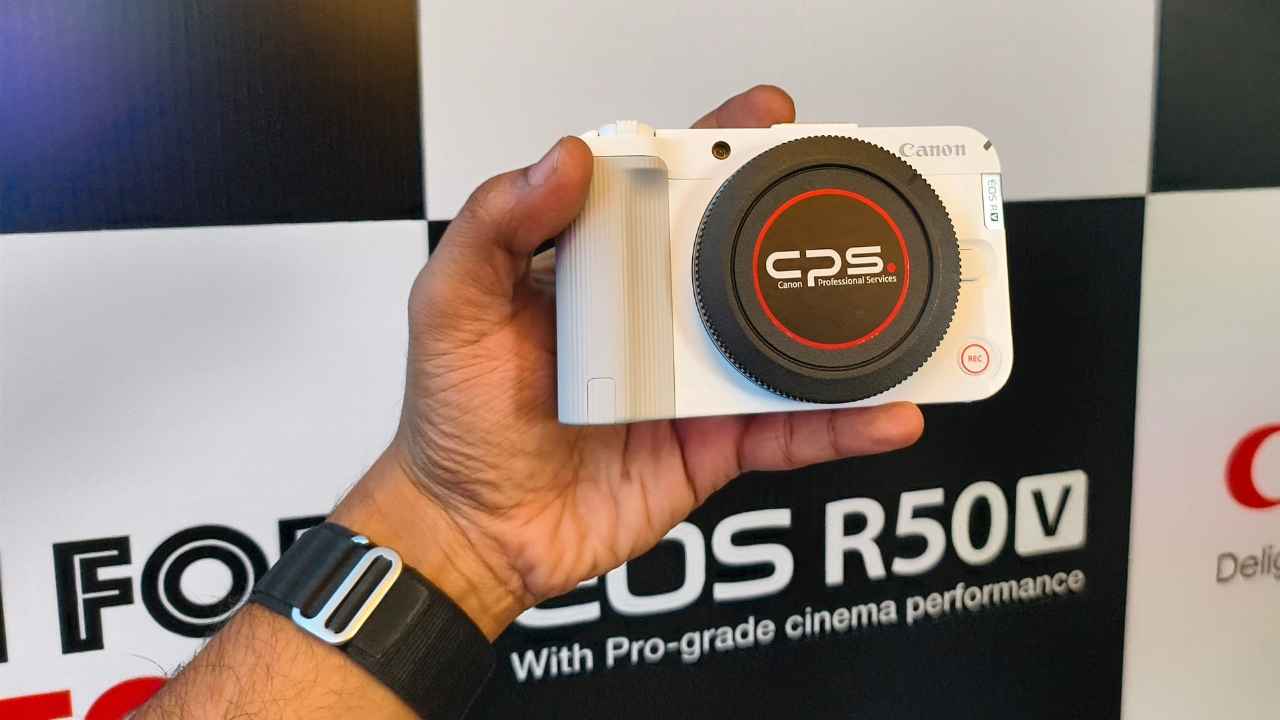
In a sunlit corner of Monkey Bar, Vishesh Magoo, Assistant Director of Canon India’s Imaging Communication Business Centre, cradles what might be the company’s most pivotal release in years. The EOS R50 V, a compact, boxy camera without a traditional viewfinder, represents Canon’s first dedicated video-first camera in its popular R series that stands in contrast to Canon’s long line of DSLRs and mirrorless juggernauts.
“This is the turning point,” Magoo explains, his enthusiasm evident. “This is the moment where maybe after a few years, we will remember, ‘Oh, that was the day when we launched it in Monkey Bar and that changed everything.'”
“The world is moving towards video. There’s no doubt about it,” said Magoo. He didn’t mince words: “We realised our consumers needed something easy. Pocketable. And also, pocket-friendly.”
That framing, casual, even disarming, is part of what makes the EOS R50 V noteworthy. Not because it’s Canon’s most advanced camera (it isn’t), or because it reinvents imaging tech (it doesn’t). But because it tries to answer a more fundamental question: What does Canon look like in a world where the line between a vlogger and a videographer no longer exists?
The R50 V is the first in Canon’s newly christened V-series, with a deliberate tilt toward video-first users — content creators, educators, and podcasters. It strips away the optical baggage: no electronic viewfinder, a simplified control layout, and a form factor that feels more designed for the desk than the field.
“We used to imagine the videographer as someone with a big black machine on their shoulder,” Magoo reflected.
“These Instagrammers or YouTubers or podcasters said, ‘I need great quality. I have a desire to achieve filmmaking sort of quality. I don’t want to spend the money. I don’t want a complex product,'” Magoo recounts. “‘I don’t want a big black bulky product. Give me something simple and it should not be heavy.'”
The camera’s design reflects these priorities with its compact form factor and ergonomic grip. That means fewer dials, more touch interface. A vertical tripod mount. A body you can drop into a tote bag. The R50 V feels more like a nod to the lifestyle camera than the professional tool. Throughout our conversation, Magoo repeatedly pulls the camera from his pocket to demonstrate its portability, a physical manifestation of the “pocketable, as well as pocket-friendly” philosophy driving the product. But curiously, it carries features typically reserved for Canon’s higher-end gear.
With professional features like Canon Log 3 that allow for flatter colour profiles and cinema format markings typically found in higher-end equipment, the camera deliberately bridges the gap between consumer and professional video gear.
“It was a deliberate choice,” Magoo confirms when asked about this. “We’re very cautious with how we use words like AI or cinema. There are creators who want more. They want to experiment with looks, with grading. This is for them.”
This approach reflects a broader shift in how Canon views its customers. “There was a photographer. There was a videographer. Now there is a creator. What you create is up to you. This camera can offer you both,” Magoo states, highlighting how traditional roles have merged in today’s digital landscape.
Magoo is quick to draw a line. “Is this for someone who just woke up one day and decides to be a creator? Maybe not,” he adds. “It’s for someone who’s serious about the art. Even if their skill is still developing.”
Canon, for its part, isn’t interested in dumbing down tools for the sake of accessibility. The idea seems to be to offer entry-level cameras that can punch above their weight, as long as the user is willing to grow with them.
Despite this video-first approach, Canon’s 90-year photography legacy remains central to the R50 V’s appeal. When asked how the company balances its photographic heritage with the transition to video, Magoo is quick to clarify a common misconception.
“We are not saying that video has come at the cost of photo. It is always on top of the photo, and even photo is getting better and better with time,” he explains.
He brings up Canon’s long-standing colour science and its vast image database, elements he claims still inform the camera’s internal processing.
“Think of it this way,” Magoo explains. “Our video colour profiles are built from decades of photography experience. That’s why the footage from our cameras looks the way it does. It’s not an accident. It’s learning.”
And there’s the rub. While competitors might chase specs or low-light wizardry, Canon seems to believe its edge lies in aesthetic consistency, skin tones that feel right, and colours that pop without shouting.
“We’ve accumulated that legacy,” he says. “We’ve carried it into video.”
Perhaps the most surprising revelation during the interview was that Canon doesn’t see itself as a traditional hardware company anymore. At least, not entirely.
“We’re transitioning,” Magoo explained. “From being a camera manufacturer to being a solution provider.”
He describes two key initiatives: Canon Northstar, a consulting programme launched about 18 months ago, to help creators build their content studios, including partnerships with Dell, Adobe, and Sennheiser, and Deep Dive, a skill development initiative designed to expose aspiring filmmakers to experts like cinematographer Santosh Sivan, walking them through every stage of filmmaking process from pre-production to editing.
“We want people to remember Canon as a brand that enhances creativity. Not just sells you a product and leaves.”
When asked about Canon’s pricing strategy in India, Magoo pushes back against the assumption that affordability is the sole driver.
“People think India is price-sensitive,” he said. “That the cheapest product will sell. That’s not our experience.”
Instead, he frames the market as value-conscious. “You can charge more if you deliver more,” he notes. “Our mid-tier and pro products sell better than the base ones. That tells you something.”
With the EOS R50 V, Canon seems to be betting that creators in India don’t just want the cheapest gear; they want a stepping stone to professional quality. And they’re willing to pay for it, provided the learning curve isn’t steep and the results are meaningful.
As we wrap up, I ask Magoo what Canon product he would recommend to a 17-year-old starting their first YouTube channel today.
“If the kid is starting a YouTube channel with a serious intent, this is the camera,” he replies without hesitation, pointing to the R50 V. For those just experimenting, he suggests other models like the R100 or V10.
When challenged to capture the essence of the EOS R50 V in a single sentence, Magoo offers a simple but telling phrase: “Pocket-friendly. Pocketable. And powerful enough to make a film.”
In a world where smartphones have commoditised casual photography and video, Canon’s R50 V represents a calculated bet that dedicated creators still crave purpose-built tools, not just for technical superiority, but for a camera that doesn’t just record stories, but becomes part of one.