Just under three years since it exploded onto the global stage, ChatGPT has become a household name. But behind the billions of queries and headlines about AI revolutionizing work, a fundamental question has remained largely unanswered: What are people actually doing with it?
Now, for the first time, a detailed report provides a comprehensive look under the hood of the world’s most famous chatbot. A new working paper published by the National Bureau of Economic Research (NBER), authored by economists and researchers from Duke, Harvard, and OpenAI, dissects the usage patterns of ChatGPT, revealing surprising trends that challenge common assumptions about how this technology is shaping our world. The findings suggest that ChatGPT is evolving less into a pure workplace productivity machine and more into a versatile, personal assistant for everyday life.
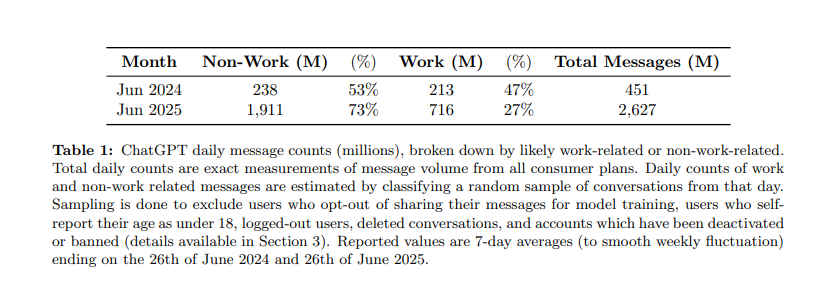
The report first establishes the staggering scale of ChatGPT’s adoption. By July 2025, the platform had amassed over 700 million weekly active users, roughly 10% of the entire world’s adult population. Together, they send more than 2.5 billion messages a day. This unprecedented speed of global diffusion makes understanding its use not just a matter of technical curiosity, but a societal necessity.
Also read: ChatGPT, Gemini, Claude, Meta AI easily made phishing emails to scam elders, in a study
The demographics of these users are also shifting dramatically. While early adopters were overwhelmingly male (around 80%), the gender gap has now effectively closed, with users having typically feminine names slightly outnumbering those with masculine names by mid-2025. The platform is most popular among the young, with users aged 18-25 accounting for nearly half of all messages. Furthermore, the report notes significantly faster growth in low- and middle-income countries, indicating a rapid democratization of the technology across the globe.
Perhaps the most startling revelation from the study is the balance between professional and personal use. Despite the intense focus on AI’s impact on the workplace, a resounding 70% of ChatGPT usage is for non-work-related queries. This trend is accelerating, up from 53% just a year prior in June 2024.
This suggests that the greatest value of generative AI may not be in automating office tasks, but in assisting with the countless decisions and activities of daily life, a contribution the report notes is on a “similar scale and possibly larger” than its impact on paid work.
So, what does this “personal” use look like? The report breaks down conversations into three dominant categories that account for nearly 80% of all interactions:
In contrast, some of the most hyped use cases are far less common. Computer programming makes up only 4.2% of messages, while companionship and personal reflection account for a mere 1.9%.
The researchers introduced a novel framework to classify user intent: are they “Asking” for help with a decision, or are they “Doing” a task?
Also read: OpenAI’s Agent Codex gets GPT-5: Key improvements explained
The study found that “Asking” has grown faster than “Doing” over the past year and, critically, correlates with higher user satisfaction. This points to ChatGPT’s primary value being a tool for decision support – a “co-pilot for the mind” – rather than simply an engine for automation.
While personal use dominates, the report provides a clear picture of how ChatGPT is being leveraged professionally. Unsurprisingly, its use at work is most prevalent among highly educated users in professional, knowledge-intensive occupations.
Workers in management, business, computer science, and engineering are far more likely to use the tool for their jobs than those in non-professional roles. For these users, “Writing” is the killer app, accounting for over 40% of work-related messages, followed by “Practical Guidance” (24%) and “Technical Help” (10%).
Across all professions, the most common work activities facilitated by ChatGPT are universal to knowledge work: documenting and recording information, making decisions and solving problems, and thinking creatively.
The entire analysis was conducted using a novel, privacy-preserving methodology. An automated pipeline classified messages without any human ever reading the content, and sensitive demographic analysis was performed in a secure “data clean room,” ensuring user privacy was protected throughout.
Ultimately, the report paints a picture of a technology that is already more integrated into the fabric of daily life than many assumed. ChatGPT is not just writing our emails or debugging our code; it’s teaching our children, helping us plan our workouts, and acting as a universal source of information and guidance. Its primary role, it seems, is not to replace human thought, but to augment it.
Also read: Hallucinations in AI: OpenAI study blames wrong model measurements