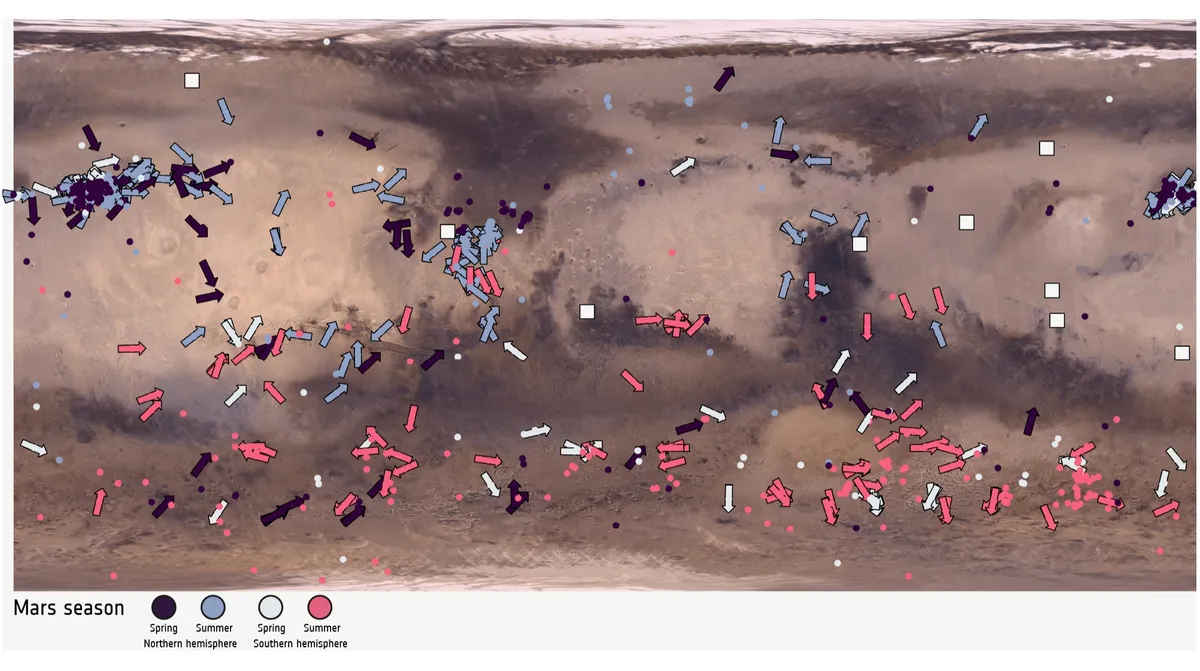
Mars is often imagined as a quiet, rusty desert, frozen in time. But look closer, and the Red Planet reveals a surprising secret: it’s alive with whirling dust devils – miniature tornadoes that dance across its plains, carrying dust, shaping terrain, and hinting at a restless atmosphere. Thanks to two decades of European orbital surveillance and the power of artificial intelligence, scientists have now mapped 1,039 of these elusive Martian twisters, painting the most detailed portrait of the planet’s hidden winds ever captured.
Also read: 30 years after 51 Pegasi b: How the exoplanet revolution redefined our place in the universe
Tracking dust devils from hundreds of kilometers above the surface isn’t easy. Enter ESA’s Mars Express and the ExoMars Trace Gas Orbiter, two orbiters armed with high-resolution cameras. Over nearly 20 years, these spacecraft collected thousands of images of the Martian surface. The challenge? Dust devils are fleeting – fast, small, and often invisible to the naked eye in single snapshots.
This is where AI became a cosmic detective. Machine learning algorithms scanned the orbital images, detecting tiny shifts and subtle distortions caused by moving dust columns. These invisible fingerprints revealed the speed, direction, and frequency of Martian dust devils, uncovering winds that sometimes roar at 98 miles per hour (158 km/h), faster than anyone expected.
The dust devil map revealed more than numbers. Most of the tornadoes appear over dust-laden plains like Amazonis Planitia, and they follow a predictable rhythm: peaking during spring and summer, typically in the late morning and early afternoon.
Also read: Potential biosignature on Mars: What the NASA Perseverance Rover’s latest discovery really means
For robotic explorers, these winds are both a challenge and a blessing. Dust can coat solar panels and slow a rover’s progress, but a well-timed Martian dust devil can also act like a natural windshield wiper, cleaning panels and giving machines a much-needed boost of energy.
Every swirl of dust tells a story about Mars’ atmosphere. These twisters lift particles, stir the thin air, and subtly shape local weather. By mapping 1,000 dust devils, scientists now have a global view of Martian atmospheric dynamics, helping predict storm patterns, temperature fluctuations, and the movement of airborne dust. This knowledge is vital for planning safe landings, operating rovers, and preparing for future human explorers.
This discovery wouldn’t have been possible without AI. Manual analysis of such a massive image archive would have taken decades. Machine learning acted like a supercharged pair of eyes, detecting patterns invisible to humans and accelerating discovery.
The dust devil map is also a testament to Europe’s dedication to Mars exploration. Mars Express, operating for over 20 years, and ExoMars Trace Gas Orbiter, monitoring atmospheric changes, together provide complementary insights. By combining these observations with AI, Europe has revealed a Mars that is dynamic, energetic, and surprisingly alive, far from the static desert we once imagined.
Understanding Martian dust devils isn’t just academic. It’s a practical necessity for future explorers. From deciding where to land, to designing solar-powered habitats, to deploying autonomous robots, knowing how and where these twisters strike could make the difference between mission success and failure.
Thanks to AI and European orbiters, what once seemed like a barren, lifeless planet is now revealed as a place of movement, energy, and secrets – a Red Planet alive with miniature storms waiting to be understood.
Also read: From balloons to satellites: Why Esrange is the world’s most flexible space center