Grok 4 xAI Elon Musk
xAI, the artificial intelligence venture founded by Elon Musk, has officially launched Grok 4, its most ambitious and capable model yet. Musk, who also helms Tesla, SpaceX, and X (formerly Twitter), aims to challenge the dominance of OpenAI, Google DeepMind, and Anthropic with a model that blends high performance, cultural awareness, and infrastructure scale.
Launched in the shadow of Google’s Gemini 2.5 Pro, and Anthropic’s Claude Opus 4, Grok 4 marks xAI’s attempt to redefine the competitive landscape. OpenAI’s GPT-5 is still “expected” but with the recent poaching spree by Meta, we don’t know if timelines will be affected. With timing that aligns with an increasingly saturated AI market, Grok 4 attempts to differentiate itself not just through benchmark results, but through its alignment with real-time internet culture and user needs.
The journey of Grok has been fast-paced and, at times, unconventional. The earlier versions, Grok 1 and 2, were embedded within the X platform and showcased basic conversational abilities, laying the groundwork for what was to come. However, these versions fell short of competing with established players. In a characteristic move, xAI decided to skip Grok 3.5 entirely, citing major architectural breakthroughs that rendered any intermediate version redundant. This approach mirrors Musk’s branding tactics elsewhere, signalling transformative jumps rather than iterative upgrades.
At the heart of Grok 4’s evolution lies the Colossus supercomputer, an in-house training setup running on 200,000 NVIDIA H100 GPUs. This infrastructure enabled a 100x increase in training compute and data compared to Grok 2. Such scale allowed xAI to move beyond toy models to what it claims is a frontier-level AI, capable of real-world generalisation and adaptation. The development focus has clearly shifted from novelty to utility, with Musk aiming to position Grok as a powerful alternative to OpenAI’s GPT family.
Grok 4 is being billed as a truly multimodal model, supporting text and image input, with video support planned later this year. It has shown particular proficiency in processing and understanding internet-native content such as memes, digital art, and informal language. xAI has deliberately trained Grok 4 to speak the language of the internet, allowing it to understand cultural trends and slang in a way that gives it a distinctly humanlike tone. This stands in contrast to its more formal, academically inclined competitors.
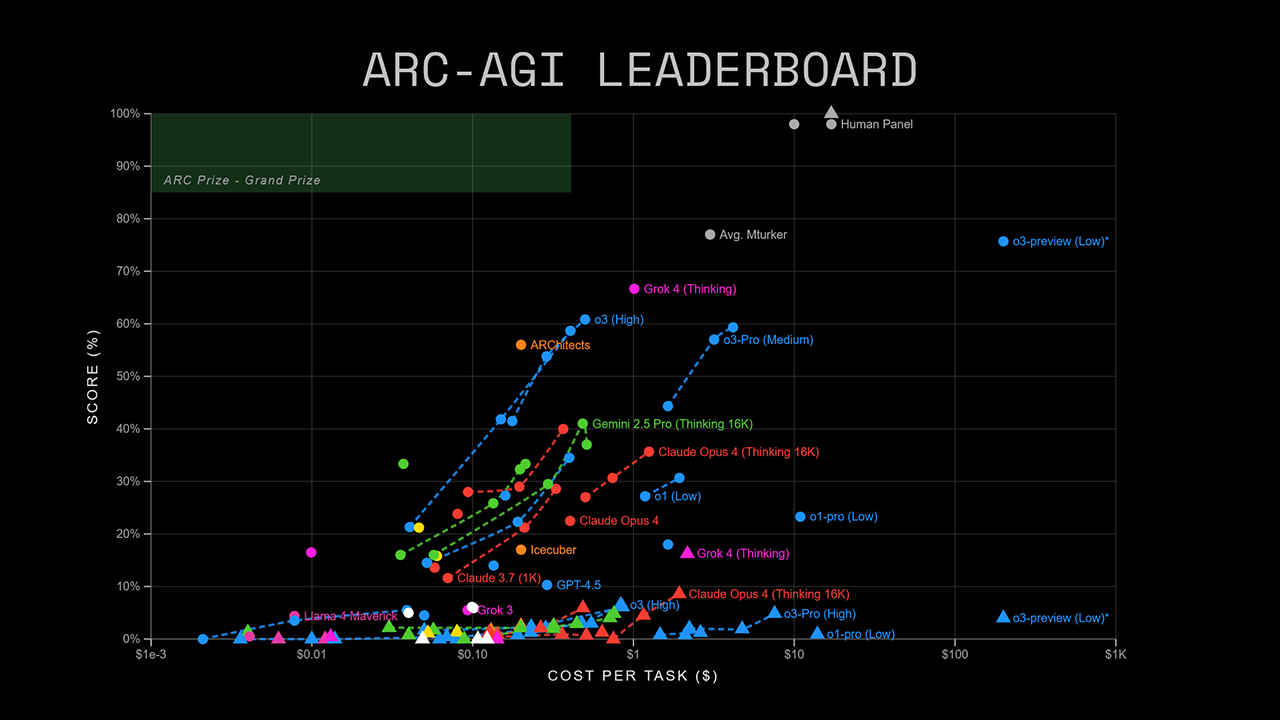
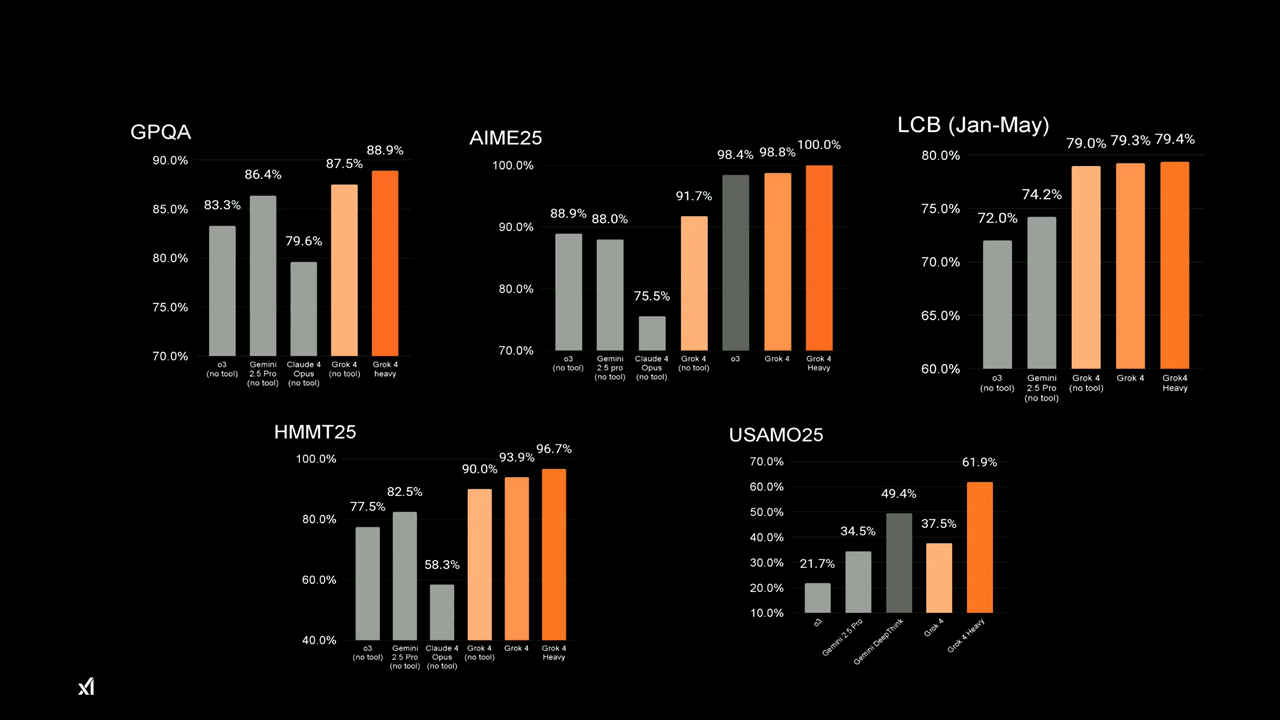
From a technical standpoint, Grok 4 appears to be holding its own against industry giants. It scored 44.4 percent on Humanity’s Last Exam (with tools) and 16.2 percent on ARC-AGI-2, both of which are considered advanced reasoning benchmarks. xAI claims Grok outperforms graduate students in several domains and has even outpaced GPT-4o and Claude Opus on specific tasks like mathematical reasoning and logic.
A major area of focus has been programming. Grok 4 introduces a specialised assistant called Grok 4 Code, aimed at developers. This tool integrates directly with code editors, enabling users to write, debug, and explain code using natural language. Unlike other coding assistants that rely heavily on prompt engineering, Grok 4 adopts a more “agentic” approach, breaking down problems into smaller components and solving them iteratively. This puts it in competition with GitHub Copilot and GPT-4 Code Interpreter, but with a noticeably different architectural philosophy.
Voice functionality has also received a significant upgrade. With new synthetic voices such as “Sal” and “Eve,” xAI is attempting to bridge the uncanny valley of human-AI dialogue. Voice latency has been reduced to create smoother, more lifelike conversations. While still in early stages, these features have been made available to users subscribed to the SuperGrok tiers.
One standout innovation is DeepSearch, which allows Grok to access live data from X and other platforms to provide up-to-date responses. Rather than being locked to a static knowledge base, Grok 4 can incorporate trending content and shifting cultural dynamics into its outputs. This adds an important layer of relevance to its responses, especially for users who rely on AI for real-time context.
xAI is offering three subscription plans to access Grok. The Basic tier remains free and is based on the older Grok 3 model. For $30 per month, SuperGrok gives users full access to Grok 4 and its single-agent capabilities. The premium SuperGrok Heavy plan, priced at $300 per month, unlocks multi-agent workflows, early access to experimental features, and enterprise-grade tools.
API usage is priced competitively at $3 per million input tokens and $15 per million output tokens. This is designed to undercut rivals like OpenAI and Anthropic, whose costs are higher at scale. The strategy seems geared toward winning over startups and enterprise developers who are cost-sensitive but want access to frontier models.
In terms of adoption, xAI is expanding Grok’s reach through direct API access and plans to integrate with major hyperscalers in the near future. Enterprise customers on the Heavy plan are already getting access to early versions of upcoming features. Musk has outlined a roadmap that includes a coding-specialised model in August, a multimodal agent in September, and video generation capabilities in October. Beyond that, Grok is expected to be integrated into Tesla Optimus robots and potentially other real-world applications.
Despite its technical promise, Grok 4’s launch hasn’t been without friction. A number of public incidents involving controversial outputs have raised concerns around content moderation and model alignment. The model’s sometimes irreverent or politically charged tone has drawn criticism, prompting xAI to revise system prompts and strengthen its moderation stack.
Leadership turbulence has added to the narrative. Linda Yaccarino recently stepped down as CEO of X, and Igor Babuschkin, xAI’s former chief scientist, has also exited the company. While no direct link has been made to Grok’s launch, the timing suggests a broader recalibration of Musk’s AI and media ambitions.
Nonetheless, Grok 4 has made a strong impression in a very crowded space. By combining serious computational firepower with cultural fluency and competitive pricing, xAI has positioned itself as more than just another player. It has made clear that it intends to set the tone, not just follow it. As the model continues to evolve, its success will depend on whether it can sustain performance, scale responsibly, and win over developers, enterprises, and regulators alike.
In the current landscape of generative AI, where every new release feels like a sprint toward general intelligence, Grok 4 is Musk’s declaration that xAI is here to run the marathon. Whether it can stay the course will be one of the defining stories of the next few years.